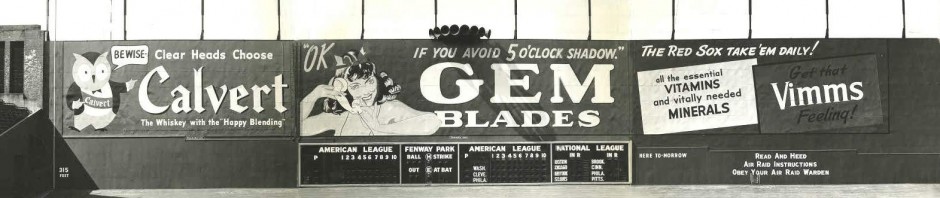
In May 2014, ten years ago, YIKES! I posted a story about the greats facing the greats. It is the most visited post in the 12 years I’ve been here. A recent comment by Hal awakened my brain to the realization that it was time for an update. Inspired by Hal and another reader named Joey, I revisit this topic. Hal, called to my attention that Babe Ruth hit 10 homers against Walter Johnson and Joey pointed out that Babe faced Johnson in his waning years. Taking both those bits of information sent me back to the drawing board for an update.
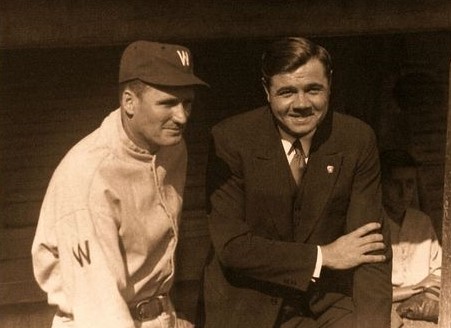
Walter and George 1925 World Series
Hal’s comment reminded me that the two fantabulous baseball web sites, baseball reference and retrosheet are in fact fluid. They are constantly being updated as new information is found. Since 2014, Babe added some production against the Big Train, including three homers. I’ve updated that in the old post but decided it was time to dive in again, with a more comprehensive look at Sir Walter and the Babe.
FIRST THINGS FIRST…
THE BABE
George Herman Ruth is the most dominant, most productive, most valuable player to ever play the game. His litany of dominance spans the wide breath of offensive categories. Here goes: eight times he led the league in runs scored, 12 times in home runs, five times in RBI, 11 times in walks, 10 times in OBP, 13 times in slugging percentage, and, despite having a career batting average of .342 (9th in history), he garnered only one batting title. Looking at some modern metrics reveals that in the metric category that perhaps best indicates overall production (OPS+), he led the league 12 times and 11 times he was tops in WAR. His career OPS+ of 206 is tops in the game and he is the only player with a career OPS+ above 200. Nine times he achieved a double-digit figure in WAR. His 14.1 WAR in 1923 remains the highest ever in a season. He also holds the second and third highest, the fifth highest and the 10th highest WAR totals in one season. Fifty-nine times a double-digit WAR has been reached in a season; Babe owns nine of them. His .690 slugging percentage is first all time and his .474 OBP is second all time. His is first all-time in OPS, and third all-time in both home runs and RBI. And this doesn’t even reflect the fact that when he left Boston for the “Big Apple,” he was the best left-handed pitcher in the game!
There are two ways to produce a run in baseball, scoring one (RS) or driving one in (RBI). Babe produced a run 41.2% of the time he stepped in the batter’s box.

Babe was the first player to hit 200, 300, 400, 500, 600 and 700 career home runs. The 700th coming in Detroit on July 13, 1934, off of right-handed pitcher Tommy Bridges. UP correspondent Theon Wright wrote, “…One lusty swing of those aging shoulders, sharp smack of wood against leather, and the mightiest warrior of the game had carved history again, with the length of a hickory. It drove the ball far and high…over the right field wall at Navin Field. It bounded along the street outside and a block away, a small boy picked it up…One of the longest balls the Bam had ever hit, traveling over 500 feet through the air.”

Babe finished his career with 714 home runs, the last three coming at Forbes Field in Pittsburg on May 25, 1935. Now sporting the uniform of the Boston Braves, he went 4-4 with three dingers and a single, in a losing effort: the last hits of his career. He held the career record for home runs for 39 years. Pittsburgh sportswriter Volney Walsh, referring to Babe as if writing of the exploits of a Greek god, described his third home run of the day. “The Great Man strode to the plate in the seventh inning…The Great Man heard three balls called on him and swung at one strike that he missed. Then came a half speed curve ball. The Great Man unloosened his bat, took a tremendous swing and the ball traveled high and far toward the right field stands. Pirate players stood in their tracks to watch the flight of the ball. It was a home run all the way and when the ball disappeared behind the stands, there was a mighty roar from the crowd of 10,000…It was the longest drive ever seen in the Oakland Flats-a prodigious wallop that carried clear over the right field stands and lit somewhere down in the hollow. No one before the Great Man ever had been able to hit a ball over that stand since it had been erected in 1925.” It was the “Great Man’s” last hit, a home run.
THE BIG TRAIN OR AS BABE CALLED HIM ‘THE BIG SWEDE”
There is no doubt that Walter Johnson was Babe Ruth’s contemporary counterpart on the mound. He is in the argument as the most dominant, most valuable, most productive pitcher of all time. Six times he led the league in wins and complete games (including four years in a row in both categories 1913-16). He led in ERA and innings pitched five times and he dominated the dominant categories of strikeouts and shut outs; leading in strikeouts 12 times (twice 300+) and shutouts seven times. Throughout his career he shut out the opposition 16.5% of the time. Modern metrics similarly reveal his dominance. Six times he led the league in ERA+ and WHIP and seven times each he led in K’s per nine and WAR. His WHIP of 0.7083 in 1913 was an MLB record until broken by Pedro Martinez in 2000! His WAR of 15.1 he accumulated in that same season, still stands as the modern (post 1900) season record. The closest to come to that was Doc Gooden’s 12.2 in 1985. Since 1900 a pitcher has achieved a double-digit WAR 55 times. Walter Johnson has eight of them. The first pitcher to 3000 career strikeouts, Walter fanned 14.9% of the batters he faced.

The first two pitchers to accumulate 2000 strikeouts in their careers were Tim Keefe (1889) and Cy Young (1905). Rube Waddell joined that crew in 1908 and he was followed by Christy Mathewson in 1911 and Eddie Plank in 1915. When Walter Johnson took the mound at the Polo Grounds to open the 1916 campaign against the Yankees, he had 1,988 strikeouts. He outdueled Yankee lefty Ray Collins for 13 innings taking a 3-2 victory and striking out 11. Five days later he was at Fenway Park, facing the Red Sox and their southpaw Babe Ruth. It was the second meeting between the veteran star and the young upstart.
The Washington Post’s Stanley T. Milliken reported that after warming up before the game Johnson went to his manager Clark Griffith, “Griff” he said, “I haven’t got a thing today. I can’t get my curve working and my fast one is not much. If you want me to pitch, I’ll do so but I am liable to get an awful beating,” Griff thought for a moment and said to his ace, “You start the game Walter…As soon as they start hitting you, I’ll take you out, you may get right while working.” As it turned out, both men were correct. Walter got hit pretty hard in the first inning surrendering back-to-back doubles to Everett Scott and Dick Hoblitzell giving the Red Sox a 1-0 lead. He did however, “get it right while working” for despite some hard-hit balls including a leadoff double by Ruth in the third, it was still 1-0 when Boston came to bat in the fourth. Hoblitzell got Johnson again leading off the fourth with a single, and after a sac bunt, a flyout and another single Jack Barry stepped in with runners on the corners and two out. Barry “fanned” and Johnson was out of another jam. It was Walter’s only strikeout of the game, the 2000th of his career and it went without mention.
Red Sox shortstop Everett Scott, who went 2-4 in the game in which Walter notched his 2000th strikeout would play a far more significant role when he faced Johnson five years later. It was September 10, 1921, and this time the Red Sox were in Griffith Stadium. Leading off the third inning, Johnson whiffed Scott for his 2,804th career strikeout, surpassing Cy Young as the all-time strikeout leader. The Washington Evening’s Star Denman Thompson, acknowledging Johnson’s accomplishment noted he had more strikeouts “in fifteen seasons than Cy Young, the former record holder, was able to compile in 22 campaigns.” In fact, Johnson was significantly more proficient at whiffing batters than Cy Young; striking out 14.9% of the batters he faced as opposed to Young’s 9.4%. A 37% higher rate. Johnson held that record for 62 years! Oh, and he also is the all-time leader in shutouts with 113; the closest active player to him is Clayton Kershaw with 15. I suspect he’ll hold onto that record for a bit.
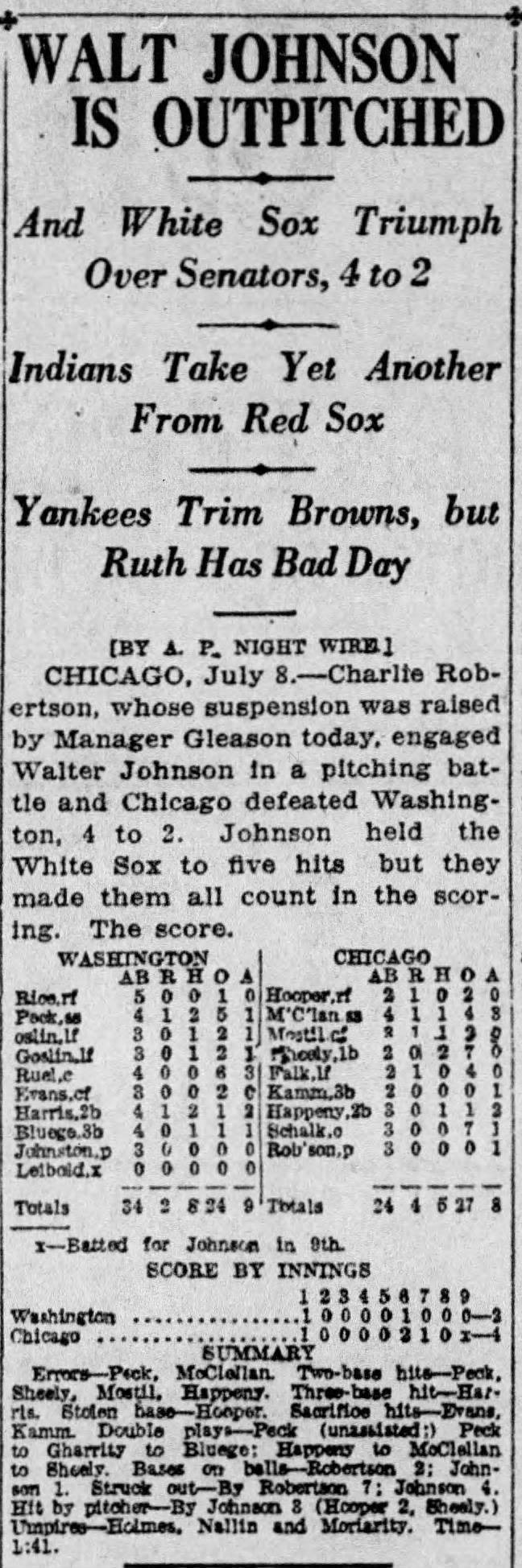
Johnson’s 3000th career strikeout came on Sunday July 8, 1923, in Chicago’s Comiskey Park. The victim was White Sox rookie third baseman Willie Kamm, who went down leading off the fifth inning. The baseball world was totally unaware of Johnson’s remarkable achievement for nowhere in the game account is there even a mention of his milestone. He would accumulate 509 more strikeouts before leaving the game. The last coming in his last outing on September 22nd, 1927, in Griffith Stadium. Leading off the third inning, Browns third sacker Frank O’Rourke succumbed to Big Train’s offerings. O’Rourke would turn out to be the last batter Johnson would ever face when his RBI single to left sent Walter to the showers an inning later.
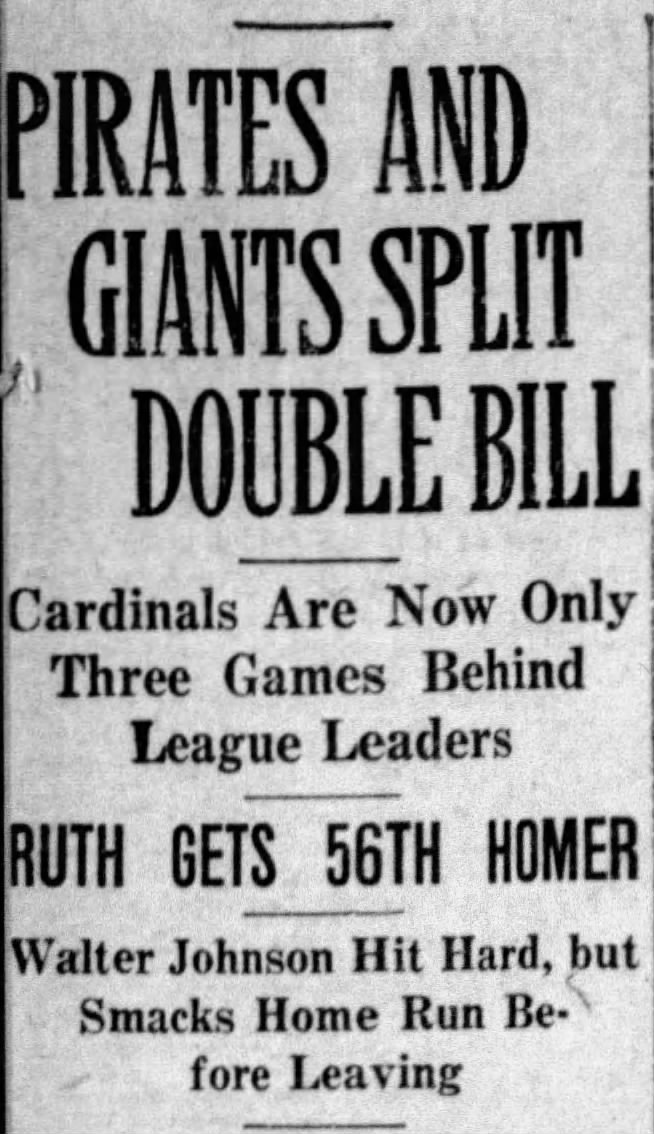
In a delicious, serendipitous twist Walter Johnson hit a home run in the game and shared, with the Babe, an AP headline that went across the country. The Babe had clocked home run number 56, on his march to 60. Walter had hit the 24th and final home run of his career.
BIG TRAIN AND THE BAMBINO HEAD-TO-HEAD
So here goes. First to address Joey’s point and assess where Babe and Walter were at in their respective careers when they faced each other. Johnson played from 1907-1927, Babe from 1914-1935.
BABE WITH THE RED SOX
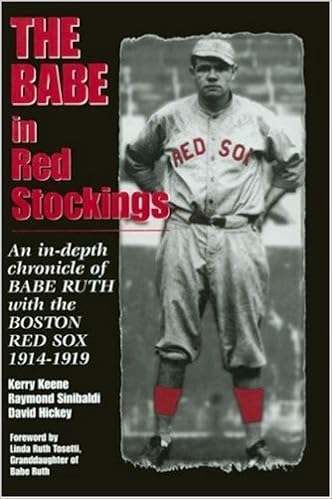
From 1914 through the 1919 season, Babe appeared in 392 games with the Red Sox garnering 1,333 plate appearances along the way. He pitched in 158 of them, played first base 19 times, was in centerfield 13 times and played in left 157 times. Fifty-five times he was called upon to pinch hit. He hit .308 for the Red Sox with 49 homers and 224 RBI. He had an OBP of .413 Slugging percentage of .569, an OPS of .981 and an OPS+ of 190. He punched out 184 times and 190 times he walked. Of his 342 hits, nearly half were for extra bases, adding 82 doubles and 30 triples to his 49 homers giving him a Power Production Average of .471. (47.1% of his hits went for extra bases).
WALTER VS RED SOX BABE
Let’s take an overall look at Walter Johnson and how he fared when he faced the Babe in Red Stockings. Babe was primarily a pitcher with the Red Sox especially in 1915, 16 and 17. In 1918 he began his transition to a position player and in 1919 that was all but completed. Babe had 50 plate appearances against Johnson from 1914 through his 1919 season. He hit .302 against him with two homers and six RBI. His OBP was .388, slugging percentage, .674 and his OPS was 1.016. Johnson struck him out twice as many times (10) as he walked him (5). It seemed to be a feast or famine for Babe against Sir Walter. In his 13 hits he gathered against him, nine of them were for extra bases. That means 19% of his plate appearances resulted in an extra base hit. Conversely, of the 31 times Johnson retired Babe, 10 of them were strikeouts, 20% of his plate appearances.
JOHNSON AT HIS PEAK 1907-1919
His average year was 23-15, ERA 1.66 with 315 innings pitched and seven shutouts per season. He won 297 games and lost 191 with a 1.65 ERA. His WHIP (Walks + Hits per Inning Pitched) was 0.969, he allowed 6.9 hits per nine innings pitched and opponents hit .213 against him. He threw 86 shutouts, struck out 5.8 per nine innings and had an ERA+ of 172.

Note the box score, Johnson, a good hitting pitcher, batting sixth,
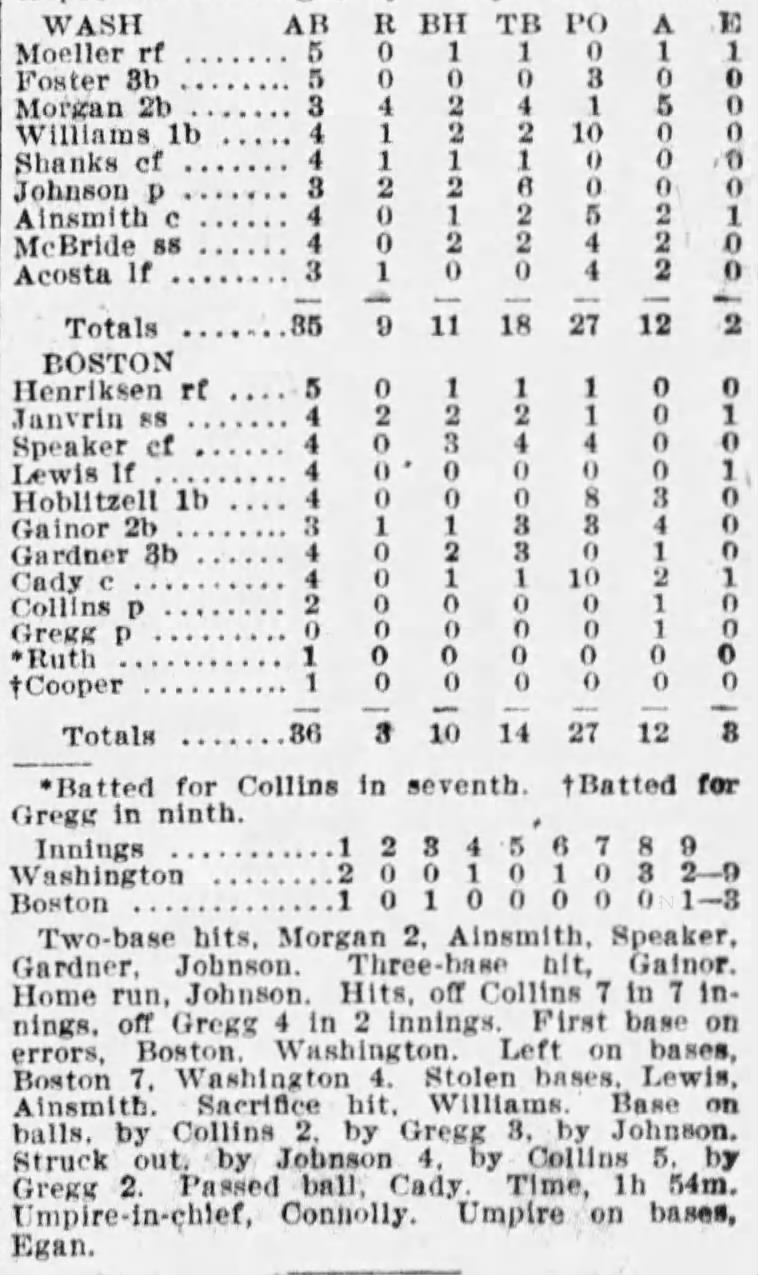
Babe appeared in just five games in 1914 and he faced Johnson for the first time as a seventh inning pinch-hitter on October 5th. It was his ninth major league at bat, and he struck out. In a bit of irony, Johnson homered in the game, a fourth inning shot into Fenway’s centerfield bleachers.
It was August 14, 1915, when Babe Ruth and Walter Johnson were opposing pitchers for the very first. time. The Red Sox came into the game in first place 3 1/2 games up on the Tigers, while Johnson and his Senators were in fourth place 14 games off the pace.
The Boston Sunday Globe called it a “Game of Games” and placed it in the middle of the front page.

Down 3-1 going into the bottom of the fifth, a two out single by Babe scored third baseman, Larry Gardner cutting the lead to one.
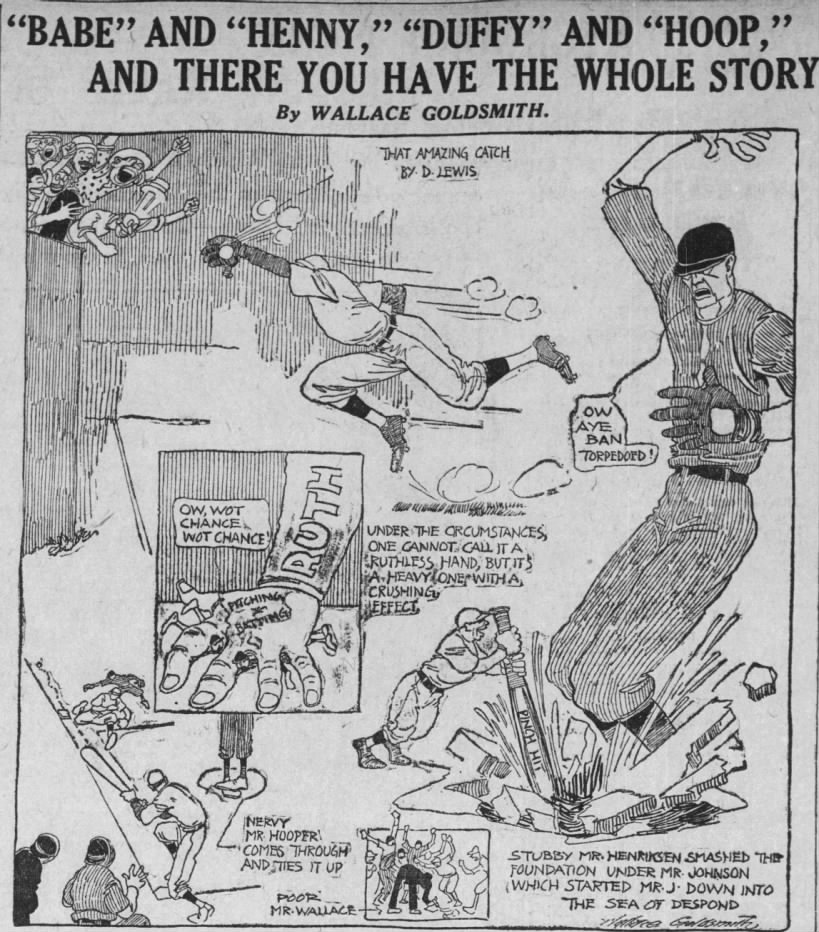
Then the bottom of the eighth unfolded. Wrote the Boston Globe; “They leaned very decisively against the offerings of a Mr. Walter Johnson of Coffeyville Kansas, sometimes described as the Blonde Speed King…who…appeared pretty certain of going to the showers with a Red Sox scalp dangling from his belt.” However, pinch-hitter Olaf Hendricksen led off with a single to left, Babe singled to right, sending Hendrickson to third. Harry Hooper followed with another single to left, tying the score and moving Ruth to second. After a sacrifice bunt by Everett Scott, Johnson intentionally walked Tris Speaker loading the bases and bringing up first baseman Dick Hoblitzell. Doc promptly flied out to centerfield, deep enough to score Ruth and give the Sox a 4-3 lead. Babe retired the Senators one, two, three in ninth on consecutive flyballs to centerfielder Tris Speaker. “Many of the 15,612 fans declared that it was one of the best games they had ever seen, and the name of “‘Babe”‘ Ruth, the great young Red Sox southpaw. was heard on the lip of every fan,”
Babe and the Red Sox finished the season in Washington on October 2nd. Babe faced Johnson one more time, pitching the last two innings in relief of Smokey Joe Wood in a 3-1 loss. It was a no-decision for Babe who was retired by the Blonde Speed King in his only at bat against him.
Johnson finished the season 27-13 while Babe’s 18-8 mark would have clearly put him in the running for the Rookie of the Year Award had it existed. Babe ended the ’15’ campaign with five at bats against Walter Johnson; he was 2-5, for a .400 average, with a run scored and an RBI.

Babe and the Red Sox were bound for the World Series which they would win in five games: doing so without their “great young southpaw, Babe Ruth.” They didn’t even need him as they only used three pitchers. He did pinch-hit once, against Grover Cleveland Alexander in game one, grounding out to first base.
HEAD-TO-HEAD SUMMARY 1914-1919
Babe faced Johnson 50 times while wearing a Red Sox uniform. He went 13 for 44 with six walks and 11 strikeouts. He hit .295 with two home runs, an OBP of .360, a slugging percentage of .520 for an OPS of .880. Both figures were significantly lower than Babe’s career marks of .342, .474, .690 for an OPS of 1.164. However, with the Red Sox Babe hit .308 his OBP was .413, slugging was .569 for an OPS of .982. His home run percentage was 3.6% with Boston, considerably lower than his career mark of 6.7%. From 1914 through 1919 Walter Johnson allowed a total of nine home runs, and his HR percentage rate was 0.00090404 %. Babe Ruth hit two of them and his HR percentage rate against Johnson was 0.04%. What that translates to is Babe’s home run percentage was four times greater than the rest of the league against Johnson, an astounding 97% higher than the rest of the of the league. Walter struck out Babe 22% of the time he faced him in Boston, a 63% higher rate than Babe struck out against the rest of the league.
Clearly Johnson kept Babe’s production level lower than what he was doing to the rest of American League pitching during his nascent years in Boston. However, let’s take a closer look at Mr. Johnson. from 1914 through 1919 and assess how he did against Babe compared to how the rest of the league fared against him. The American League hit .215 against Sir Walter, with an OBP of .262, a Slugging percentage of .267 for an OPS of .529. His strike out percentage was 14.6% and he shut out his opponents in an astounding 20% of his starts!
Babe versus Johnson…Batting Average, .295, vs AL .308. OBP vs Johnson .360, vs AL .413, SLG vs Johnson, .520, vs AL .569, OPS vs Johnson.880, vs AL .982.
Johnson versus Babe…Batting Average, AL .215 vs Babe .295, OBP, AL .262, vs Babe .360, SLG AL .267 vs Babe, .520, OPS vs AL .529, vs Babe .880.
Babe’s batting average facing Johnson was 27% higher than what Johnson allowed to the rest of the league. However, it was 4% lower than Babe’s own performance against the rest of the league. His OBP was also 27% higher than Walter allowed the rest of the league yet it was 12% lower his own performance against the rest of the AL pitchers. The Babe’s slugging percentage was 49% higher than the Big Train allowed toiling against all other American Leaguers from 1914 through 1919. Conversely, it was 9% lower than what Babe achieved against the rest of the AL field. Similar results emerge from the OPS category with Babe hitting 40% higher than Walter’s mark against all other AL batsmen. Yet he held Babe 10% lower than he achieved against the remainder of AL moundsmen! The home run and strikeout differential mentioned above are most interesting. Johnson’s forte, the heater and Babe the emerging home run machine. Babe’s two homers against him both came in 1918 and as you can see Johnson’s miniscule numbers in surrendering round trippers reveals that two was a lot in that six-year stretch. Yet Walter Johnson struck him out at a rate that was 63% higher than he fanned the rest of the league. Walter kept Babe somewhat in check in the totality of his time in Boston. Then came 1918 and Babe Ruth emerged from the cocoon of the pitcher’s mound.
ISOLATING 1918 AND 1919
Let’s take it one more step and isolate the years of 1918 and 19. It was the 1918 season where Babe began the transition from pitcher to position player. Prior to 1918 he pitched and pinched hit exclusively. And he was pretty damn good on the mound too, but that’s another story for another post. During the spring at Hot Springs Arkansas Babe began working out at first base and was impressive from the start. “Say Eddie” he said to manager Ed Barrow, “Were you watching me out there…If you did not know differently, you would think I was a regular on the corner.” Boston Globe sportswriter Edward Martin noted “Those who have seen Ruth play first think he would be able to do the position justice. He has shown great skill there, He gets his throws away quick and plays the bag scientifically.” St. Louis Browns manager and baseball lifer Fielder Jones called Ruth, “The best bat in baseball, Tyrus R. Cobb included. I’ve never in all time,” he told the Fall River Daily News, “seen a man use the bat as does the slugging Boston Hurler.” Newly acquired Red Sox catcher Les Nunamaker said “He has no weakness…and can hit anything coming in the direction of the plate. If ever a hurler is foolish enough to give him a high one on the inside, it is all off. He will knock it out of the grounds. He just handles that old bat like it was a toothpick.”
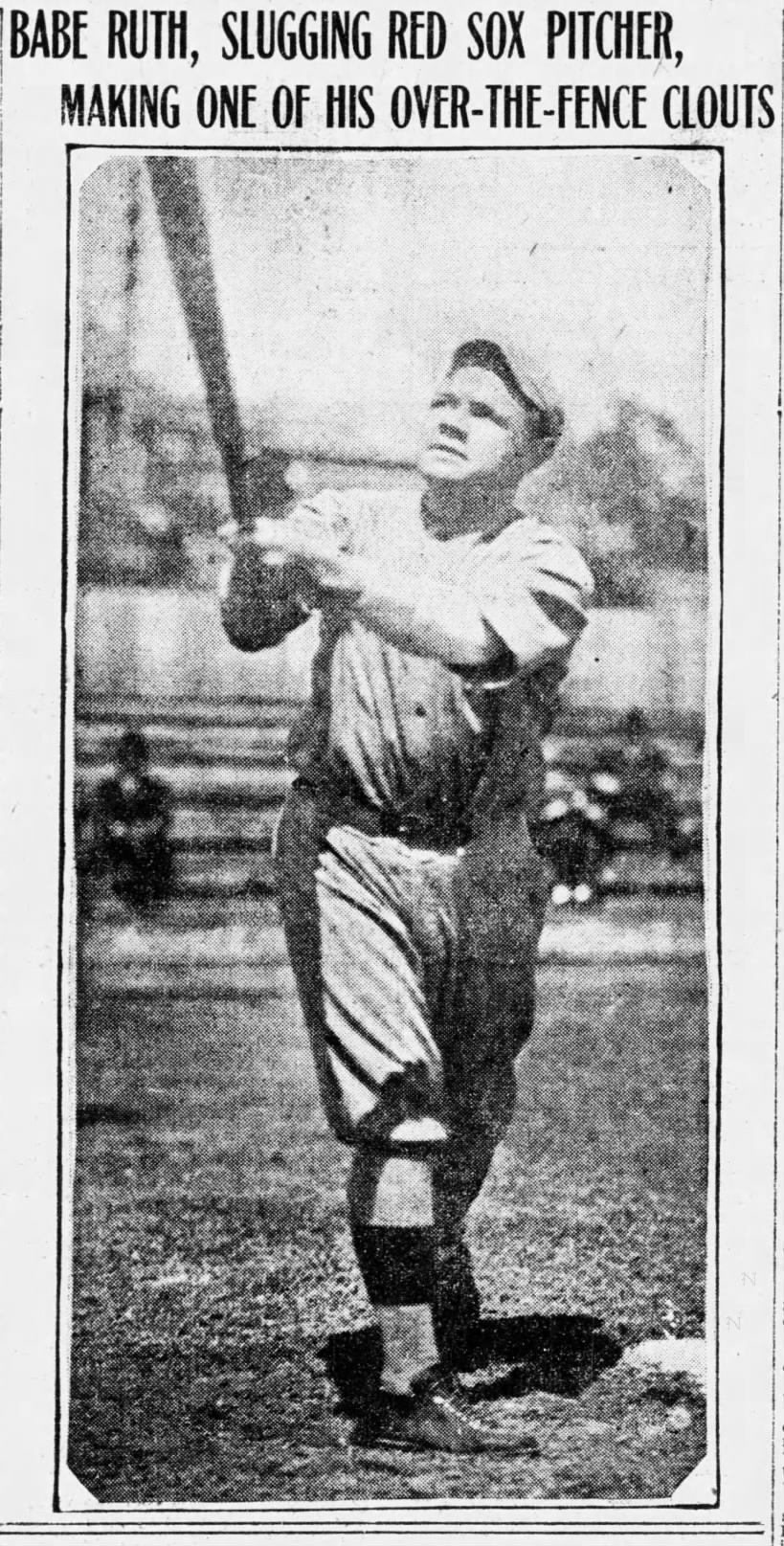
The Boston Globe April 3, 1918, made note of Babe’s prodigious spring training “clouts”.
Babe finished the spring hitting a robust .489 with four home runs. For a bit of perspective, his team hit a total of nine dingers and their opponents totaled seven. And in his first seven games of the 1918 season Babe pitched and pinch hit twice. He was hitting .438 with an OBP of .526 and an OPS of 1.276. He had a homer, two doubles and six RBI. His bat was clearly screaming “GET ME IN THE LINEUP!” His time was coming.
It was Saturday May 4th, and the Red Sox were in New York battling the Yankees at the Polo Grounds. They were in first place a game and a half ahead of the Indians. Babe was on the mound for his fifth start of the year. He was 3-1 having thrown four complete games. The game was all Babe, the good, the bad and the ugly. The Yankees beat the Sox for the second day in a row, 5-4. Babe went two for three, hitting his first homer of the season, a two-run shot in the seventh inning. He also doubled in a run in the ninth accounting for three of the Red Sox four runs. Only two of the five runs surrendered were earned, but the three unearned runs came on Babe’s two errors in the third frame. The very next game he was on first base, his first game as a position player and within ten days he was the talk of the league with pundits nationwide asking the question.

Babe’s explosive turnover to a primary batsman was all but complete.
Babe emerged offensively in 1918 and began to peak in 1919, setting the AL home run record knocking 29 homers. The record he held until Roger Maris hit 61 in 61. He also led the league in runs, RBI, OBP, Slugging, OPS and OPS+. Johnson was still at his peak, winning 20 games for his 10th consecutive season, leading the league in shutouts, strikeouts, ERA, WHIP and ERA+. In that small sample of what came to be 12 Plate Appearances, Babe went 4-10, with two doubles, a triple and two walks. His batting average was .400, his OBP, .500. He had no homers or RBI, but his slugging percentage was .800 making his OPS, 1.200, and he struck out once
In 1918 and ’19’ Walter was still in his prime. He had 58 starts in those two seasons and completed 56 of them. He went 43-27 with an ERA of 1.37. He hurled fifteen shutouts, leading the league in both seasons. In fact, he led the league both seasons in ERA, Strikeouts, ERA+ and WHIP as well. The league hit .216 against him, with a collective OBP of .260, a slugging percentage of .268 and an OPS of .528. In ’18’ and ’19’ Johnson surrendered a grand total of two home runs, both to Babe in 1918.
In those two seasons Babe, using today’s vernacular, blew up. He led the league in home runs, slugging and OPS in 1918 and ’19’. And in ’19’ adding league leads in runs, RBI, OBP and OPS+. All the while setting a new season home run record with 29 dingers. A record he would reset three more times. He faced Sir Walter of Washington 22 times going 7 for 18 (four walks) for a .389 clip. His OBP was .500 and his seven hits included two home runs, three doubles and a triple which added up to a slugging percentage of .818, all accounting for an OPS of 1.381. He had six RBI.
HEAD-TO-HEAD 1918 AND 1919
Comparision of head-to-head competition compared to how they each fared against the rest of the league.
Babe versus Johnson…Batting Average, .389, vs AL .312, OBP vs Johnson .500 vs AL .438, SLG vs Johnson, .818, vs AL .614, OPS vs Johnson 1.381, vs AL. 1.052.
Johnson versus Babe…Batting Average, AL .216 vs Babe .389, OBP, AL .260, vs Babe .500, SLG AL .268 vs Babe, .818, OPS vs AL .529, vs Babe 1.381.
Johnson against Babe as opposed to how the rest of the American League hit him. Babe average was 44% higher than the rest of the American League hit Big Train. His OBP was 48% higher, his SLG% was 67% higher and his OPS was 62% higher.
Babe against Johnson as opposed to how he hit the rest of the league. His batting average was 20% higher against Johnson than against the rest of the American League pitchers. His OBP was 12% higher, his SLG% was 25% higher and his OPS was 24% higher.
Twenty-two plate appearances comprise a relatively small sample size; however, it is all we have to evaluate the head-to-head duel of these greats in the prime of their careers. What it reveals is the fact that when unburdened with the task of “toeing the slab” against Johnson, Babe unleashed the fury of his bat, and it did damage. Nobody that Johnson faced in the years 1907-1919 with 20+ plate appearances, put up the numbers against him that Babe did, not Speaker, not Shoeless Joe, not Tyrus R. Cobb.
The only one who came close to Babe’s numbers was Lou Gehrig who hammered Walter for four home runs from July of 1926 through July of 1927 when Walter was clearly but a shell of his former self. In those years the AL had hit Walter at a .267 clip with an OBP of .316, a SLG% of .403 for an OPS .720.
BABE AS A YANKEE
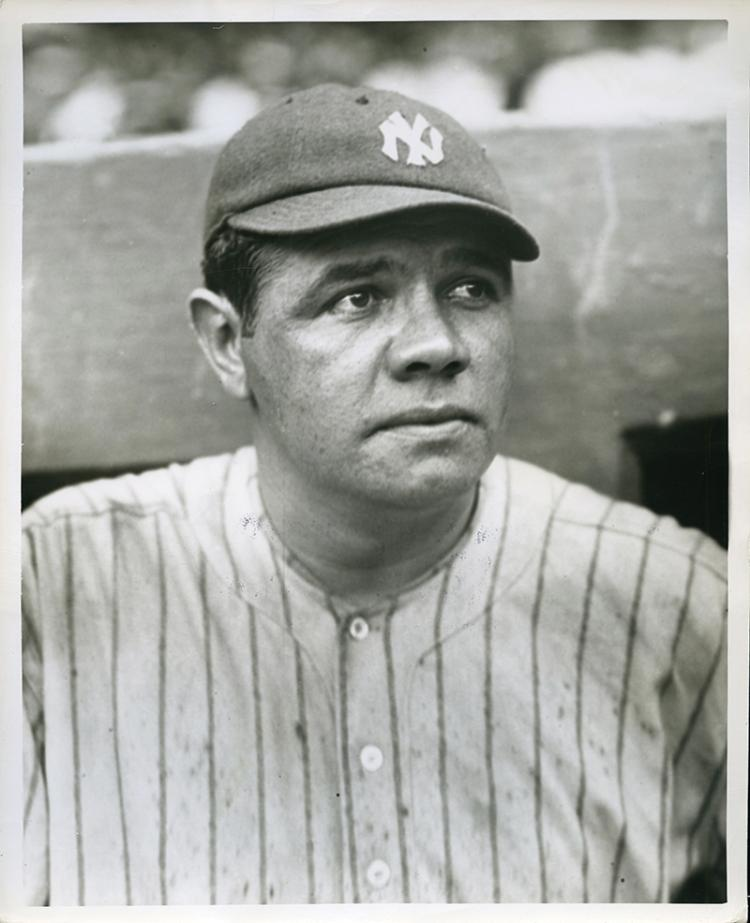
From 1920 through the 1934 season, Babe appeared in 2084 games, garnering 9,203 plate appearances. He played 1,128 games in right field, 871 in left, 62 in center and 14 times at first base. He pitched in five games in a Yankee uniform, one in relief and although his ERA was 5.52, he won all of them. Ninety times the Yankees called upon him to pinch hit. He hit .349 with the Yankees with 659 home runs and 1,978 RBI. His OBP was .484, slugging percentage of .711 for an OPS of 1.195 and an OPS+ of 209. He struck out 1,122 time and received a base on balls on 1,852 occasions. His Power Production Average was .472. (47.2% of his hits went for extra bases)
Let’s isolate Babe’s performance from 1920 through 1927. Prime years? Maybe, but really his prime years for offensive production ranged from 1918 through 1932. He fell off in 1933, only hitting .301 with 34 homers and a league leading 114 RBI. In the eight seasons from 1920 through ’27’, Babe led the league in: runs, home runs and OBP six times. RBI four times, slugging, OPS and OPS+ seven times and he won one batting title. He hit for a .361 average, had an OBP of .498, slugged at a .750 rate and his OPS was 1.248. His walk percentage was 20.8%, strikeout 13.1% and his home run percentage was 7.4%.
THE BIG SWEDE VS THE SULTAN OF SWAT
While in New York Babe stepped in 116 times against Walter, his batting average was .333, with eight doubles and eight homers. His OBP was .466, and his slugging percentage was .677, making his OPS 1.143. Johnson walked him 23 times and punched him out 16 times, a 30% difference. Of his 31 hits, 16 were for extra bases, eight doubles and eight homers.
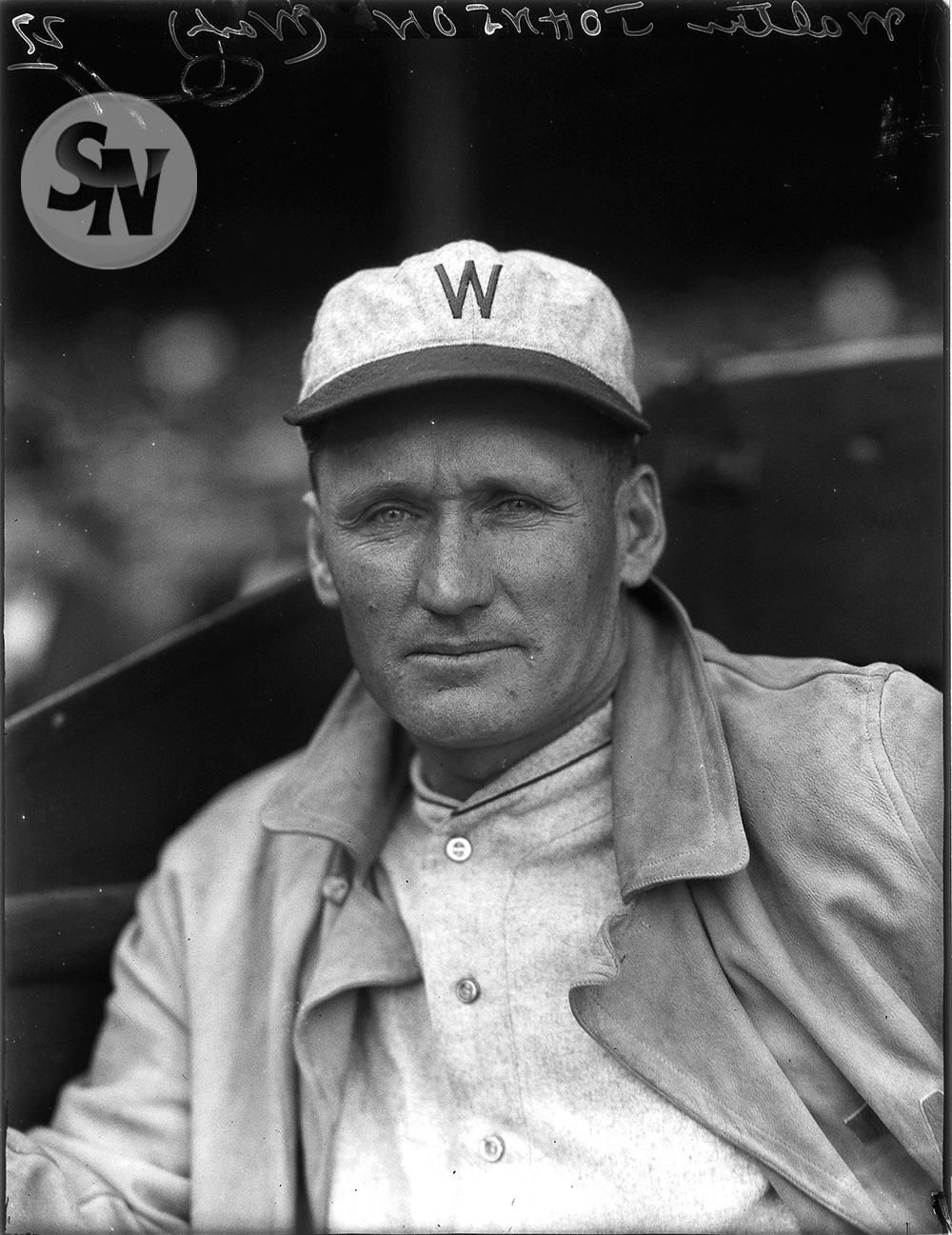
From 1920 until his retirement following the 1927 season, Walter won 120 games and lost 88 with a 3.33 ERA. (doubled). His WHIP was 1.268 (25% higher) and he allowed 8.7 hits per nine innings pitched (21% higher) and his opponents hit .257 (17% higher) against him. He threw 24 shutouts, struck out 4.4 batters per nine innings and had an ERA+ of 119 (31% decrease). His average season was 15-11 with a 3.16 ERA with 228 innings pitched and three shutouts per season.
HEAD-TO-HEAD 1920-1927
Babe took a liking to New York and New York sure as hell took a liking to him as well. From 1920-27 Babe hit .361 with an OBP of .498! His SLG% was .750 and his OPS 1.248. His strikeout percentage was 13.1%, walks 20.8% and his home run percentage was a hefty 7.4%.
Age was catching up with Walter and it was showing. He did have one more Walter Johnson year in him, winning the MVP in 1924. Leading the league in wins, ERA, Shutouts, Complete Games, Strikeouts, ERA+ and WHIP. And he followed that up with a 20-7 season in 1925, however the four years before, combined with the two after reduced the “Big Swede” to a .500 pitcher, 77-74. The league hit .257 against him with an OBP of .315, a SLG% of .368 and an OPS of .683. His strikeout percentage was 11.7, walk was 7.1% and his home run percentage was still under one at 0.9, it had doubled.
How did this translate into their head-to-head encounters?
Babe hit .333 against Walter, with a .470 OBP, a SLG% of .677 and an OPS of 1.147. His strikeout percentage was 13.8, walks 19.8 and home run percentage 6.9%. Babe had unleashed an assault upon the American League, the likes of which baseball had never seen. And even though his old friend Walter was essentially limping to the finish line of his career; the “Old Swede” still had enough to keep the Bambino in check, somewhat. In every category, Babe did not perform as well against Johnson as he did against the rest of the league. His batting average was 7.8% lower, his OBP, 5.6% lower, his slugging 9.7% down and his home run percentage was 6.8% lower than against the field. His walk rate was 4.8% lower and his strikeout rate was 5.1% higher, just the way pitchers like it.
How did Walter fare against Babe compared to how he handled the field. His batting average was 22.8% higher than Sir Walter allowed the field. OBP 33%higher, SLG% 45.6% higher and OPS 40.4% higher. His walk percentage was 64.1% higher and Walter struck him out at a 15.2% higher rate than he whiffed against the field. Babe’s home run percentage against Walter was an astounding 87% higher!
CONCLUSIONS
They toiled against each other for 14 campaigns. Babe entered in 1914, the year following Walter’s most dominant season, in which he went 36-7 with a 1.14 ERA, leading the league in both categories. He also led in complete games, innings pitched, strikeouts, shutouts, WHIP and WAR. One of the most dominant years by a pitcher in the history of the game.
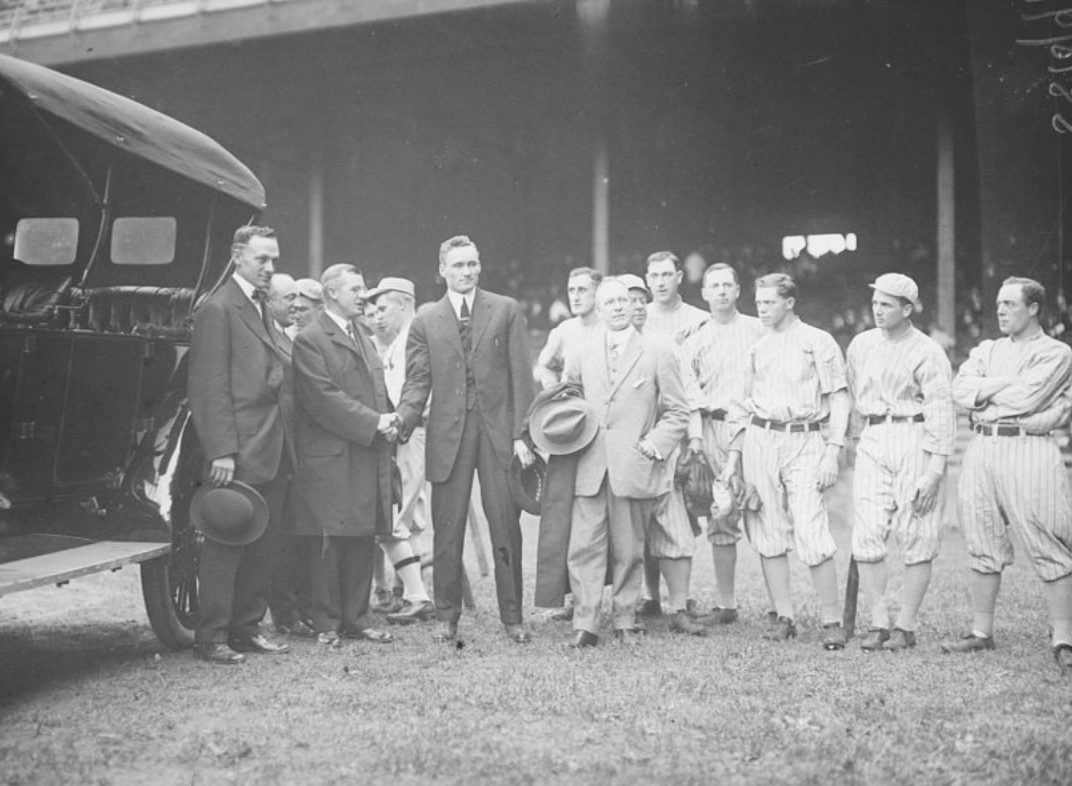
Walter Johnson receives an automobile for winning the Chalmers Award as American League Player of the Year.
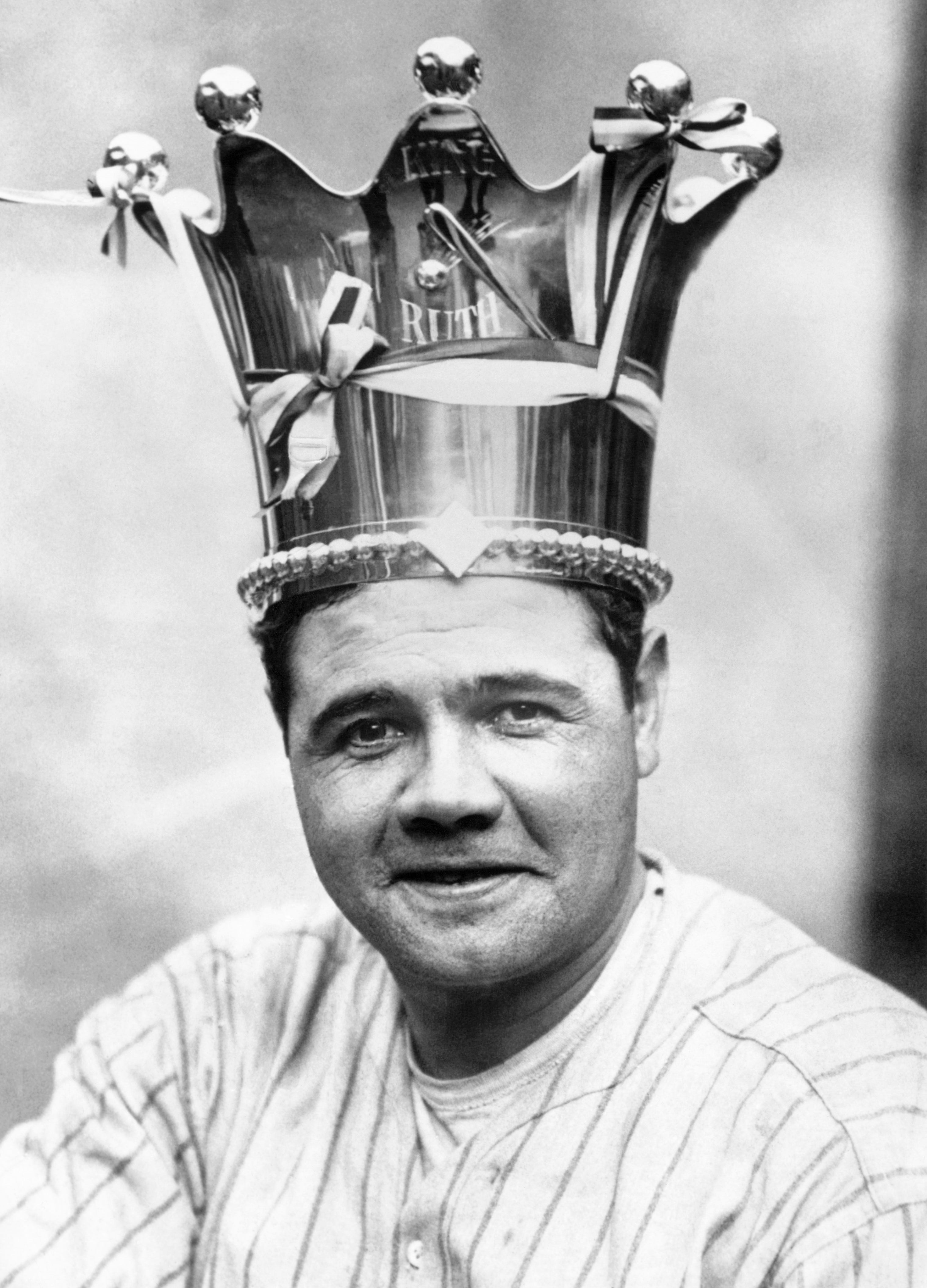
Walter left following the 1927 season. The year in which Babe hit .356 with 60 home runs and 165 RBI. Leading the league in homers, runs, OBP, SLG%, OPS and OPS+.
At the end of the 1927 season, Babe’s career totals were .349, with 416 homers. His OBP was .480, SLG% .709 and his OPS 1.189. His home run percentage was 6.6%, his strikeout percentage 13.2% and his walk percentage 19.4%.
Throughout the 14 years in which they clashed Walter kept the lid on Babe, so to speak. Babe hit .324 against Sir Walter (7.1% lower than the league). His OBP was 7.9% lower, his SLG% was 4.6% lower and his OPS was lowered by 5.9%. His home run percentage was down 7.6% his walk percentage dropped 17.1%, while the “Big Swede” struck him out at a 15.9% higher rate than all the rest of the AL hurlers.
Let’s flip it around and see the differences from Walter’s end of things. From 1914 through 1927, Johnson was 266-182 with a 2.47 ERA. He hurled 66 shutouts and had an ERA+ of 137. The American League hit .236 against him, with an OBP of .288, a SLG% of .316 and an OPS of .604. His home run percentage was 0.5%, walks percentage, 6.1 and his strikeout mark was 13.1%.
How well did Babe perform compared to all the other AL hitters? Here goes. Babe’s batting average (.324) was 27.2% higher than the rest of the league versus Walter. His OBP (.442), 34.8% higher. The power categories of SLG% (.676) and OPS (1.118) were 53.3% and 46% higher! Johnson walked Babe at a 64.3% higher rate than he walked the league. And he struck him out at a 17.7% higher rate as well. As for home run percentage, Babe’s was an astounding 92% higher than all the rest.
There is an adage in baseball that says good pitching will stop good hitting. If we could ask Mr. Johnson about that I get the feeling he might say, “unless the hitter is Babe Ruth.
Babe Ruth was a force of nature! He dominated the sport like no one had done before or since. It was over a century ago that Babe left Baltimore bound for Boston and the Red Sox. And in a little town in Florida a seven-year-old little boy who throws and bats left, gazes upon a baseball field and sees the possibilities.

A little boy who chose the “Great Man’s” number.
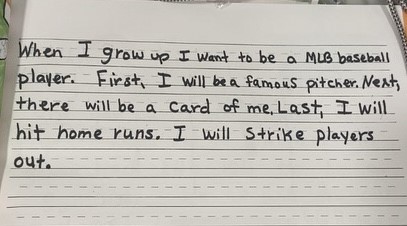
A little boy who wants it all!
AND SO IT IS ON THIS DAY, JUNE 24, 2024

 fenwaypark100