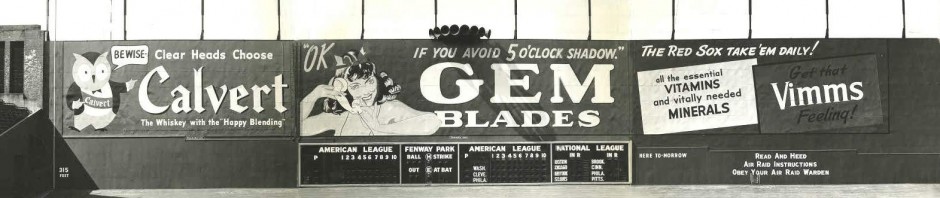
“Giants Legendary Hall of Famer Dead at 86” the newsfeed said, coming just days after my son’s text which simply read, RIP Willie Mays. Back-to-back cold shot reminders to those of us traversing the back nine of our lives, that the clubhouse gets a little closer every day.


A loyal American League fan, my first World Series memory is rooting for the Go Go White Sox to beat the brand-new Los Angeles Dodgers in the 1959 Fall Classic. My American League loyalty always went out the window when the Yankees were involved, and I recall the wild glee I felt in 1960 watching Bill Mazeroski’s homer turn the Pittsburgh Pirates into World Champions. The Yankees rebounded to take the Reds in five in 1961 and in 1962 they moved into first place on July 25th and ran away from the pack, clinching in mid-September and winning the American League pennant by eight games.
The National League race, however, was a heavyweight championship fight that went roughly 145 rounds as the Giants and Dodgers swapped positions between first and second from late April until the All-Star break. On the last game of the season’s first half Sandy Koufax shut out the Giants 2-0 putting them in second place, where they remained until the last game of the year.

September 23rd dawned with the Giants four games behind LA with seven games to go. San Francisco won five of those seven while LA dropped six of theirs, leaving the teams deadlocked, with the pennant to be decided in a three-game series.

The first game was all San Francisco as the Giants shellacked Sandy Koufax (a sentence not often written) on their way to an 8-0 win. Koufax faced only seven batters, giving up three runs, four hits, two of them homers. Willie Mays led the way going three for three with two dingers and three RBI.

The Dodgers entered the bottom of the sixth inning of game two, down 5-0. They put up seven runs to take the lead only to have the Giants tie them in the seventh. LA walked it off in the ninth with three walks and a sacrifice fly. After 164 games played it was all down to one!

“The Los Angeles Dodgers” wrote the Boston Globe’s Roger Birtwell, “in a welter of walks, errors and tense situations…gave San Francisco its first championship… In the third inning the Dodgers tried to give away the game and were thwarted. In the ninth-two runs ahead and two outs from triumph- they succeeded. The Giants scored four runs and won 6-4.”


The first time I saw these two Giants play was on the black and white Zenith TV in my living room during the 1962 World Series. This was the first bicoastal World Series. I didn’t get to watch the games in New York because they started at 1:00 PM and I didn’t get home from school until 4 o’clock or later. However, the games in San Francisco started at 3 PM east coast time. The curtain of my memory rises with me sprinting the quarter mile from the bus stop and running through the kitchen door to put on the TV. It was October 16, 1962, and it was the seventh game of the World Series.
I turned on the Zenith just in time to watch Giants pitcher Jack Sanford facing Yankee pitcher Bill Terry. “Moose” Skowron was on third and Clete Boyer was on first, they both had singled. There was nobody out and the score was 0-0. Terry walked on four pitches, to load the bases bringing up Tony Kubek. Kubek hit a hard groundball to short which Jose Pagan, Chuck Hiller and Orlando Cepeda turned into a double play allowing “Moose” to score. The Yanks led 1-0.
When Ralph Terry put down the Giants 1,2,3 in their half of the fifth, I learned that he was halfway through a perfect game, having retired the first 15 Giants in succession. That would come to an end in the sixth when, with two outs, opposing pitcher Jack Sanford singled into right centerfield.
The Giants were running out of time when Chuck Hiller led off the seventh inning. Sanford was the only Giant to reach base and the Yankees were clinging to a 1-0 lead. Trying to get something going, Hiller attempted to bunt for a base hit (a disappearing art) and popped out to Terry, bringing up Willie Mays.
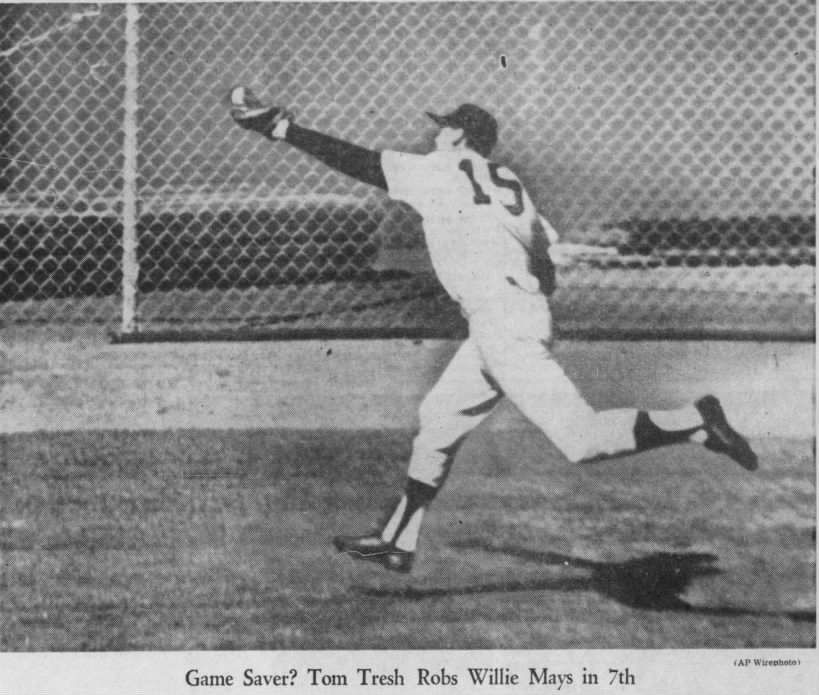
Mays proceeded to smoke a line drive down the left field line. Tom Tresh made an outstanding running catch, snaring the ball in the web of his glove for out number two. The magnitude of the catch was magnified exponentially when Willie McCovey followed with a booming 410-foot triple to right center field.

Terry bowed his back and got the best of Cepeda, striking him out to end the inning and the Yanks still led 1-0.
The Yankees missed a golden opportunity to blow the game open in their half of the eighth. Bobby Richardson led off and reached on an error by Jose Pagan. after which Tresh and Mantle delivered singles. With the bases loaded and nobody out, Giants skipper Al Dark summoned lefty Billy O’Dell from the bullpen to face Roger Maris. Maris hit a ground ball to second base which Hiller threw home forcing Richardson for the first out. O’Dell got the Giants out of trouble when he induced Elston Howard to hit a ground ball to third which resulted in a 5-4-3 double play. Terry continued his mastery of the Giants in the eighth, setting them down 1,2,3 and after O’Dell disposed of the Yankees with equal ease, the Giants were down to their last shot.
The 1962 season marked the first year the National League had ten teams, thus it was the first year of the 162-game schedule. Adding the three-game playoff and the World Series, the San Francisco Giants of 1962 played more games than any other team in history. Their 1962 season was comprised of 4,617 outs and now they were down to their last three.
Pinch hitting for O’Dell. Matty Alou reached on a perfectly executed drag bunt which brought the 43,000+ fans in Candlestick Park to their feet. Ralph Terry, again, bowed his back striking out Matty’s older brother Felipe and Chuck Hiller. Now all the stood between Terry and the Yankees 20th World Championship was Willie Mays.
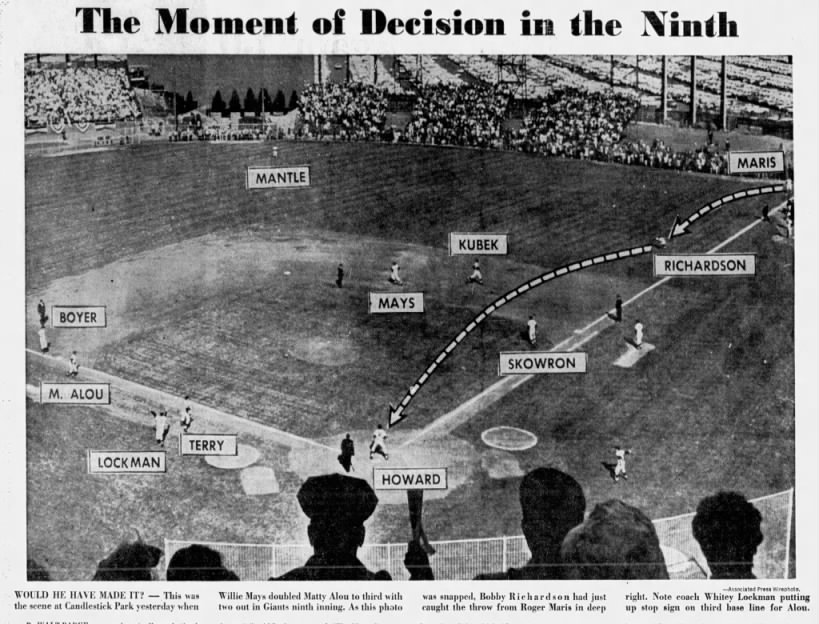
“I had one thing on my mind” Willie wrote in the San Francisco Examiner, “I wanted the home run.” With the count 2-0, Terry delivered a fastball on the outer half of the plate. “I simply was going to hit that pitch as hard as I could wherever it was…It was a fast ball outside, that’s why I went to right field.” The line drive hit about 10 feet inside the right field foul line. “Second Guessers immediately began questioning whether fleet Matty Alou could have scored the tying run”, wrote the Examiners Walt Radke. “Maris is a good fielder with a strong arm” retorted Giants third base coach Whitey Lockman. “If he bobbled the ball for even a second, I’d have sent Alou home, but Maris fielded it cleanly.” Two other factors were at play, the first, Ralph Terry was laboring, and second Willie McCovey was coming up. The same Willie McCovey who had walloped a 410-foot triple in his previous at bat. Yankee manager Ralph Houk visited Terry, “You want to walk him and pitch to Cepeda?” he asked his lanky right-hander, “I’d just as soon pitch to McCovey” he told his skipper, and the stage was set. He threw two pitches to McCovey, both fast balls and Willie turned on both of them, hitting them squarely. The first one was high and deep into the right field stands, just foul, strike one. The next one he hit just as square, just as hard on a line to second baseman Bobby Richardson and just like that, one of the greatest World Series games ever played, was over. Both swings brought me leaping off the couch screaming yelps of exhilaration which quickly turned to silence and disappointment.

Bobby Richardson and the ball make their way to a jubilant Yankee clubhouse.
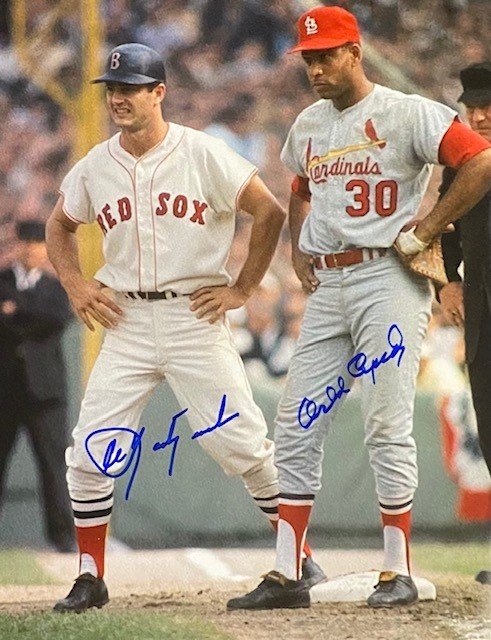
I never did get to see Willie play in person, I did however, cross paths with the “Baby Bull.” The first time was on October 1, 1967, at Fenway Park. It was game one of the World Series and Dad and I got up, pre-dawn and grabbed SRO tickets. Four players bound for Cooperstown were on the field that day: the two 1967 MVP’s Carl Yastrzemski and Orlando Cepeda, as well as Lou Brock and Bob Gibson.
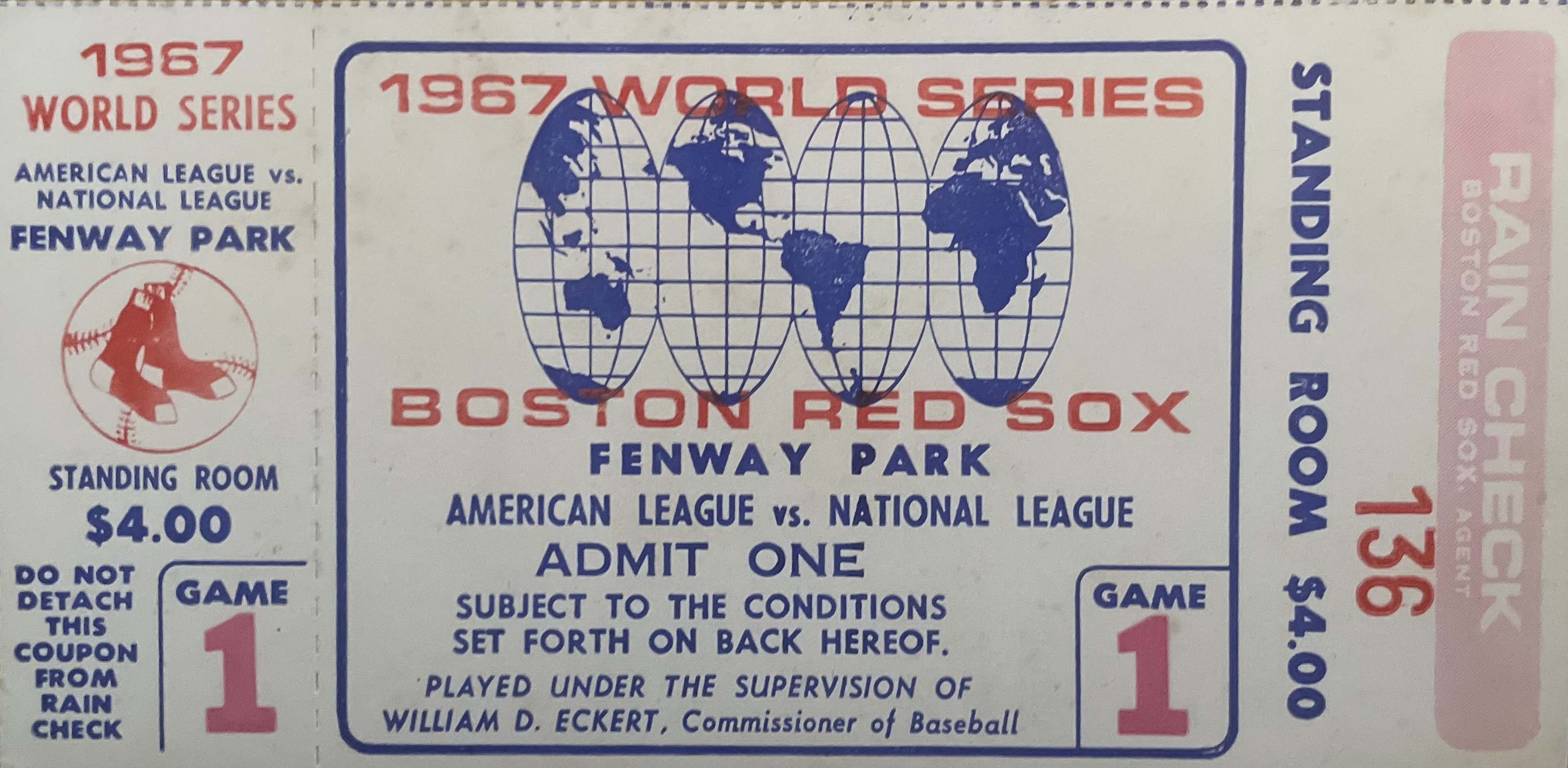
Yaz and Cepeda were both neutralized in this game, Yaz by Gibson and Cepeda by Red Sox pitcher Jose Santiago. Lou Brock on the other hand went 4-4 and scored both St. Louis runs, believe it or not, both on ground ball outs to second base by Roger Maris. And in yet another believe it or not, the only Red Sox run came on a third inning home run by Jose Santiago, THE PITCHER!

On January 18, 1973, Orlando Cepeda signed a one-year contract with the Boston Red Sox for a reported $60,000. Struggling with bad knees and near the end of his career, he was a perfect choice to be the first Red Sox Designated Hitter. “I always said I wanted to finish my career with the Red Sox”, Cepeda told the Boston Globe’s Clif Keane. “I was crazy about Ted Williams; he was my favorite player.” The “Baby Bull” and I would once again cross path, but by this time he was known primarily as “Cha Cha”.

It was Friday April 6th, and the Yankees and Red Sox were opening the 1973 campaign at Fenway Park. The sun was shining but high temperature of the day would not reach 50. However, wind gusts reached 50 as a prevailing wind at 15 to 20 mph blew throughout the afternoon. The starting time of 1:37 assured that history would be made at Fenway Park. You see the first DH in the history of baseball would come to the plate on this day. Mel Stottlemyer and Luis Tiant would become the first pitchers in history to play defense only and not come to bat in a game and either Ron Bloomberg or Orlando Cepeda would be the first DH to step in the box.
My Big Bro and I were at the game, beginning our second year as Red Sox partial season ticket holders, and once again there were four players on the field Cooperstown bound. All in the Red Sox lineup, the two 1967 MVPs, as well as Luis Aparicio and Carlton Fisk.
The game was, in a word, a hullabaloo! Every ball hit in the air became an adventure and needless to say, 40-degree temps with gusting April winds in New England, does not lend itself to optimum baseball play.

The Yankees jumped out to a 3-0 lead in the first inning as Ron Bloomberg became the first DH of all-time, receiving a walk from Tiant with the bases loaded scoring the first run. Yaz got one back with a homer into the centerfield bleachers in the bottom half of the inning and the Sox added four in the second, two coming on a home run into the left field screen by Fisk.
Yankee third baseman Craig Nettles homered in the top of the third and the Sox came to bat in the bottom half with a 5-4 lead. They rang up five hits, added three runs and after Tiant set the Yankees down in order in the fourth, Fisk hit a grand slam and the game was, for all intents and purposes, over. The Red Sox won 15-5, they banged out 20 hits and Luis went the distance. In a touch of irony, Cepeda was the only player not to have a hit, taking the collar in six attempts. Following the game, the bats of both Ron Bloomberg and Cepeda were boxed up and sent to the Hall of Fame in Cooperstown.
The next day, the cold continued, Cepeda went hitless again but did have two sacrifice flies, accounting for two RBI in the Sox 10-5 win. On Sunday, Big Bro and I returned, two of the 12,754 patrons to battle the 41-degree frigid temperature. “Cha Cha” ran up and down the runway to the clubhouse trying desperately to keep his body warm and his weak knees loose. He had three groundouts and was yet to have a hit in 13 plate appearances as the Red Sox DH, when he stepped to the plate to lead off the ninth. It was 3-3. And then…

The count was one and one when Sparky Lyle threw, what he called a “fastball down the middle” and what Cepeda called “a slider up and in.” No matter, the result was “a vicious liner through a heavy north wind,” into the screen giving the Red Sox a 4-3 win and a sweep of the series.
It has become fashionable nowadays for every walk-off win to be celebrated like the World Series has just been won. Everyone runs down the hero in the middle of the field, tears his shirt off (really not sure why) and then douses him with a cooler of Gatorade while he chats with the talking heads. Believe it or not, being greeted at home on a walk-off homer was a rarity. The dugout emptied for Cepeda because it was obviously a big win, but it was also a tribute to him. His mates loved him, appreciated what he was enduring physically to simply play the game and deeply respected him for it! And those of us in the stands, loved him too!
“Cha Cha” hit 19 more home runs in 1973, and I saw one more of them. It is as alive today in my mind’s eye as it was on the night it happened. It was May 29th and despite the fact that Yastrzemski was out, nursing a bad back, there were five players bound for Cooperstown on the field. Cepeda, Aparicio and Fisk for the Red Sox. Nolan Ryan was pitching for the Angels with Frank Robinson, the Angels DH, hitting third.
THE PITCHER
Nolan Ryan arrived in California in December of 1971, traded by the Mets for the Angels perennial All-Star shortstop Jim Fregosi. He’d had five seasons with the Mets going 29-38 with an ERA of 3.58. He pitched in 105 games, of which 74 were starts, throwing 510 innings and striking out 493 batters, while walking 344. He threw only two shutouts, had a WHIP of 1.398 and an ERA+ of 98. Amidst a rather non-descript resume there were flashes of dominance and brilliance. In April of 1970, his first appearance of the year, there was a 15 strikeout one hitter against the Phillies in which he walked six and in May 1971 he struck out 16 Padres in a four hit 2-1 win. The Nolan Ryan that baseball would come to know, and love arrived in Anaheim California in 1972.
He went 19-16 that first year in Anaheim with a 2.28 ERA. He started 39 games, completing 20 of them and he led all major league hurlers with nine shutouts. He also led the majors in strikeouts with 329, hits allowed (5.3) and strikeouts (10.4) per nine innings. It was his first of three consecutive 300+ strikeout seasons. He also topped the American League with 157 walks and 18 wild pitches. The AL hit .171 against him in 284 innings pitched.

On this May night in 1973, as part of his pre-game preparation, Ryan took a seat on the field, leaning against the third base box seats and watched the Red Sox take BP. He was making his 12th start of the young season and was two weeks removed from the first no-hitter of his career, a 3-0, 12 strikeout performance in Kansas City. In fact, he arrived at Fenway having recorded 37 strikeouts in his last three starts.
“Cha Cha” and the “Ryan Express” had met before, 24 times in fact. Cepeda mustered but four hits in those 24 encounters for a meager batting average of .167. However, two of those hits were home runs and one was a double. His first home run came in the third game of the NLCS in Shea Stadium, putting the Braves in the lead 4-3 in a game which Ryan and the Mets would eventually win on their way to a World Championship in their “Amazin” 1969 season.
It was a beautiful spring night, the daytime showers had parted and I, along with my soon to be brother-in-law, were bound for Fenway. I was eager to get my first look at this kid whose name was finding itself in the same sentences as guys named Waddell and Johnson, and Feller and Koufax!
Southpaw, Bill “Spaceman” Lee, was on the mound for the Red Sox, the antithesis, of the right-handed, flame throwing Ryan. Ryan was heat, heat and more heat. Lee was an array of off-speed spins, twists and curves all designed to make his fastball, when he threw it, appear 10 MPH faster.
The action started early as Lee surrender singles to the first two Angel combatants before getting Frank Robinson to hit into a 6-4-3 double play. Bob Oliver followed with the third hit of the inning and Boston was down 1-0. Ryan retired the side in order in the first and when the Angels came to bat in the second, they threatened again with back-to-back singles after two were out. Lee wiggled out of the jam and when the Sox came to bat in the second, the Angles held a 1-0 lead and already had five hits on the board.
Reggie Smith led off the Sox second and quickly went down 0-2 to Ryan before working him for a walk.
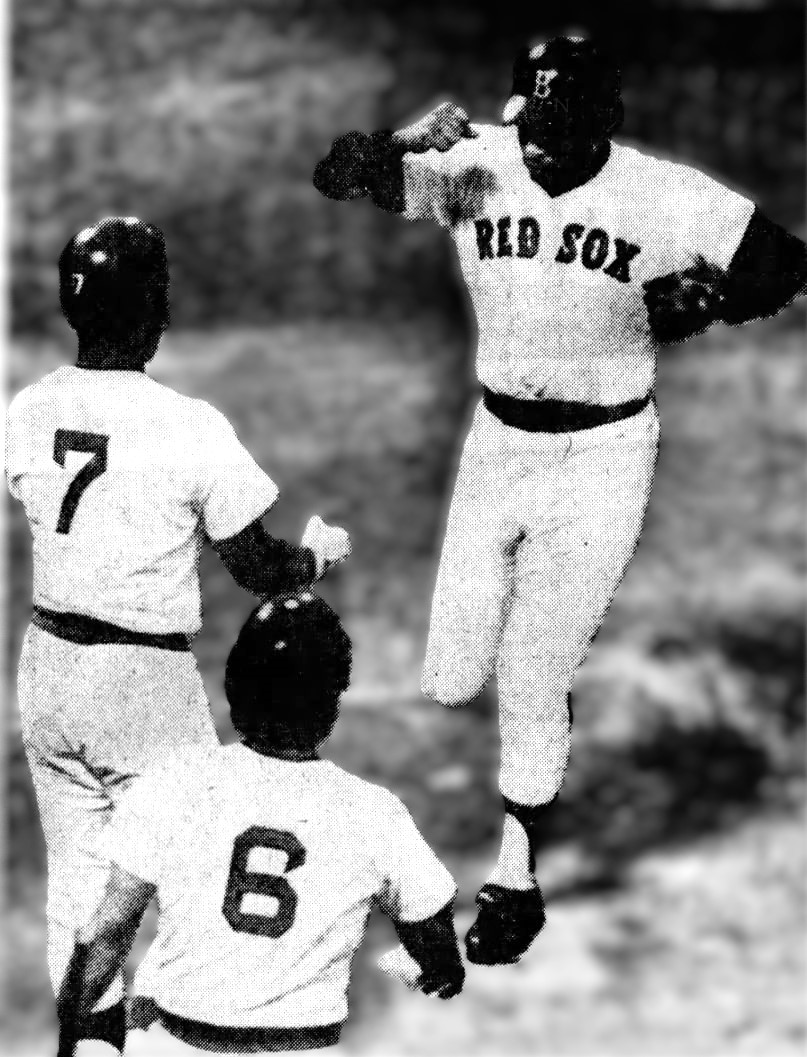
I was sitting in the bleachers above and behind the Red Sox bullpen, Ryan threw the first pitch, a fast ball on the outer half of the plate. Cepeda attacked it and met it square sending a blistering, rising line drive into the Red Sox bullpen below me. It went in just to the right of the 420 mark on the centerfield wall. I saw it through its entire five second journey from home plate. Reggie Smith (7), who scored ahead of him and on deck hitter Rico Petrocelli welcomed him home and the Red Sox led 2-1.
It was a thrilling baseball game which ended in a 2-1 Red Sox victory, the same score it was at the end of the second inning. Both pitchers pitched themselves in and out of trouble for virtually the entire game. They each had only one more frame in which they retired the opposition 1,2,3, and every other inning was a nail-biting adventure packed with all the drama any baseball fan could ask for. Ryan got out of a two on, one out jam in the third, inducing Fisk to pop-out to first and striking out Reggie Smith. And in the fourth, the Sox loaded the bases with one out when Ryan punched out John Kennedy and got Rick Miller to foul out to the catcher. In the top of the sixth, Bill Lee sandwiched a double play ground ball between a single and a double and then got another ground ball to end the inning with the tying run on second. In the bottom half of the frame, Tommy Harper singled with one out and stole second base. Ryan disposed of both Danny Cater and John Kennedy on called strike three.

Then came the top of the seventh and for the fourth time in the game, Bill Lee put the leadoff man on, a Ken Berry single to right. He was sacrificed to second, bringing up pinch-hitter Winston Llenas who promptly singled to center. Reggie Smith fielded the ball and made a perfect two-hop throw to Fisk at the plate nailing Berry for the second out. The Angels threatened again in their half of the eighth. With two outs and two on, Lee walked third baseman Al Gallager to load the bases bringing Skipper Eddie Kasko to the mound who summoned closer Bob Bolin. Bolin, a 13-year veteran who was playing in his last year, got pinch-hitter Tommy McGraw to fly to left, ending the inning and the threat.
In the bottom of the eighth, Ryan put the Sox down in order striking out both Cepeda and Petrocelli swinging and getting Evans on a line drive to second. Bolin returned the favor in the ninth, getting a flyball, a pop-up and a strikeout in order, for his second save of the season.
Ryan’s complete game line was five hits, five walks, 10 strikeouts, two earned runs and one home run. The loss put him at 6-5 on the year. He won 21 games in 1973 pitching 326 innings, with 39 starts and in those starts he had double digit strikeouts in 23 of them. He led the league in strikeouts with a new MLB record 383, a record he still holds. Remarkably, his last one came on the last batter he faced on the year, Rich Reese of the Twins who went down swinging in the top of the 11th inning. On July 15th he threw his second no-hitter of the season at Tiger Stadium, striking out 17 Tigers along the way.
Orlando Cepeda was the Red Sox Designated Hitter for 142 games in 1973. He hit .289 with 20 homers and was second on the team with 86 RBI. Three times Ryan was his opposing pitcher and “Cha Cha” fared pretty well against him. He got him for another homer on June 12th, sparking the Red Sox to a 6-5 win. Against Ryan on the season, Cepeda went 4 for 11 (.364) with two homers and four RBI. Ryan punched him out twice. He finished 15th in the American League MVP balloting and at season’s end, Orlando Cepeda was named the first winner of the Designated Hitter of the Year Award.
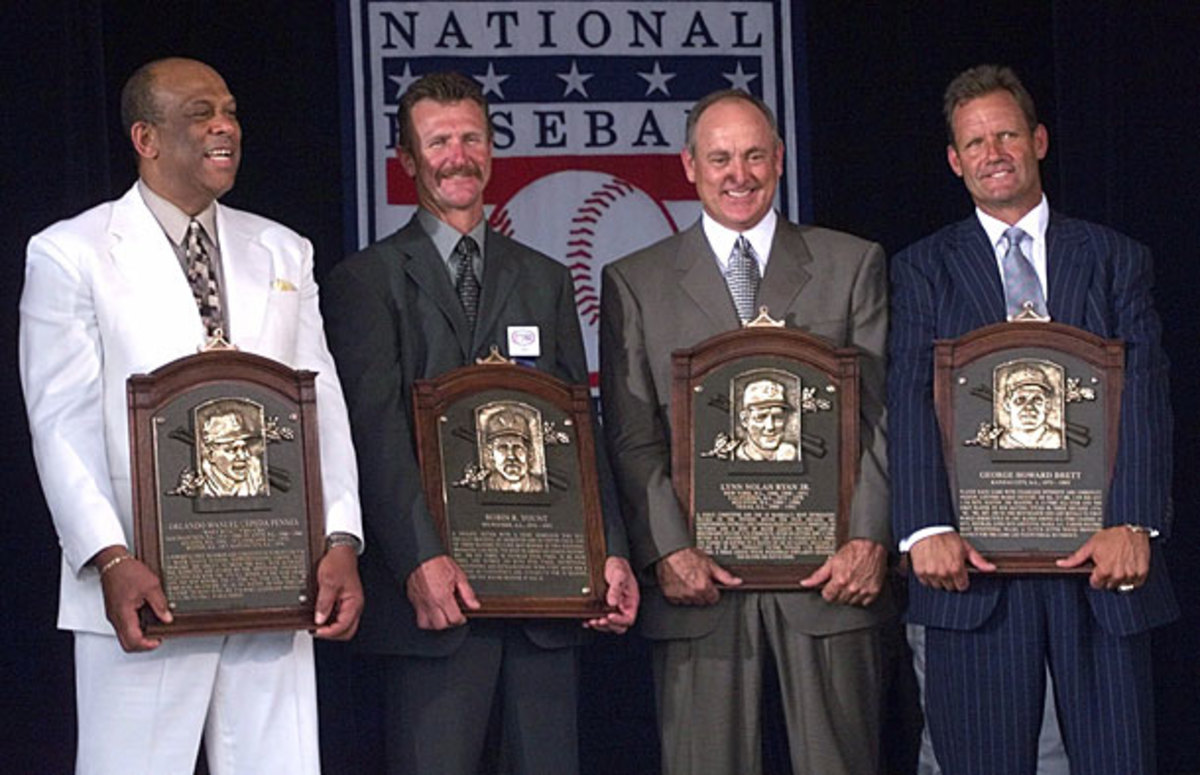
“Cha Cha” and the “Ryan Express” crossed paths again, both, along with Robin Yount and George Brett were inducted into the Hall of Fame in 1999.

The “Baby Bull” and the “Say Hey Kid” played together for nine seasons in San Francisco. On June 20, 2024, Major League Baseball held a celebration at Rickwood Field in Birmingham Alabama. A celebration of the Negro Leagues. Willie played there in 1948 when he was 17 years old.
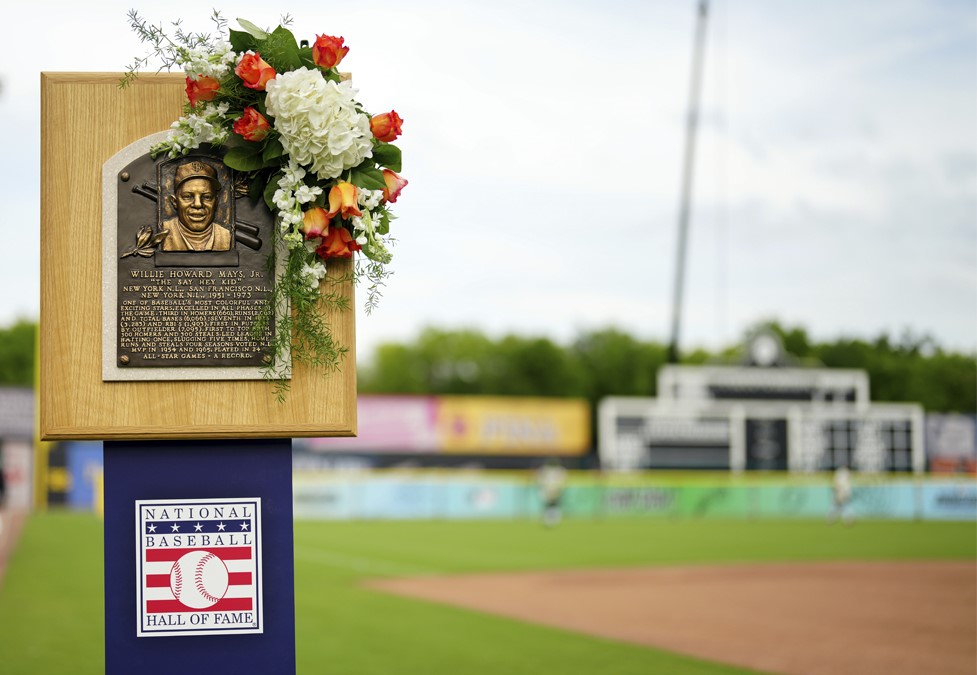
Willie died two days before the event transforming it into a celebration of his remarkable life.

In 2017 MLB designated the World Series MVP Award the Willie Mays Award.

In 2004, upon the retirement of Seattle Mariner long time DH Edgar Martinez, MLB designated the Designated Hitter Award as the Edgar Martinez Award. Martinez had won the award four times throughout his career and in 2019 he became the first player, who was primarily a DH, to be inducted into the Hall of Fame. I submit that MLB should add Cepeda’s name to the award and call it the Cepeda Martinez Award, honoring baseball’s first best DH. I don’t think Edgar would mind.

With gratitude that I got to share a season with “Cha Cha” at Fenway and that I got to see Willie work his magic, if only through the black and white images of my Zenith, I say, so Long “Say Hey,” Auf Wiedersehen “Baby Bull,” thanks for the joy you brought to the game that we love and to the lives of so many. May the peace of the Cornfield be yours eternal.
And so, it is on this day in baseball history, July 6, 2024

 fenwaypark100
divine! 45 2025 “They will come to your door as innocent as children…It will be as if they dipped themselves in magic waters, the memories will be so thick they’ll have to brush them away from their faces…” Terrance Mann beautiful