
The All-Star break is here; a time held baseball tradition that dates back to 1933. For 89 times baseball has paused to celebrate its best players from each league in a one game contest with the prize being simply pride. From 1959 through 1962 there were two games played each year and thus 93 games have been played. The teams head to Arlington Texas for this year’s contest with the American League holding a three-game edge having won 47 while losing 44, there have been two ties. In baseball’s honor let’s take a look at the iconic 1941 All-Star game played in the middle of one of baseball’s most iconic seasons.
On July 1st of the historic 1941 baseball season, Ted Williams was one of five Red Sox players named to represent the American League in the ninth annual “Dream Game.” The 22-year-old outfielder was joined by teammates: Bobby Doerr, Dom DiMaggio and Jimmie Foxx; who was named to his eighth straight American League squad. Player manager Joe Cronin rounded out the Red Sox five.
Eight days later Williams and his .405 average were batting clean-up for the American League at Briggs Stadium in Detroit. Hitting in front of him was Yankee centerfielder Joe DiMaggio. Widely recognized as the greatest player in the game, the Yankee Clipper entered the game with a 48-game hitting streak. He had surpassed George Sisler’s American League record of 41 games set in 1922. And just days earlier he supplanted Willie Keeler’s Major League record of 44 games straight in 1896.
THE FIRST HALF OF ’41’
A “twisted ankle” relegated Williams to pinch hitting duties for the first six games of the ‘41’ campaign and following his first start, the Red Sox were in first place sporting a 5-2 record. When April came to an end, he was hitting .389 in only 19 plate appearances. The opening two games of May saw Ted go 1 for 8 and dip to .308, the low watermark for his season. The following day he hit a ground ball single up the middle in Cleveland launching him on a 23-game hitting streak, which culminated in a 2 for 4 night on the sixth of June leaving the lanky lefty sitting on a batting average of .436.
Meanwhile 200 miles down the road in the Bronx, it was mid-May, and the Bombers were stumbling along. Losers of four straight games they engaged the Chicago White Sox in a Thursday afternoon contest in Yankee Stadium. The Chisox scored twice in the top of the first and in the bottom of the frame, Joe DiMaggio singled in Phil Rizzuto to cut the lead in half. It proved to be the only Yankee run of the day, while Chicago piled on a dozen more. It was their fifth straight loss leaving them in fourth place 6 ½ games behind the Indians with the White and Red Sox between them. Under a headline which read “Yankee Hitters Join in Collapse, DiMaggio, Keller Among Culprits”, Brooklyn Eagle scribe Ben Gold called the pitching staff, “the worst to represent the New Yorkers in more than a decade.” He followed with a rebuke of their flaccid offense. Noting a homerless stretch of over a week, Gold admonished the heart of the offense; “…Not only are the Yanks deficient of hitting homers but…their three key men, Joe DiMaggio, Charlie Keller and Joe Gordon are driving McCarthy to the aspirin cabinet.” Ninety-two days and 119 hits later, Joe DiMaggio was hitting .381, the Yankees were in first place 12 ½ games ahead of the Indians and 18 games up on the third place Red Sox. And manager Joe McCarthy’s need for the “aspirin cabinet” vanished. Joe DiMaggio completed an unprecedented streak in the annals of baseball. A feat that continues to echo down through the ages, hitting safely in 72 of 73 games including the inconceivable stretch of 56 straight games.
Catching up with Ted Williams at the All-Star game, United Press correspondent George Kirksey observed, “Long, Lanky Ted is easy to interview because he loves to talk about hitting. I asked him if he had any desire to hang up a consecutive game hitting record like Joe DiMaggio. ‘I sure have’ came Ted’s reply, ‘I want to break every hitting record in the book. When I walk down the street, I’d like for them to say, there goes Ted Williams, the best hitter in baseball.'”
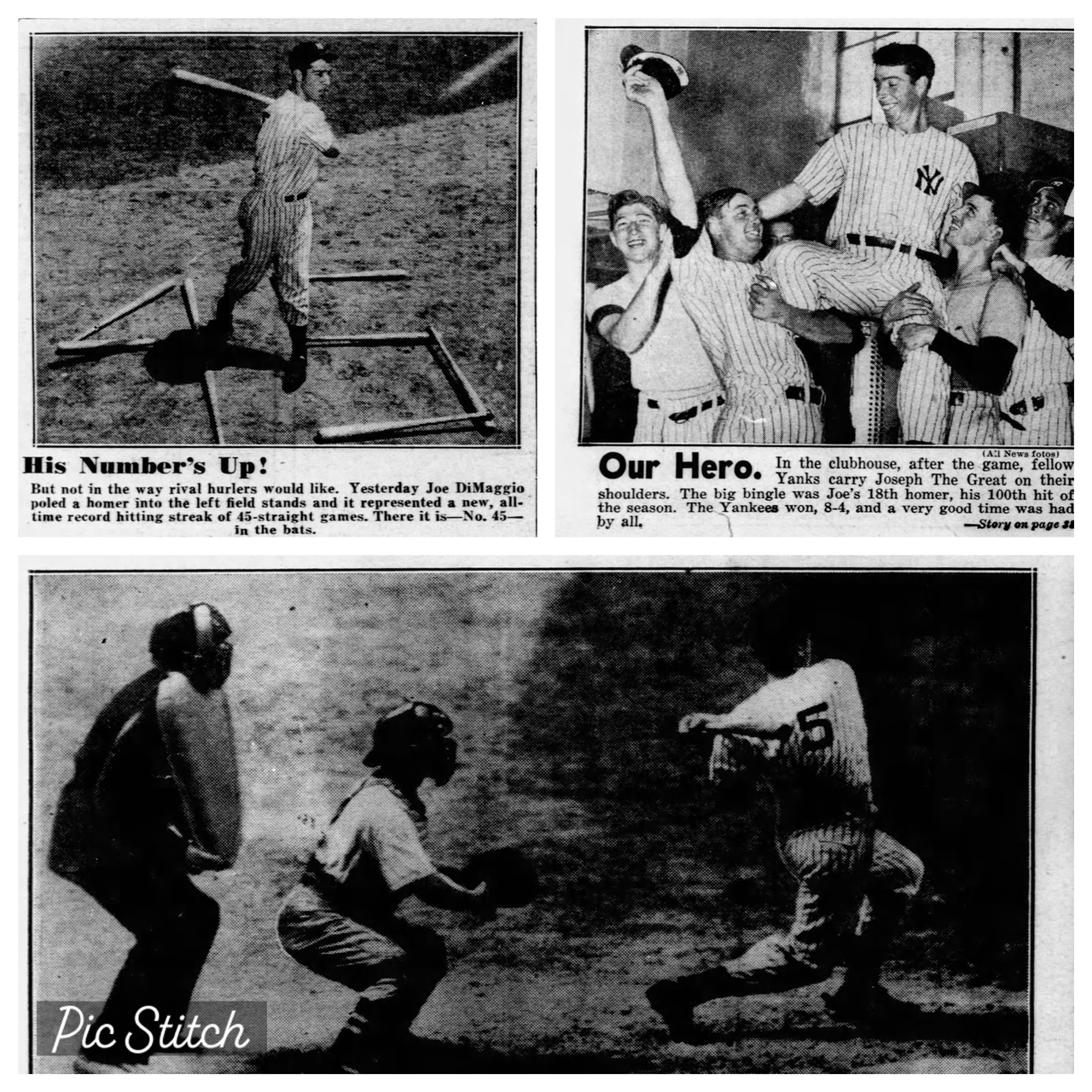
“Joseph The Great” broke Willie Keeler’s record, in Yankee Stadium on July 2nd, with a home run (bottom photo) off of Red Sox hurler Dick Newsome, giving the Yanks a 5-0 lead and driving Newsome to the showers.
On June 25th, the Red Sox thumped the Indians 7-2 at Fenway Park, with Ted Williams hitting his 14th home run of the season. The win brought the Sox to within two games of the Indians and Yankees who were in a virtual tie for first. One week later following a Yankee sweep of a three-game set with the Sox, the pennant race was virtually over. It was the Red Sox fourth straight loss, their seventh in eight games. A modest four game win streak closed the season’s first half getting the Sox to within 7 1/2 games. They would draw no closer and by the end of July, 16 1/2 games separated them from first place. September first they were 19 1/2 out and they finished the season winning 13 of their last 17 games securing a third-place finish, 17 games behind the pennant winning Yankees.
THE ALL-STAR GAME
A crowd of 54,674 jammed Briggs Stadium for the 2:30 start. Manager Del Baker named Bob Feller, the Indians’ 22-year-old phenom flamethrower to start for the Americans while National League skipper, Bill McKechnie, tabbed 33-year-old Dodger righty, Whit Wyatt. Winner of five of the eight games played, the American League was seeking to bounce back from a 4-0 loss in St. Louis in 1940, the first shutout in All Star competition.

Whit Wyatt pitched for nine seasons in the American League going 26-43 with a 5.22 ERA and an ERA+ of 88. Signed by the Dodgers off of an Indians minor league roster in 1938, he pitched six seasons in Brooklyn where he went 80-45 with a 2.86 ERA and an ERA+ of 128. He was a four-time all-star and twice lead the league in shutouts. He faced six batters in his two innings in the ’41’ classic. He walked Ted Williams leading off the second inning, but he was promptly erased on a double play.

Hall of Fame bound Bob Feller joined the Indians at the age of 17 in 1936, striking out 76 batters in 62 innings. He finished the 1941 season having led the league in wins three straight years and strikeouts four times in a row. He had an ERA+ of 136 and 1,233 strikeouts. And he was 22! “Rapid Robert” also faced the minimum in his three-inning stint, surrendering a single to Reds second sacker Lonny Frye who was then gunned down trying to steal second. Feller fanned four and when he left the game it was scoreless.
This was Ted’s second All-Star contest and upon his selection, the local Lynn Daily Item noted, “Williams who failed to connect in his two trips in the 1940 ‘dream game,’ will be a heartbroken youngster if he does not get at least one solid single…And it is likely that the majority of the spectators will be disappointed if the American League’s .405 slugger draws another blank.” His fourth inning RBI double down the right field line saved himself from a “broken heart,” the spectators from “disappointment,” and it staked the American Leaguers to a 1-0 lead. Both teams scored in their sixth inning and the NL Stars came to bat in the top of the seventh trailing 2-1. Enter this guy, Joseph Floyd “Arky” Vaughan.

Twenty-nine-year-old Arky Vaughan was in his tenth season as the Pittsburgh Pirates shortstop. He was playing in his eighth consecutive All Star game and was bound for the Hall of Fame. It was the top of the seventh and twenty-six-year-old Senators’ righty Sid Hudson was now on the mound. Enos Slaughter, another future Hall of Famer, was leading off. Hudson threw his first pitch and Slaughter smashed a line drive single to left, taking second when Ted Williams bobbled the ball. Vaughan stepped to the plate. He took the first pitch for a ball, and then launched a Hudson fast ball high into the Detroit afternoon landing in the right field upper deck and giving the NL team a 3-2 lead. NL skipper Bill McKechnie then handed the ball to Cub veteran Claude Passeau who disposed of the Americans in order in the seventh. Del Baker countered with White Sox southpaw Eddie Smith in the top of the eighth, and the NL squad picked up where they left off in the seventh. A double by Johnny Mize was sandwiched between strikeouts of Pete Reiser and Slaughter. Vaughan again stepped in and just as he had done in the seventh, he launched another 1-0 fastball into the upper deck at Briggs Stadium, becoming the first player to hit two homers in an All-Star game. The NL stars now lead 5-2.
Domenic DiMaggio, the Red Sox centerfielder and younger brother to “Joseph the Great,” made his first of seven All Star teams in 1941. He entered the game in the top of the seventh inning, playing right field next to big brother Joe.

Trailing 5-2 in their half of the eighth, the American’s Cecil Travis led off and fouled out to third, Joe DiMaggio doubled into the left center field gap and then Passeau caught Ted Williams looking at strike three, a very rare feat. This brought up Dom DiMaggio who, after fouling a ball off, lined a single to right center scoring his brother and cutting the NL lead to 5-3. Lou Boudreau followed with a single and advanced to second on an error. This brought up Jimmie Foxx, who just two days earlier had hit career home run number 512 (only Babe Ruth and Mel Ott preceded him with 500 career homers). With the lead run on second, Passeau threw three straight strikes past the aging slugger and the NL took their two-run lead into the ninth.
Eddie Smith vanquished the NL stars on seven pitches and just like that the Nationals were back on the field. Passeau was back on the mound becoming the first NL pitcher of the day to not leave after pitching two innings. The crafty veteran went right to work inducing Athletics catcher Frankie Hayes to pop up. An infield hit by pinch-hitter Ken Keltner was followed by a scorching line drive single to right center by Yankee second sacker Joe Gordon. Cecil Travis went down 1-2 and worked a walk loading the bases for none other than Joe DiMaggio. The talk of the baseball world, DiMaggio was riding a 48-game hitting streak and, in a doubleheader, heading into the All-Star break, went 6 for 9 against Philadelphia in Yankee Stadium. He fouled off the first pitch and swung and missed the second. He then hit a perfect double-play ball to short but an errant throw by second baseman Billy Herman pulled Reds first baseman Frank McCormick off the bag, keeping the game and the American’s alive. Keltner scored and Gordon moved to third. The score was now 5-4. This brought up Ted Williams.

Judson Bailey of the Scranton Tribune wrote, “There was an obvious dramatic tenseness as Williams, slender Boston Red Sox slugger with a batting average of .405, took his place in the box.” He was 1 for 3 on the day with a walk. His double in the fourth inning knocked in the game’s first run and following a flyball to center in the sixth, Passeau had caught him looking at strike three with Joe DiMaggio on second base in the eighth. He took Passeau’s first offering for ball one. After fouling off the next pitch, he looked at ball two. National League umpire Lou Jorda called for Passeau to toss the ball his way. Williams and catcher Harry Danning watched as Jorda inspected the sphere before throwing it out of the game. Danning took his position behind the plate. “The ball Ted hit was a fast ball about belt buckle high”, Passeau told the Boston Globe’s Hy Hurwitz. “I had struck Ted out the time before on a low outside fastball and that’s what I was trying to give him, but the ball got away from me, and I knew where it was going the second I released it.” He hit a towering fly ball which carried inside the right field foul line, banged off the roof facade, nearly leaving the ballpark, and bounced back onto the field as a grinning Williams bounded around the bases clapping his hands. The American’s had prevailed 7-5. Williams was greeted at home by Joe DiMaggio and first base coach Mervyn Shea as Joe Gordon looked on with a smile. A “youthful rooter representing the spirit of all America, “leaped from the stands to join in the welcome.


“One lusty thrust of boyish Ted Williams’ bat, changed the glory and pride of a National League victory into the bitter disappointment of defeat,” wrote the New York Daily News’ Jack Smith. “The 22-year-old Bostonian,” he continued, “whose .405 batting average has been overshadowed by the great hitting of Joe DiMaggio, hammered his way into the long overdue limelight…No movie plot could have been more thrilling.” Ted also deposed Arky Vaughan and his two homers from the All-Star hero’s throne.
National League skipper Bill McKechnie took some heat in the press for leaving Passeau in the game to face Williams. The aforementioned Jack Smith opined that the “usually astute Reds Manager had plenty of warning that Passeau was passe in the eighth inning…any number of NL fans will wonder why he didn’t lift the Cubs hurler.” St. Louis Star Times columnist Sid Keener dissected the move. “Second guessing opened high and wide as soon as DiMaggio strolled to the plate,” he wrote. A legitimate point to be sure, after all there were fresh right-handed arms in the bull pen and Passeau, after surrendering two hits, walked Travis after being ahead in the count 1-2. He seemed to be running out of gas. McKechnie’s decision to stay with Passeau seemed genius when Passeau got two quick strikes on the “Yankee Clipper” and then induced him to hit a tailor-made double play ball to short. After Herman’s throw was wide at first, “McKechnie had several choices from which to select”, wrote the St. Louie scribe, “He could walk Williams and risk the pot of gold on Dom DiMaggio, or he could play percentage baseball and use a left-handed pitcher against a left-handed swinging Ted Williams…National League supporters in firing verbal shots at McKechnie, would like to know why ye ole Deacon did not call for Hubbell.”

Aaaah, Mr. Carl Owen Hubbell. The “ole Deacon” didn’t have just any lefty at his disposal, he had Carl Hubbell, one of the game’s all-time great lefties. The two-time MVP was chosen for the NL All-Star squad for the eighth time. And of course, he had seared his name into All-Star folklore when in 1934 he struck out five AL Hall of Famers in a row. In the first inning of the second All-Star contest Hubbell was touched for a lead-off single by Charlie Gehringer and then he walked Heinie Manush. Up stepped “The Babe” who Hubbell caught looking, for out number one. This brought up Lou Gehrig who struck out swinging. Foxx followed and did the same. Al Simmons led off the second and continued the streak as he and Joe Cronin behind him went down swinging. “The Meal Ticket” threw 23 pitches to those five gentlemen and only Foxx and Cronin managed to put their bats on the ball, both fouling off a pitch. The Hall of Fame website reports that Hubbell’s five victims hit a collective .329 with a total of 13,452 hits and 2,208 home runs. Not too shabby! Nearly a century later, Hubbell’s feat is still recognized as one of the greatest moments in the history of the Mid-Summer Classic.
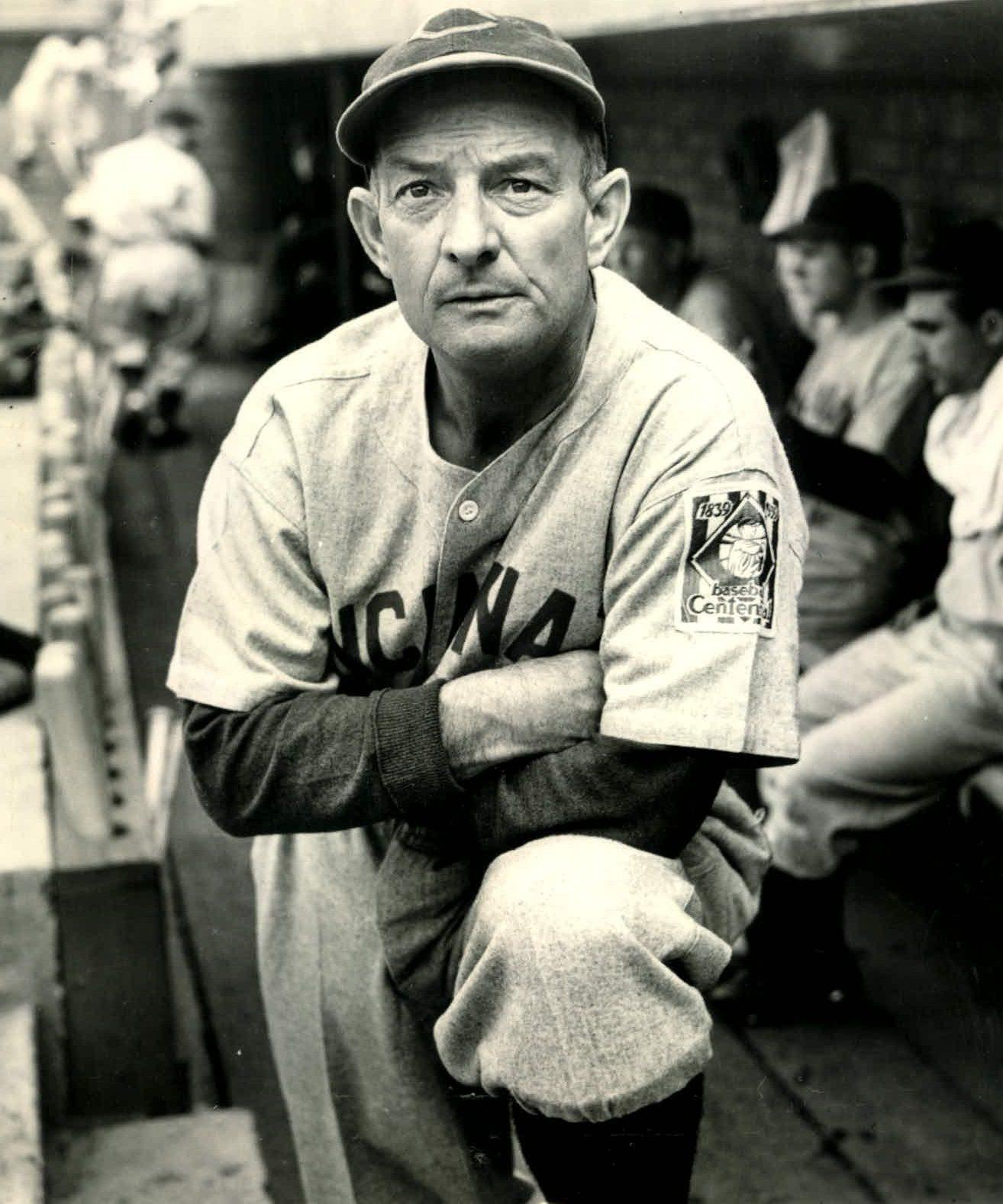
“Ye ole Deacon” chose not to walk Williams and “risk the pot of gold on Dom DiMaggio.” Rather he stuck with the baseball adage of not putting the winning run on second base. And he stayed with Passeau because he’d struck Williams out in his previous at bat and he ostensibly “got DiMaggio,” It was Billy Herman who let Joe D go, with his errant throw. “One pitched ball changed everything,” Keener wrote. “Williams, leveling with full power, cracked a mighty home run in the pinch, and McKechnie, hero of yesteryear, became the fall guy in 1941!” Tulsa World Sports Editor B.A. Bridgewater called the Deacon’s move “suicide”, opining “He’d (Hubbell) have had a better chance to get the batter out than the tiring Passeau, a fellow who had pitched a full game Sunday and was working on only one day’s rest.” Passeau’s complete game came in Pittsburg was a 2-1 loss in which he faced 30 batters.
The 1941 All-Star game elevated the rivalry that would permeate the game for over a half century.
THE YANKEE BIG BOY AND THE WILLOWY STRINGBEAN
The Red Sox opened the second half of the season with a 2-0 loss in Detroit. Ted went 0-4 ending the day under .400 for the first time since May 24th. This began a streak of five hitless games, his longest hitless streak of the season, after which he sat at .393. The following day under the headline, Ted and Dermage Battle It Out, Boston Globe reporter, Fred Barry wrote, “When a fellow cowtails all pitching in sight to the tune of a .400 hitting mark and remains in that figure for a lengthy spell, only to see headlines and fanfare stolen by some “third party,”- something has to be done. And it was done-and how…presented the one and only occasion to at least temporarily hurdle his ‘newspaper rival’ Joe DiMaggio, the willowy string bean of the Yawkey brigade was equal to the challenge.”
DiMaggio’s streak continued for eight more games following Williams’ dramatic home run. The two shared the spotlight as pundits and scribes began to chronicle the 22-year-old kid’s quest for .400 alongside baseball’s best player’s pursuit of his own personal 61 game minor league hitting streak.
The streak came to an end on Thursday afternoon July 17th in Cleveland. Joe went 0-3 with a walk, grounding out twice to Ken Keltner at third. Two pretty good backhand plays and a double-play grounder to short spelled the end of one of baseball’s all-time great feats. When it ended Joe gave Keltner his due, “I can’t say I’m glad that it’s over, but Smith and Bagby [Indian pitchers] didn’t break my string. The guy who turned that trick was that Keltner. He was a little rough on me.” The following day, DiMaggio and the Yankees faced Bob Feller. Joe D. had a single and an RBI double, beginning a 16-game hitting streak and knocking in the only Yankee run of the day as Feller beat the Yanks 2-1.
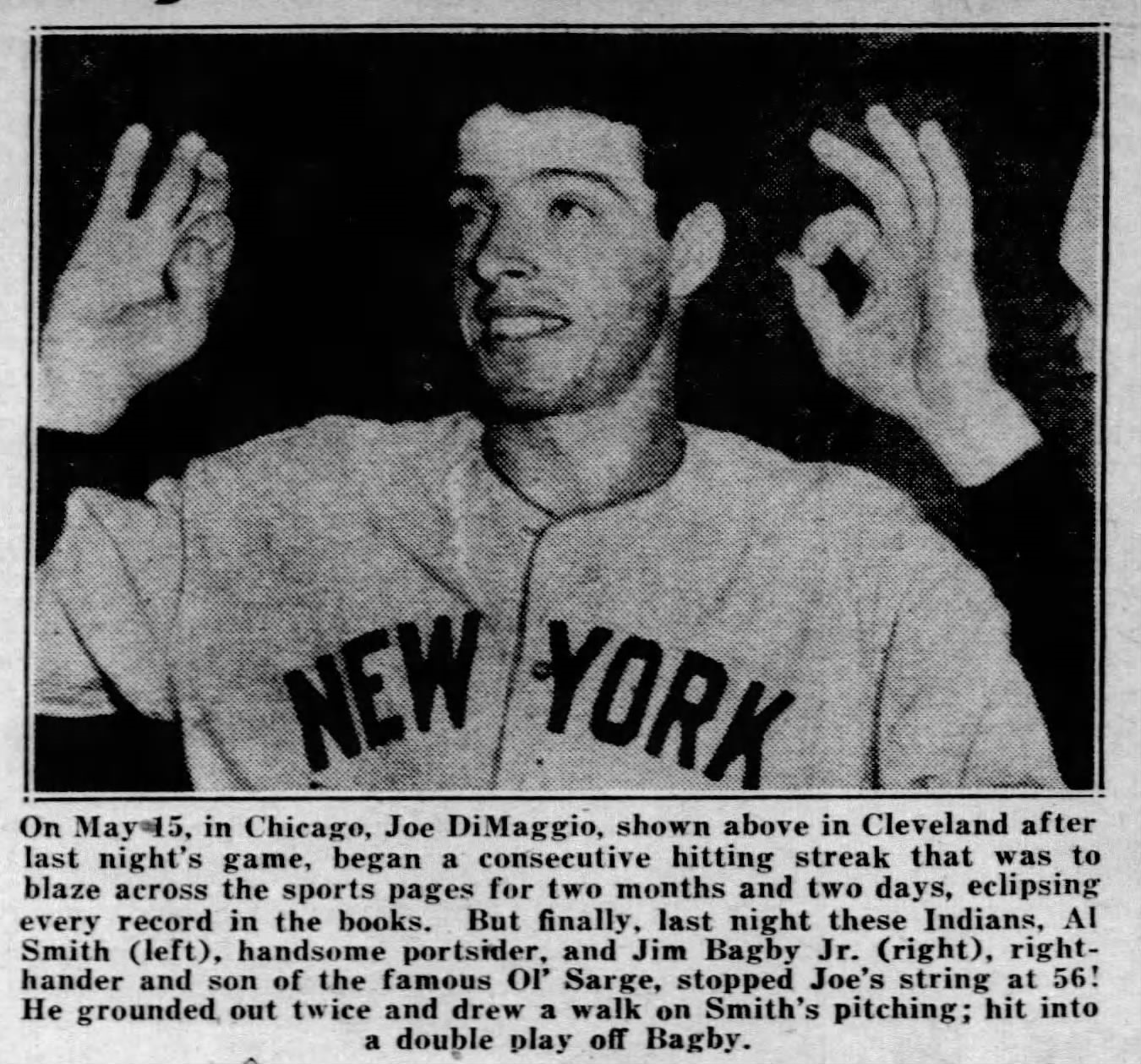

A wave of attention came Williams’ way following his All-Star game’s winning clout and for a brief instant all eyes of the sports world were upon him. From his newfound position at baseball’s center stage, the 22-year-old thumper took the opportunity to tell the world of baseball’s best hitter. “Theodor Williams, soaring through the west again at a .400 clip, modestly salaams to Joe DiMaggio,” wrote NEA sports editor Harry Grayson then adding, “Though he maintained a .405 gait while Joe DiMaggio batted .380 in breaking the all-time record for hitting in consecutive games, Ted Williams considers the Yankee’s Big Boy the best hitter in baseball.” In a lengthy interview, Ted demurely deferred to the “Yankee’s Big Boy.” “I have to tie into a pitch to get power”, Williams told Grayson, “DiMaggio is stronger, he hits the ball in any direction.” Ted then recognized the importance of a hitter to maintain his composure. “I’ve been down on myself” he said through a smile, “but never heard of Joe getting unsettled.”
Looking to the second half of the season, legendary sportswriter Grantland Rice, perpetually, possessive of powerful, profound and prolific prose, offered his view on the Williams and DiMaggio batting duel. “Those looking for further late summer and early autumn excitement,” he wrote “should find what they want in the battle for the batting championship of the American League-between its two best hitters…Williams and DiMag are the two AL standouts, and they still have the better part of three months in which to prove their places in polite baseball society.” Referring to DiMaggio as the “San Francisco entry” Rice noted that his hitting streak had given him “most of the publicity.” He then pointed out that “the gangling kid from San Diego and Boston is still far out in front when it comes to the main [batting] figures. Anyone who can reach the halfway mark over .400, as Williams did,” Rice continued, “knows how to handle ash furniture [a bat]. And even the excellent DiMag will have to keep on swinging his mace [club] effectively to catch or pass the tall, relaxed entry from the Red Sox Reservation.” Rice proved prophetic, for by the end of the streak, the pennant race was virtually over as well and the baseball world turned their eyes to the “relaxed entry from the Red Sox Reservation,” to see if he could in fact capture the holy grail and hit .400.
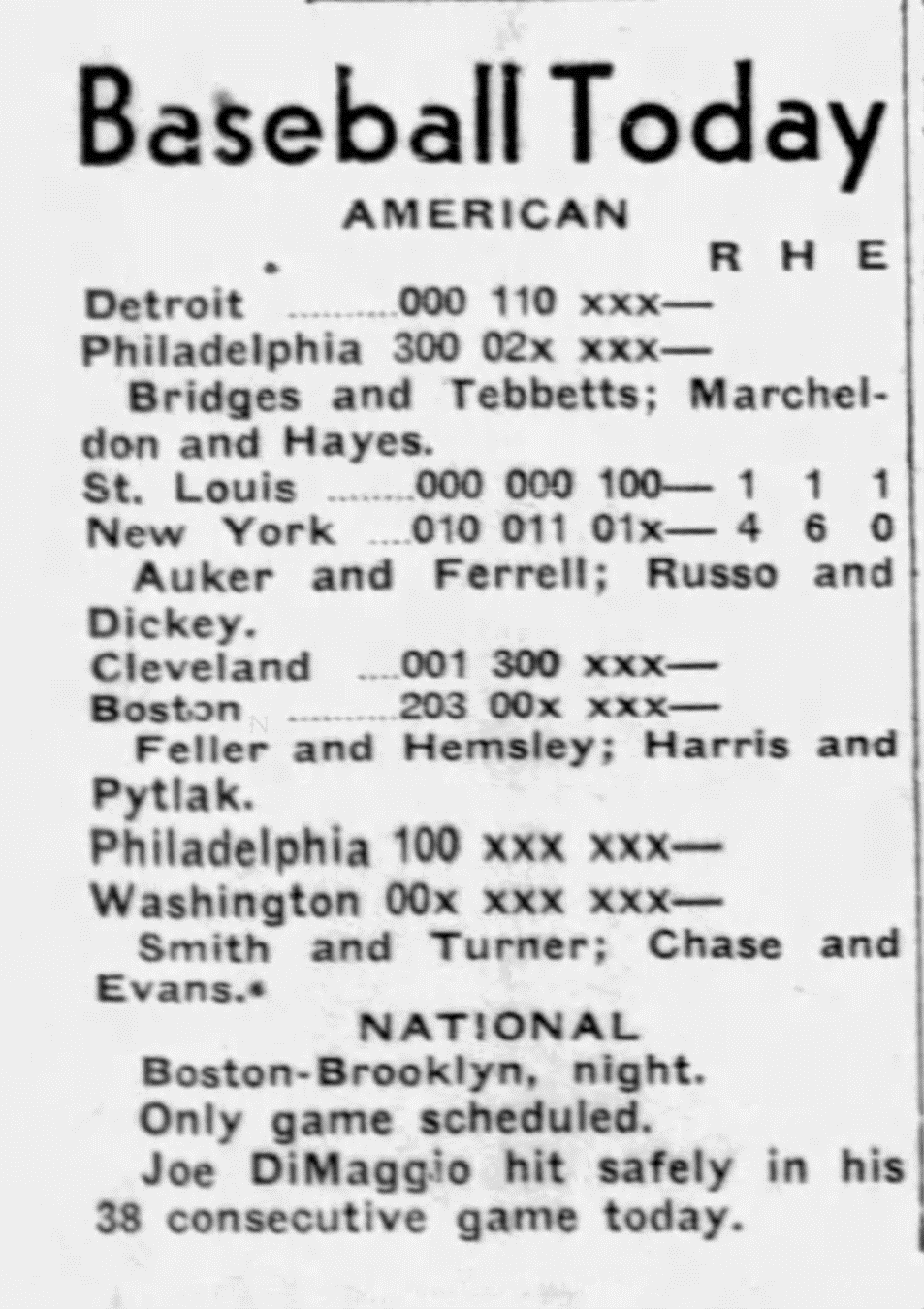
And just as Joe’s streak became a regular piece of reporting baseball scores,

so too, did Ted’s pursuit of .400.
.406
Ted opened the second half of the season on July 11th in Detroit where, after following an 0-4 game he dipped below .400. He remained there for the next two weeks; returning to the .400 club in the fifth inning of a game against the Indians at Fenway Park, pounding a two-run homer into the right field stands tying the game 4-4. The Sox would eventually win the contest and in a sprinkle of serendipity, it was Lefty Grove’s 300th career win. Ted never looked back, hitting a highwater mark of .414 in Chicago on August 21st, but there was high drama ahead.
It was September 14th, and he was hitting .409 going into a double-header with the White Sox at Fenway Park and there were 13 games remaining in the season. He went 2-3 in the first game which moved him to .411. There were now 12 games left and even though Ted hit safely in eight of the next ten games, he entered the last day of the season perilously close to dipping below .400 for the first time since July 24th. In fact, he was sitting at .3996 with a double-header in Philadelphia’s Shibe Park remaining.
Despite the fact that his .3996 would round up to .400, the media nationwide reported that Ted Williams was now below the .400 mark.

New York Daily News
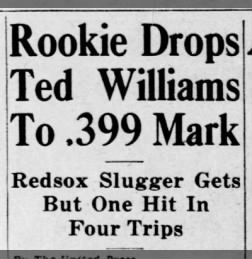
The Pittsburg Press
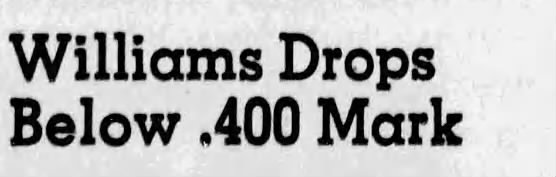
Santa Barbara News

Scottsbluff, Nebraska Star Herald

Springfield MA Daily Republican
The Boston Globe’s Fred Barry wrote that he was…”In his first major slump of the year at the most inopportune time.” This is what his slump looked like. Ten games in which Ted hit safely in eight of them, at a .303 clip, with two homers and seven RBI. His OBP was .452 and his OPS was 1.089. Every big leaguer would love to be mired in such a slump.
Rumors and scuttlebutt abounded about the baseball world that Ted would sit out the weekend in Philly to preserve his quest for .400. And why not, the Red Sox season had been virtually over for weeks. Ted made it very clear that he would not be backing into a .400 season. He’d figured he need five hits on the weekend. “I’m going to be out there taking my cuts”, he said “even if I finish at .360. I think I can turn the trick here at Shibe Park, but if I don’t, I won’t alibi.”
To say he “turned the trick” is an understatement of gargantuan proportions. After going 1-4 on Saturday to dip to .3996, he proceeded to bang out six hits in the season ending double-header to finish the season at .406.

Ted Williams became the first player to hit .400 since NY Giants Bill Terry turned the trick in 1930. And he was the first American League player to accomplish the feat since Detroit’s Harry Heilmann hit .403 in 1923.
JOE’S STREAK…TED’S PURSUIT
How did these two behemoths of baseball measure up head-to-head during this titanic season.
After the first game of Joe’s streak, he was hitting .304 with five homers and 22 RBI. His OBP was .422, SLG% .527 and his OPS .949. Ted was hitting .339 with four home runs and 13 RBI. His OBP was .435, SLG% .593, his OPS was 1.028 and his RPI was .474.
Let’s look at them now in two chunks. First, the streak which ran from May 15 through July 16th.
Joe D hit .408 knocking out 15 homers and knocking in 55 runs. His OBP was .463 and his SLG% a hefty .718 giving him an OPS of 1.181.
Within that same time frame, Ted hit .412 with 12 homers and 49 RBI. His OBP was .540, SLG% .685 for an OPS of 1.224. His RPI was .460.
During “Joe’s Streak”, Ted Williams’ batting average was 1% higher, his OBP 14% higher, and his OPS 4% higher. Joe D outperformed Williams in SLG% by 5% and he did hit three more home runs and had six more RBI.
Perhaps the most incredible part of DiMaggio’s streak is not 56 consecutive games, although that’s pretty damned impressive, but the fact that he followed that up with a 16-game hitting streak! That’s 72 out of 73 games!!!! Good lord! Let’s compare Ted and Joe through that 73-game stretch.
From May 15th through August 2nd, Joe D’s average was the same .408 with 20 homers and 73 RBI. His OBP was .471, SLG%, .738 for an OPS of 1.209.
Ted hit at a .431 clip with 17 homers and 61 RBI. His OBP was .559 and his SLG% was .744 for an OPS of 1.303.
Through this 73-game stretch Ted out hit Joe D by 5%. His OBP was 16% higher, SLG% virtually even with Ted edging him by less than 1%. His OPS was 7% higher and RPI. Joe D had 15% more homers and 16% more RBI.
Let’s look at the totality of the 1941 season. Joe D hit .357 with 30 homers and 125 RBI. His OBP was .440, SLG% .643 and his OPS 1.083. His OPS+ was 185, and his WAR was 9.3.
Teddy Ballgame hit .406 with 37 homers and 120 RBI. His OBP was .553, SLG% .735 and his OPS was 1.287. His OPS+ was 235, and his WAR, 10.4. Ted led the league in batting average, home runs, walks, intentional walks, OBP, SLG%, OPS, OPS+ and WAR.
Ted’s OPS of 1.287 and OPS+ of 235 were the highest in all of baseball since Babe Ruth’s 1.389 and 239 in 1923. His .406 batting average was the highest in baseball since Rogers Hornsby hit .424 in 1924. His .553 OBP set a new record for all of baseball dating back to 1876 and has only been surpassed once since then. It still remains an American League record!
THE 1941 AMERICAN LEAGUE MVP
If you are under the age of 45, you will look at these stats and, in all likelihood, conclude that Ted Williams was the 1941 American League MVP. Hands down. But as the Wizard said to the Cowardly Lion, “Not so fast, not so fast”.
Joe DiMaggio entered his sixth season in 1941 widely regarded as the best player in baseball. He already had one MVP Award under his belt (1939), was runner-up in 1937, third in 1940 and was eighth and sixth respectively in 1936 and 1938. He was a five time All Star and four-time World Champion. In his sophomore season he led the league in runs scored, home runs, and SLG% and he was the back-to-back batting champ in 1939 and 1940. His .381 mark in 1939 was eight hits short of hitting .400 himself. He was the Yankee heir of Ruth and Gehrig and the face of Major League Baseball.
Ted, on the other hand, was a gangly, awkward 22-year-old kid from San Diego California. A very highly touted kid who in his years in the Pacific Coast League was consistently proclaimed “the next Joe DiMaggio.” He was brash, he was bold, he was unpolished, he was opinionated, he was honest, and he was unfiltered.
Twenty-four writers voted for the MVP Award, three from each major league city and in mid-November the winner was revealed.

In one of the closest balloting to take place since it began in 1923, “Baseball’s Mr. Big” copped the award. He received 15 votes for first gathering 291 points while Ted had eight votes for the top spot finishing with a total of 254 points.
Both men were exceedingly gracious. In LA for a radio appearance with Bing Crosby, Joe told the Pasadena Post, “Boy, was I happy to get the honor, but…I wouldn’t have been disappointed if it had gone to Ted Williams…He certainly had a sensational season for himself.” Hugh Fullerton wrote, “Ted Williams tells friends that he doesn’t blame the sportswriters for picking Joe DiMaggio…because he did a man-sized job.” He then added, “I will make em pick me next season.” “Next season”, Williams won the Triple Crown, and again finished second.
Chic Feldman from the Scranton Pennsylvania Tribune provides great insight into the view held by the vast majority of the voting writers at the time. “…By playing an important role in the winning of a pennant an athlete performs the greatest service to his club. Joe…qualified via this medium.” This prevailing school of thought is borne out by the fact that of the 22 MVPs from 1931 through 1941, 68% came from pennant winners.
The 1941 season forged a bond between these two icons that has only intensified solidified and strengthened through the ages. Eighty-three summers have come and gone and Giuseppe Paulo DiMaggio and Theordore Samuel Williams still stand among the Goliaths of the game.

Joe DiMaggio wore the number 9 in his rookie year. The following year he was issued the number 5, a clear indication that he was crowned the successor to Babe Ruth (#3) and Lou Gehrig (#4). Is it serendipity or fate that these two pillars of the game, wore the same number?
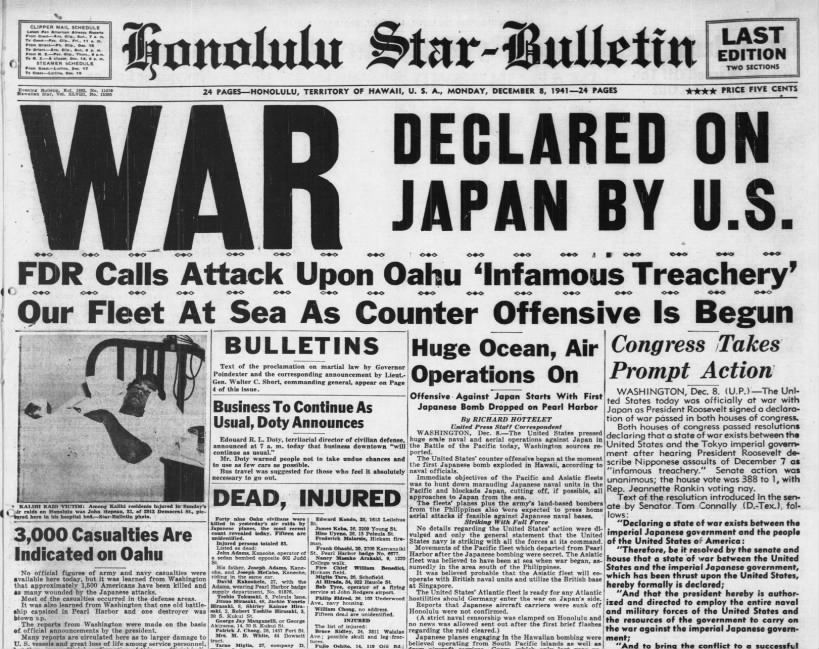
Twenty-five days after Joe DiMaggio was named the American League MVP, Japan bombed Pearl Harbor. The worst of times had begun.
And so it is at this time in baseball… the All-Star break, 2024.

 fenwaypark100
I heard that the triple crown year for Williams a writer from Boston gave him no vote at all, an obvious personal sin. Triple crown should get an mvp automatically.
Excuse my ignorance as I am new and dont know how to initiate a new comment. As an old Indians fan from the 50’s, I want to point out that the tribe has the record for most consecutive wins, 2016 I think. I suggest one fact that will never be beaten–in one of the tribe’s dominant years of 95–97, the fans bought 100% of the home game tickets before the season opener. During the 1948 pennant year, the fans set an attendance record that lasted until the Dodgers went to L.A. Remarkably, the number was more than twice the local population, something no other city has done, I think.
The Indians won 22 straight in 2017 which is an American League record. The NY Giants won 26 straight in 1916 for the National league and MLB record. From June 12, 1995, through April 4, 2004, the Indians sold out 455 consecutive games. (A record at the time.) The Red Sox broke that record on their way to 820 consecutive shutouts from May 15, 2003, until April 10, 2013. You are correct about the 1948 Indians who drew 2,620,627 fans in their World Championship season of 1948, a record which they held until the Dodgers drew 2,755,184 in 1962. Cleveland’s population in 1948 was 914,000!! I appreciate you reading and I will look into Mathewson’s numbers. Thanks!