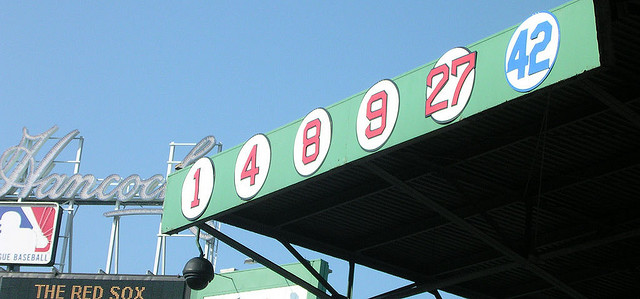
” I always looked up there, because I remember a time when the only things on the walls in Fenway were the Jimmy Fund sign and the retired numbers. Never in a million years did you think you’d ever be up there with those guys.” Carlton Fisk

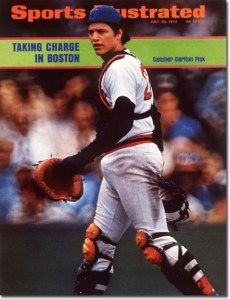
He was born in Bellows Falls Vermont, raised in Charlestown New Hampshire, went to UNH and as a kid dreamed of playing for the Boston Celtics. A New Englander through and through, the Boston Red Sox, in 1967, made him their number one draft pick (4th overall) and in 1969 he made his major league debut. Not quite yet ready, it would be the September call up of 1971 before he returned to Fenway Park but when the team broke north for the 1972 season, they did so with Carlton Ernest “Pudge” Fisk in tow.

The year 1972  saw the first ever players strike which delayed the start of the season until mid April. At the season’s inception, Carlton Fisk was the Red Sox number three catcher but by the time the summer winds blew at Fenway, “Pudge” Fisk and his number 27 were entrenched behind home plate.

He was an instant hit, because he could hit. A pull hitter with power with a swing made for Fenway, he was a stalwart behind the plate with a canon for an arm. The old timers said he was the best catcher the Red Sox had seen since “Birdie” Tebbetts crouched behind the plate during the 1946 pennant winning campaign.

Tough, hard-nosed and honest, he called out veteran Reggie Smith and superstar Carl Yastrzemski in August of his rookie year for not providing leadership in the clubhouse. “We are a young team and we look to them” he said in the midst of the 1972 pennant race and both responded with torrid Septembers. The Red Sox took the race to the last weekend of the season before succumbing to the Tigers. He was 24, he could catch, he could throw, he could hit and he could lead. And when the year ended, and the pundits and writers cast their votes for the seasons best; Carlton Fisk won the Gold Glove for American League catchers, and became the first unanimous selection for the honor of Rookie of the Year.

And so it was, this week in Fenway Park history, November, 1972…..

An All Time Fenway Favorite……

Posted in Fenway Park Baseball | Tagged , , , | Leave a comment

“Reasons, there are no reasons, why some of us live and why some of us don’t” William Forrester

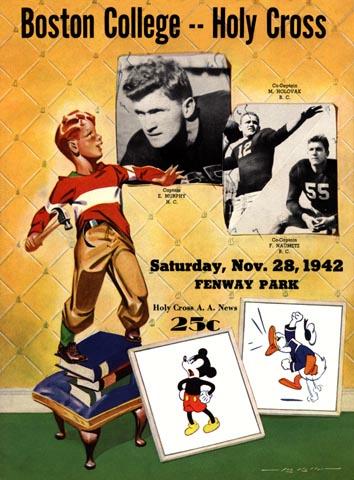
The Boston College football team (begun in 1892) played its first game at Fenway Park in 1914 and in fact played their home games at Fenway for 13 different seasons, the first in 1928, the last being 1953-1956. Just like Boston University, they too found Fenway to their liking, going 56-16-1 in the 13 seasons they called Fenway Park home. In the other 10 seasons when they played at least a game at Fenway, they enjoyed success as well, going 11-5-3. Their overall mark of 67-21-4 is an indicator of just how much the Eagles liked keeping their nest at Fenway. In the days when they played their home games in other venues, they often played their traditional rivalry game with Holy Cross at Fenway Park; simply because it was big enough to hold the crowd which often broached 40,000. In 1940, 41 and 42 Boston College was a national power and in that stretch they were an astounding 20-2 at Fenway Park. One of those losses came at the hands of their rival Holy Cross.

It was November 28, 1942 when the the Eagles took the field at Fenway. Undefeated and ranked number one in the nation, they were a three touchdown favorite to beat the Crusaders and claim their first National Championship. Led by their All American fullback Mike Holovak (who would coach the Boston Patriots from 1963-69) the Eagles were so sure of victory they booked the popular Boston nightclub, the Cocoanut Grove for their Saturday night championship celebration.  Holy Cross, however, had other ideas and not only did they beat the Eagles, they trounced them 55-12; canceling the season and the victory party. As the would be champions left Fenway Park on that cold November afternoon, mired as they were in disappointment, they could not have known just how much they had won. For that night, the Cocoanut Grove burned to the ground and nearly 500 people lost their lives in what remains today, the second largest nightclub fire in the history of the United States.

 A fateful day…..

A hellish night…..   

http://www.boston.com/news/daily/21/archives_cocoanut_112792.htm

Posted in Fenway Park and Football, Fenway Park Baseball | Tagged , , , , | Leave a comment

“The finest prospect I have ever seen.” Notre Dame Head Coach Frank Leahy on Harry Agganis

The Terriors of Boston University played their home games at Fenway Park for four seasons, (1949-1952). They found the confines of Fenway Park very friendly as in those four seasons they compiled a record of 14-7-1 in games played there. The newly formed team was in only their fifth season when they moved into Fenway and the success of the team coincided with, not only the move to Fenway, but the arrival of one Aristotle George (Harry) Agganis.

As a sophomore in 1949, Agganis set a school record throwing 15 touchdown passes, intercepted 15 passes, led the nation with a 46.5 punting average and was named the second team All American quarterback behind Kentucky’s Babe Parilli (see Thanksgiving post). On November 1, 1949, over 40,000 fans jammed Fenway Park to witness Agganis lead the Terriors against the University of Maryland. The game was broadcast nationally on CBS radio with a young voice by the name of Vince Scully making his national broadcast debut. Maryland squeaked out a 14-13 win and Scully went on to broadcasting immortality. He remains the voice of the Los Angeles Dodgers, a position he has held since 1950.

The Cleveland Browns made Agganis the 12th overall pick in the 1952 NFL draft, hoping he would replace Otto Graham. He opted for baseball however becoming the Red Sox regular first baseman in 1954. The Terriors floundered following the departure of Harry Agganis and though the football program showed flashes of brilliance on occasion they never returned to the glory days of Fenway Park and Harry, “The Golden Greek” Agganis and disbanded following the 1997 season.

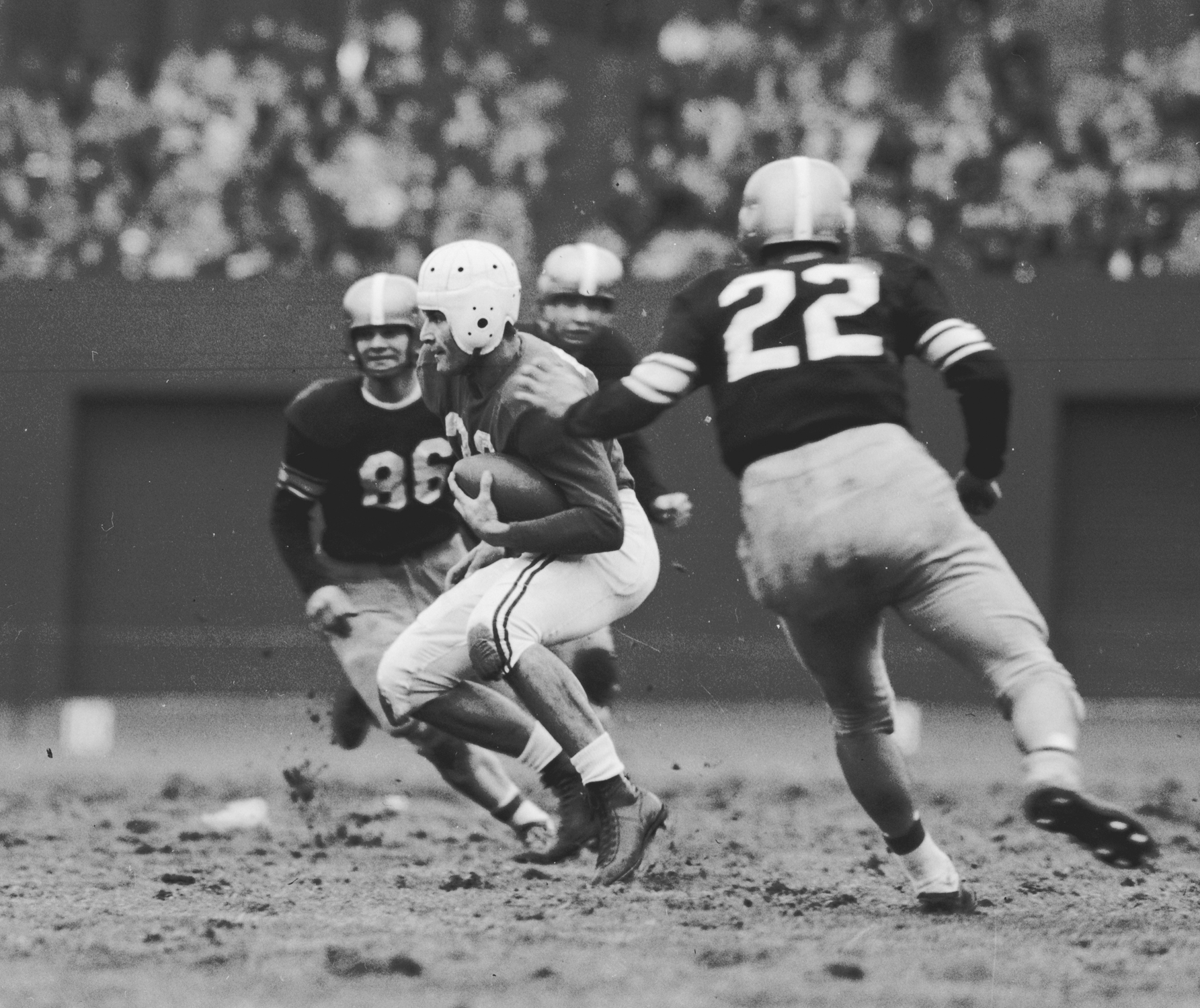
 A relic from the golden days of Boston University football.

“The Golden Greek” carries at Fenway.              

Posted in Fenway Park and Football | Tagged , , , , , , | 3 Comments

“We love Fenway Park because we love antiques, be they rocking chairs or ballparks. But we love it even more because the eccentricities of the place mirror our own. It is, like us, difficult and cranky. And this makes it a mighty hard place for a player to play in. Too bad. Players come and go, but Fenway Park may become an American Pyramid.” Clark Booth

HAPPY THANKSGIVING…..

Thanksgiving means football and one might ask what does football have to do with Fenway Park. Well, quite a lot actually! No less than five different professional football teams called Fenway Park their home; not to mention both Boston College and Boston University as well. In fact the Washington Redskins used Fenway Park as their home field from 1933-1937. Originally known as the Boston Braves, they played their first year at Braves Field before moving to Fenway to become the Boston Redskins. They departed for the nations capital in 1938 where they have thrived.

Fenway Park’s first Thanskgiving in 1912 saw her play host to the 25th anniversary Thanksgiving game between Boston Latin and Boston English High Schools. It was the first sporting event, other than Red Sox baseball to be played at Fenway Park. This Thanksgiving rivalry has been played since 1887 and when they take the field today they do so as the oldest High School football rivalry in the country. An interesting Fenway fact is that High School football is the second most played sport in the 100 year history of Fenway Park, behind only Red Sox baseball.

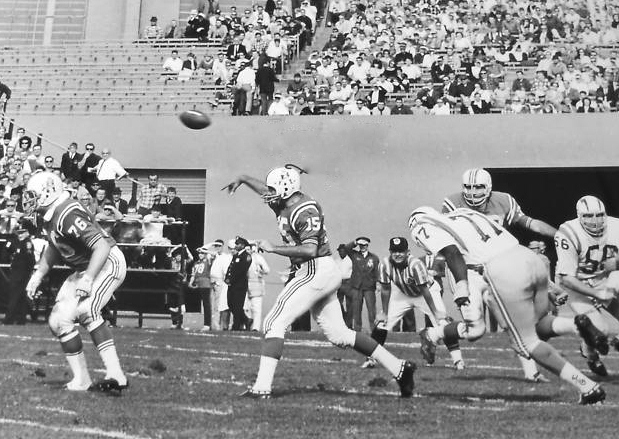
  Boston Patriots quarterback Babe Parilli fires a pass downfield in a game against the San Diego Chargers played at Fenway Park in 1968, the last year football was played at Fenway Park.


Posted in Fenway Park and Football | Tagged , , , | Leave a comment

“As I grew up, I knew that as a building (Fenway Park) was on the level of Mount Olympus, the Pyramid at Giza, the nation’s capitol, the czar’s Winter Palace, and the Louvre — except, of course, that it is better than all those inconsequential places.” Bart Giamatti

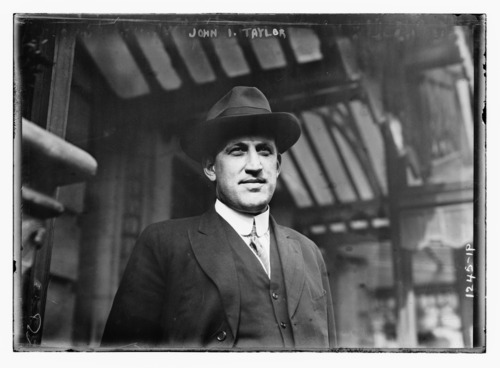
The ground was broken for Fenway Park on September 25, 1911 just days after John I Taylor sold his share of the Red Sox to James McAleer. Taylor stayed on however to oversee the construction of his new ballpark. Through the fall and into the winter construction took place. In fact it started before any permits were issued by the city of Boston to do so.
Taylor hired the Charles Logue Building Company for the construction of the park, James McLaughlin was the chief architect and the Osborne engineering firm of Cleveland was responsible for all the engineering services.
All names and faces lost in the pages of history never knowing that the impact of their endeavor would reverberate down through the ages for generations.

The Dreamer…..John I Taylor

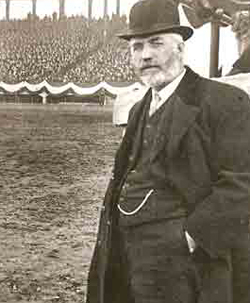
The Builder…..Charles Logue  

Posted in Fenway Park Baseball | Tagged , , , | Leave a comment

“It [baseball] will take our people out-of-doors, fill them with oxygen, give them a larger physical stoicism. Tend to relieve us from being a nervous, dyspeptic set. Repair these losses, and be a blessing to us.” Walt Whitman

The 2012 baseball season will mark the 100th birthday of Fenway Park. When Fenway Park opened there was no federal income tax, the first radio station was 12 years away, the world had never known a world war, Babe Ruth was a 17 year old living in St. Mary’s Industrial School for Boys and major league baseball was still one year away from its first $10,000 a year player. In 1912 Julia Child, Sam Snead and “Birdie” Tebbetts were born and Bram Stoker and Clara Barton died.

This blog will follow the progress of Fenway’s opening season as the 100th anniversary 2012 season unfolds. It will look at the players, the plays and the events of 1912 and while doing so will keep abreast of the historic season which 2012 promises to be. And interspersed throughout will be tales of Fenway Park and the Red Sox glorious history.

   A blueprint for the development of the land in the Fens section of the city purchased by Red Sox owner John I. Taylor to build a new ball park for the Boston Red Sox.

Posted in Fenway Park Baseball | Tagged , | Leave a comment