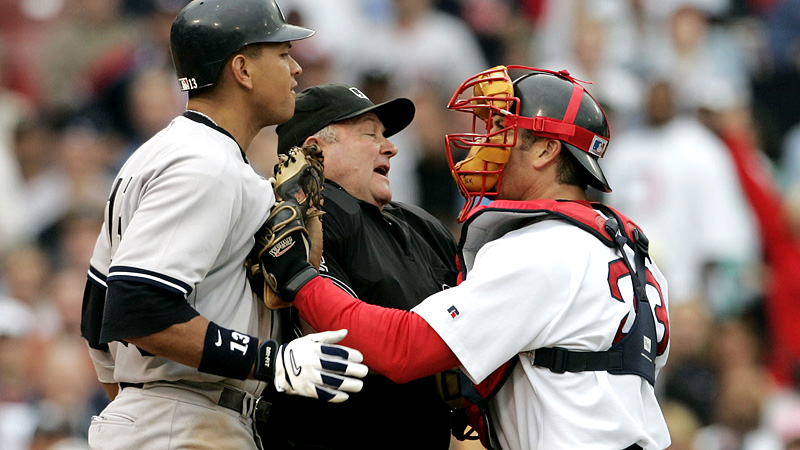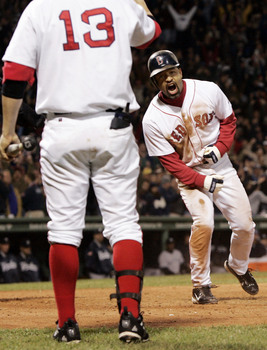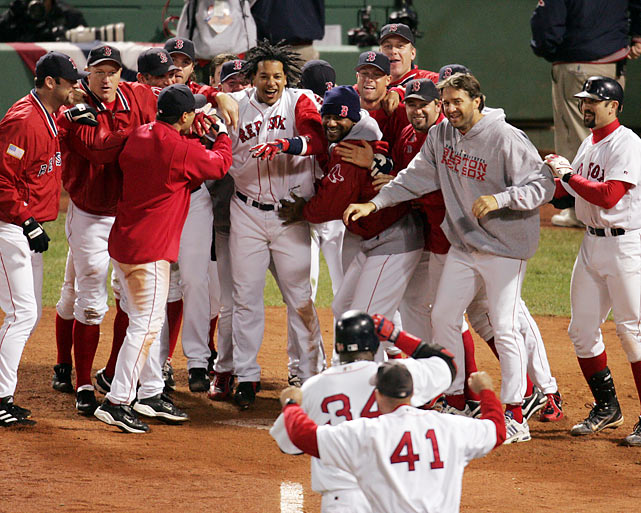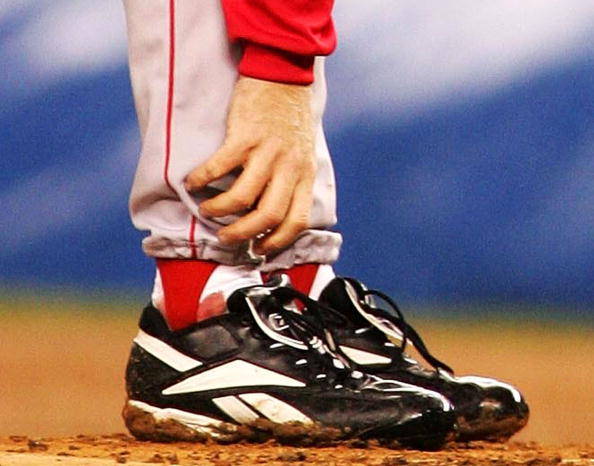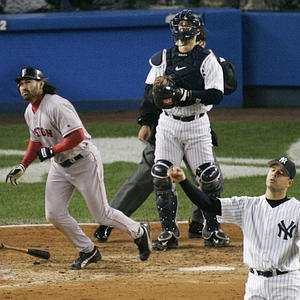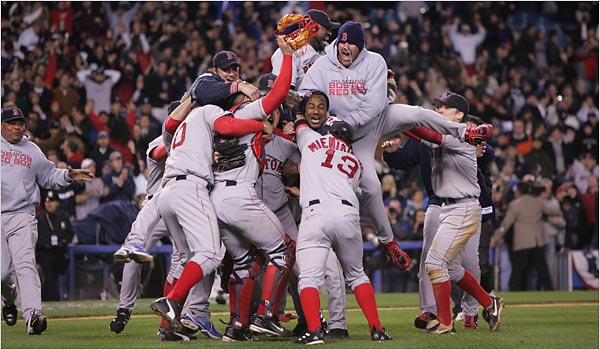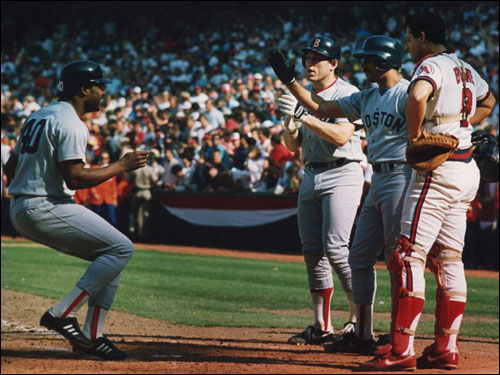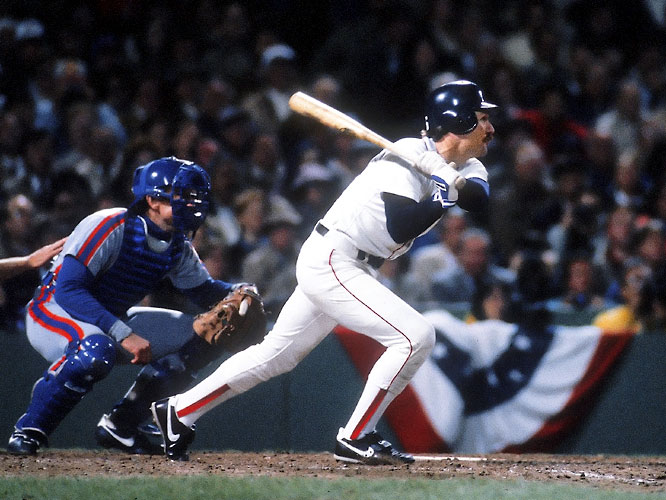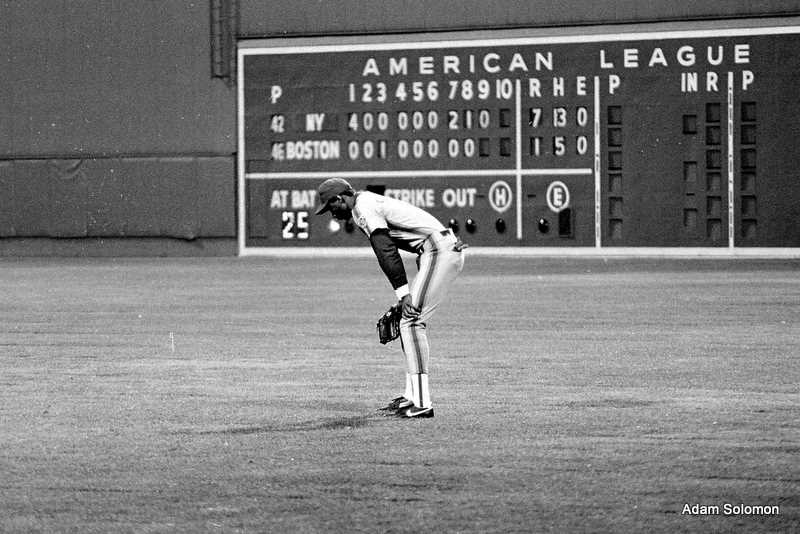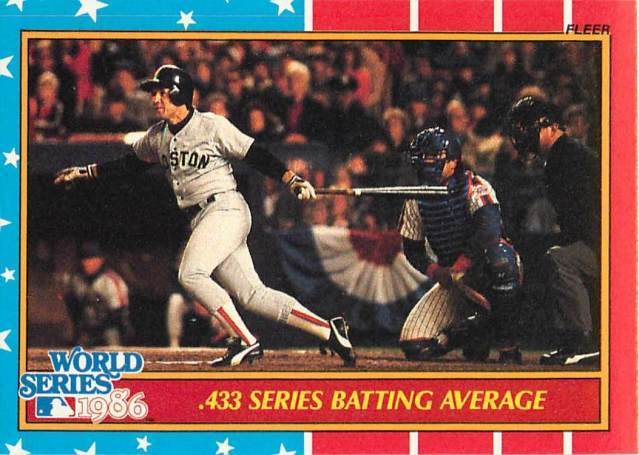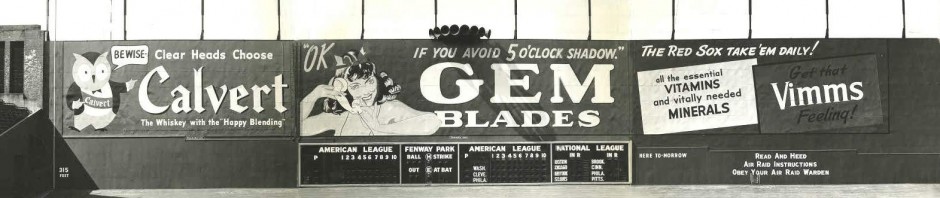
“What goes around comes around, I just didn’t realize it comes around that fast.” Marty Barrett Red Sox Second Baseman 1986

There are catch phrases, buzz phrases, and words that are meaningful to Red Sox fans. They invoke all sorts of emotion and angst. For example, Game Six, “67“, “04″ bring smiles and warmth. But there are others that bring well, let’s just say not warmth. The top of that list is simple, just say the word, eighty-six!

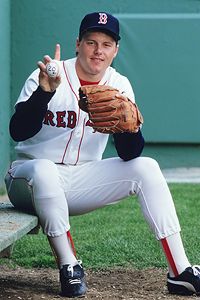
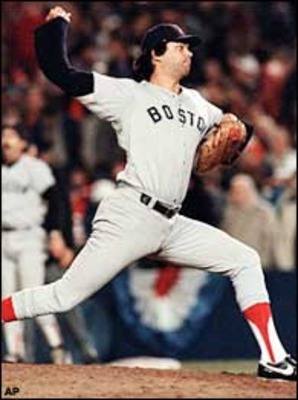
There is no reason to talk about the season. Safe to say that, led by the emergence of this man as the premier pitcher in the American League, the Red Sox won the AL East.

Roger Clemens won the 1986 American League Cy Young Award and MVP.

Clemens went 24-4 and along the way became the first player in baseball history to strikeout 20 batters in a nine inning game.

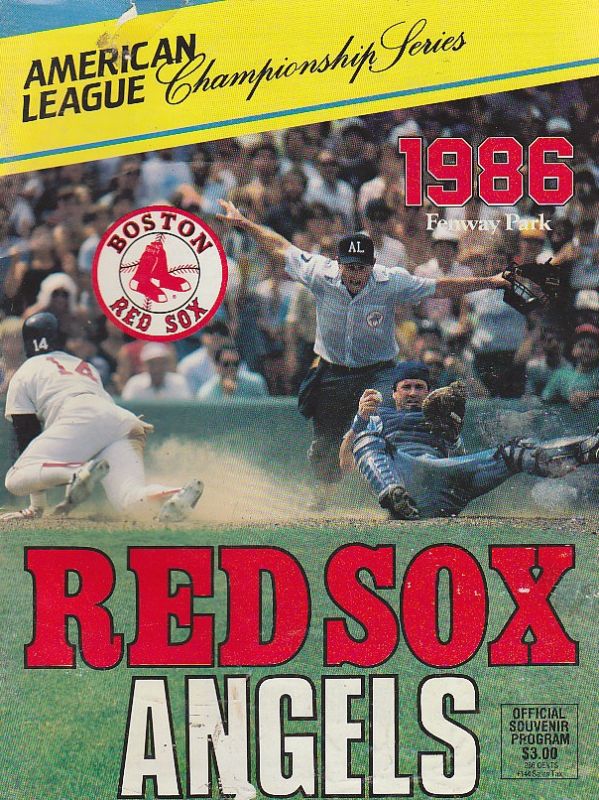
Winning the East pitted the Sox against the California Angels for the American League pennant and that’s where the fun began! Well, wait a minute, the first four games were not exactly a whole lot of fun for the Fenway Faithful. You see in game four in Anaheim, our beloved BoSox had entered the ninth inning ahead 3-0 and were one out away from tieing the series and then, well they didn’t. Instead they went down three games to one. Then came game five and there, there is where the fun started.

It was the top of the ninth inning, one out, Angels ahead 5-2, Bill Buckner on first and DH Don Baylor up. Baylor launched a home run to bring Boston to within a run.

And then….Two batters later with two outs, a man on first and the Sox still down a run, Dave “Hendu” Henderson stepped to the plate.

And his two run homer put the Red Sox ahead 6-5. The Angels tied the game in their half of the ninth but eventually succumbed in the eleventh. The series shifted back to Fenway Park where the Red Sox trounced them 10-4 and 8-1 to win the American League pennant. It was on to the World Series and the New York Mets.

The New York Mets won 108 games in 1986 and they were heavily favored to win the Series. However, the Fenway Faithful were buoyed when Bruce Hurst won game one of the Series in New York 1-0.

Bruce Hurst was 2-0 in the 1986 World Series. 

And when the bats of Wade Boggs, Jim Rice, Dwight Evans and Dave Henderson pummeled  Dwight Gooden for a 9-3 victory in game two, the Fenway Faithful began to sense that their 68 year wait for a World Series Championship, may soon be over.

 Wade Boggs had nine hits and hit .290 in the 1986 World Series.

They had no way of knowing what the baseball gods had in store for them. They had no way of knowing that in one weeks time they would endure the most excruciatingly painful loss in the history of the franchise!

The Mets won games three and four at Fenway Park but behind Bruce Hurst again, the Red Sox prevailed in game five and they headed to Shea Stadium needing just one more win. Then came the 1986 version of Game Six!

Often forgotten in the anguish of the 1986 World Series is Marty Barrett’s recording tying 13 hit performance.

The game was tied in the top of the tenth inning when Dave Henderson struck again. He led off the frame with yet another clutch home run to give the Red Sox the lead. Before the inning ended, Marty Barrett had an RBI single and the Boston Red Sox had a two run lead. They were three outs away from a World Championship and the Fenway Faithful were three outs away from release from sixty-eight years of anguish!

Calvin Schiraldi

Red Sox reliever Calvin Schiraldi got the first two Mets out in the tenth and the Red Sox were now but one out away from the joy which had eluded them and their “Faithful” for 68 years. The scoreboard at Shea Stadium flashed a congratulatory message to the Boston Red Sox 1986 World Champions and also to Red Sox pitcher Bruce Hurst who had been named the Series MVP.

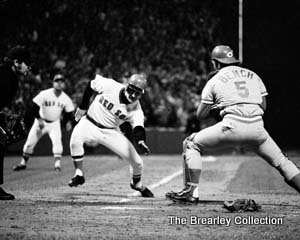
But then…..Three singles and a wild pitch later, the score was tied. The Mets had a man on second base and Mookie Wilson stepped in and hit a dribbler toward first base and Bill Buckner.

The ball bounded past Bill Buckner and into history while Ray Knight raced around from second giving the Mets an astonishing come from behind win which tied the Series. The following night the Mets completed their inexplicable comeback but every member of the Fenway Faithful who lived this will tell you the 1986 World Series eluded the Red Sox when that baseball eluded Buckner.

The New York Mets cashed $86,254.00 World Series checks that fall, the largest in history! The record purse of $74,985.65 each that went to the Boston Red Sox could, in no way, assuage the pain, the anguish, the torment of the World Series loss which gave birth to “the Curse”.

               And so it was at this time in Fenway Park history, October 1986,

                                                               World  Series time.

Posted in Fenway Park Baseball | Tagged , , , , , , , , , , , | Leave a comment

” We won that World Series three games to four.” Carlton Fisk

After the Red Sox won the 1918 World Series, the Fenway Faithful waited 28 years before hoisting another American League pennant. After the 1946 AL Champs raised their flag it was another 21 years before they got to do it again. They came close in 1972, collapsed in 1974 but in the midst of that collapse, these two kids arrived from Pawtucket.

Fred Lynn hit .419 in just 22 September games and Jim Rice showed power that despite the disappointment of the collapse, had the Fenway Faithful excited as they couldn’t “wait till next year.” Spring training 1975 brought with it, hope!

These two rookies joined a team which included, Carlton Fisk behind the plate, Rick Burleson “the Rooster” at short, Rico Petrocelli, the 1967 shortstop, had moved over to third, the ageless wonder “Yaz” had moved to first base, a 23-year-old Dwight Evans was in right and Denny Doyle who was acquired from the Angels in June, took over at second base. The “Goldust Twins” of Lynn and Rice were in center and left respectively and they comprised a rookie tandem, the likes of which Fenway Park had never seen.

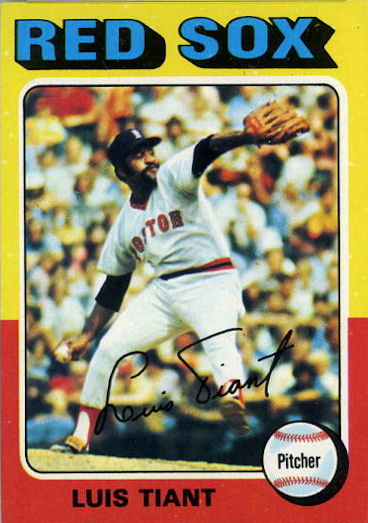
The pitching staff was anchored by Luis Tiant who just two years earlier had been written off but was a 20 game winner in 1973 and 74. The rotation included Bill Lee, Rick Wise and Reggie Cleveland with Dick Pole and Rogilio Moret splitting duties as the fifth starter.

The closer was Dick Drago who had eight saves the last month of the seasons and saved two of the three wins in the AL Championship series.

On June 29th the Red Sox beat the Yankees and Jim “Catfish” Hunter in a come from behind 3-2 win that put them in first place by a half game. They never again trailed and when they reeled off 10 straight wins in early July, they stretched the lead to 6 1/2 games.

They clinched the AL East with four games to go and then swept the three-time defending champion Oakland A’s in the ALCS setting the stage for what still is often referred to as the greatest World Series in baseball history, the Boston Red Sox versus Cincinnati’s Big Red Machine.

The 1975 World Series for the ages opened up at Fenway Park. It was a 0-0 game in the bottom half of the seventh inning with Luis Tiant and Don Gullett locked in the scoreless duel. Tiant and Boston prevailed 6-0 with Luis not only hurling the shutout but singling and scoring the games first run.

The next three games were decided by one run and when the Reds took game five 6-2 at Riverfront Stadium the Red Sox were on the brink of elimination. The Series shifted to Fenway Park for what Red Sox fans now simply refer to as Game Six! 

It opened with a three run homer by Fred Lynn in the first inning.

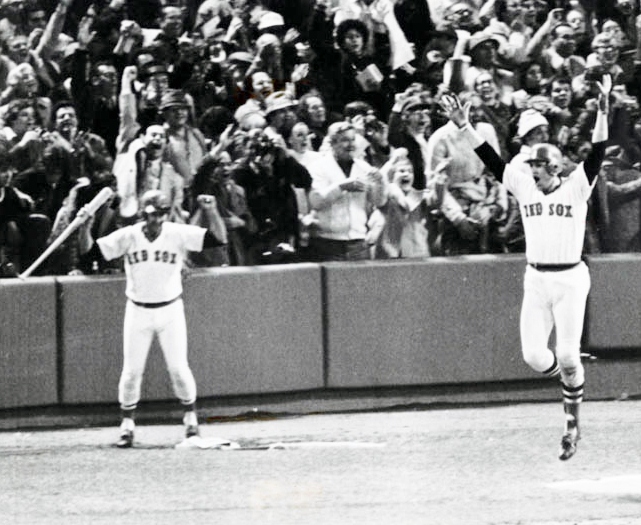
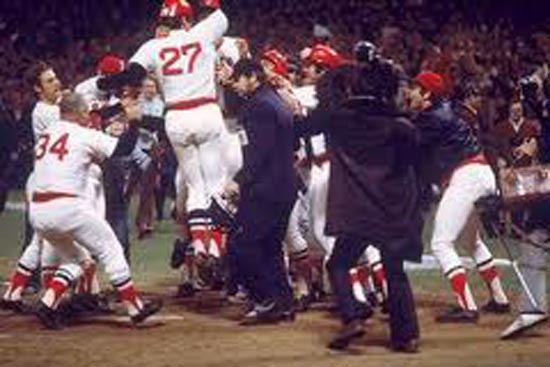
It ended with Carlton Fisk hitting the foul pole to win it in the bottom of the twelfth, 7-6 and tie the Series.

And in between there was,

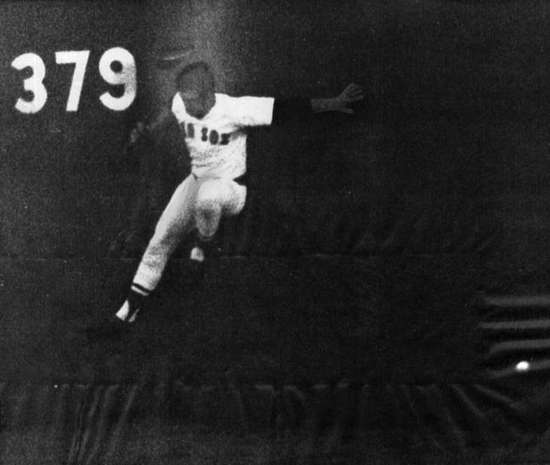
Fred Lynn in a heap at the base of the wall in the fifth inning following his attempt to catch Ken Griffey’s (Daddy) triple. It was this near disaster which led to padding on the outfield wall.

 Bernie Carbo’s pinch hit three run homer with two outs in the bottom of the eighth to tie the game 6-6.

Denny Doyle being thrown out at home by George Foster in the bottom of the tenth with what would have been the winning run.

Dwight Evans catch robbing Joe Morgan of a home run in the top of the eleventh inning and then…..

JUBILATION!

The Reds won the following night and were crowned World Champs. Five of the seven games in the Series were decided by one run and the 1975 World Series restored baseball to its rightful position as America’s Pastime. The winner’s share was $19,060.45 while the Red Sox pocketed $13,325.86 each. Last year the MLB Network called Game Six the Greatest Game Ever Played, take five minutes and tip toe back thirty-seven years and have fun!              http://www.youtube.com/watch?v=QmRC3RwZNmU

A month later, Fred Lynn became the first player in major league history to be named Rookie of the Year and MVP in the same season.

    And so it was at this time in Fenway Park history, 1975, World Series time.

Posted in Fenway Park Baseball | Tagged , , , , , , , , , , , , | Leave a comment

” To dream the impossible dream …..To fight the unbeatable foe….. To bear with unbearable sorrow…..To go where the brave dare not go.” Joe Darion

Just as his moment in the 1946 World Series defined the career of Enos “Country” Slaughter, the 1967 baseball season redefined the franchise of the Boston Red Sox!

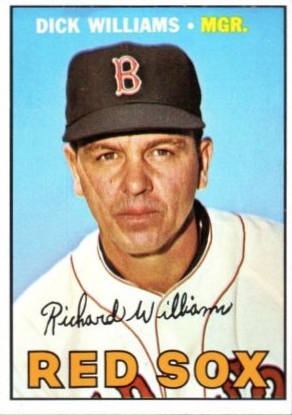
 They had been mired in mediocrity, check that, they were abysmal. They had not had a winning season since they were 79-75 in 1958. They had hit the 1,000,000 mark in attendance only once in a decade and they had lost 90 games in 1964, 100 games in 1965 and finished in ninth place in 1966. Fenway Park was turning into a mausoleum as the 1966 edition of the Red Sox drew 16 crowds of less than 3,000 people and one game they actually had 485 people! However, late in 1966, a glimmer of hope showed in the performance of some young players. Then in the winter, they hired this man to manage the team.

” I promise we’ll have a hustling ball club” he told the press and the Fenway Faithful and “they won’t quit…..I don’t intend to have anybody quit on me here.” And then he added, “We’ll win more than we’ll lose.” A bold and brash statement about a team that in the previous three years had a combined record of 198-272 and had finished in 8th, 9th and 9th place. Most members of the media and most members of the Fenway Faithful thought he was nuts!

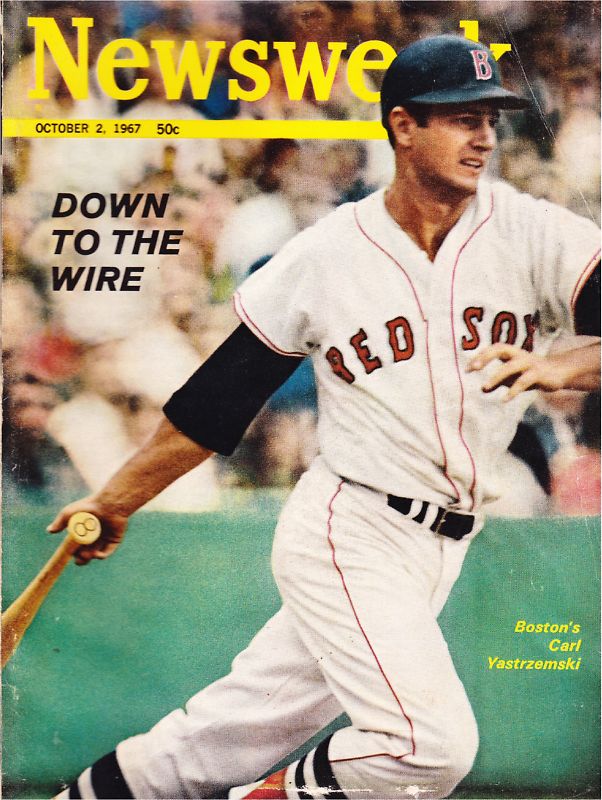
 The transformation on the field was led by this man, MVP Carl Michael Yastrzemski, the man called simply “Yaz”! It is hard to describe his performance in 1967. The numbers tell part of the story, a .326 average with 44 home runs and 121 RBI. Good enough for the Triple Crown, the last seen by major league baseball. His Hall of Fame manager, Dick Williams went to his grave saying that Carl Yastrzemski in 1967 was the best player he ever saw! There are still many who saw him and/or played with him that season that say the same thing.

His supporting cast was not bad either.

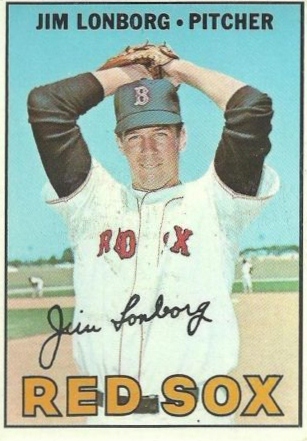
Jim Lonborg emerged as one of the best pitchers in baseball going 22-9 and winning the American League Cy Young Award!

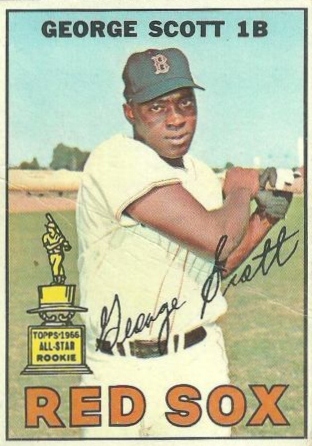
George “Boomer” Scott  played Gold Glove first base with the grace of a deer and he endeared himself to the Fenway Faithful naming home runs “taters” hitting 19 of them and batting .303.

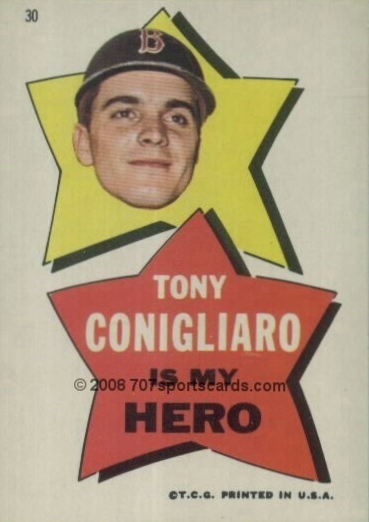
Tony Conigliaro, (see posts Jan 7-13 2012)  blossomed into an All Star before being beaned in August,

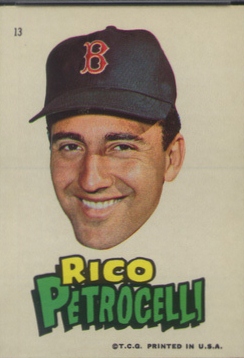
and shortstop Rico Petrocelli did as well.

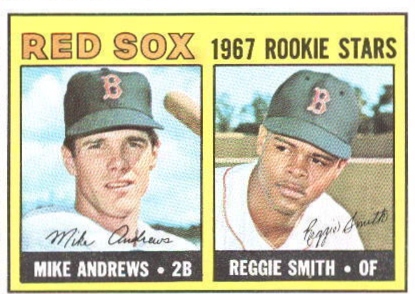
Two rookies emerged with contributions which far exceeded expectations, Mike Andrews at second base and switch-hitting Reggie Smith in centerfield.

The front office made four very significant acquisitions during the season which were invaluable:

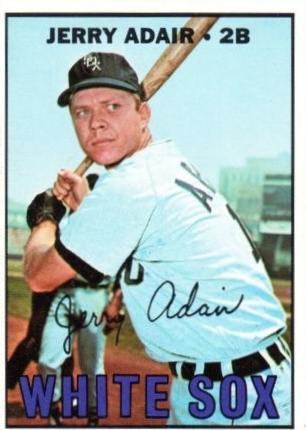
Adair provided veteran stability and leadership to a young infield.

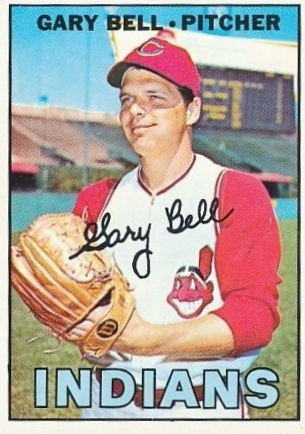
Gary “Ding Dong” Bell went 12-8 after joining the Red Sox in June. 

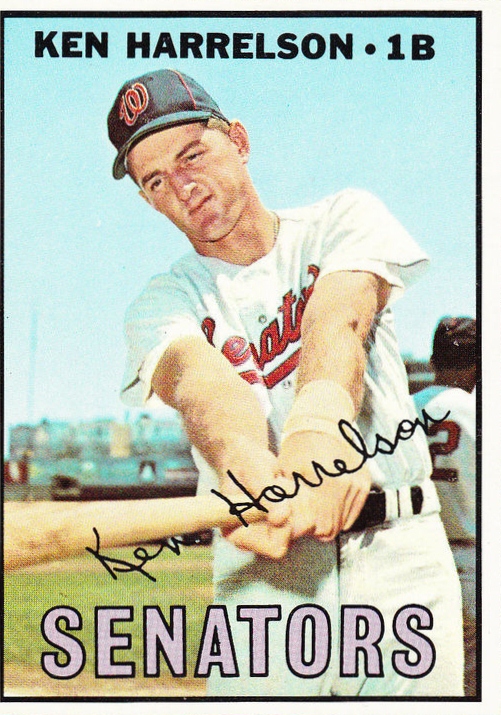
“The Hawk” provided some power when Tony C went down. 

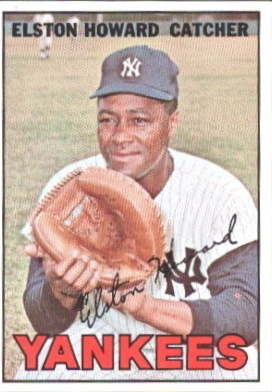
Howard brought an incalculable presence in handling the young Sox pitching staff. 

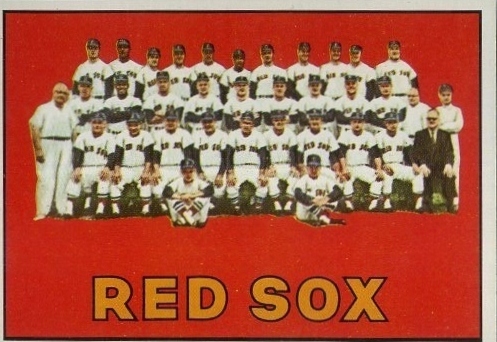
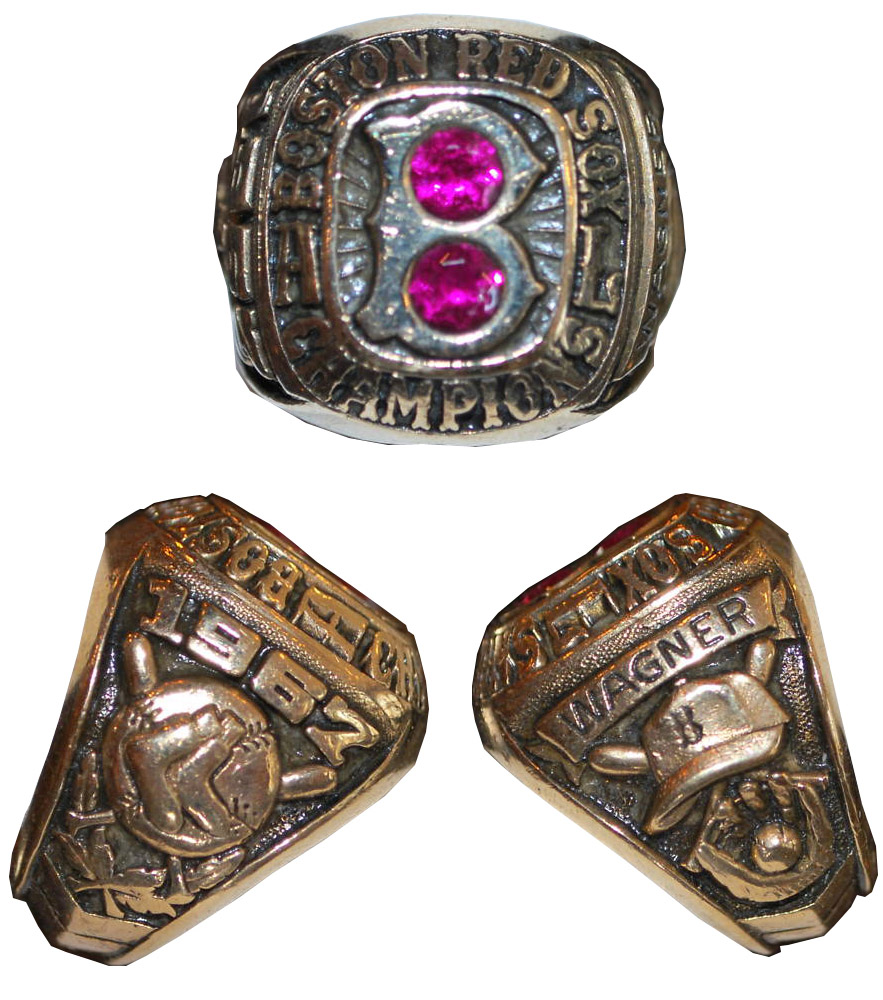
The 1967 pennant chase, perhaps the most dramatic in baseball history, went down to the last week with the White Sox, Tigers, Twins and Red Sox still alive. The Red Sox emerged victorious by taking the last two games of the season from the Twins at Fenway Park, earning all of them one of these.

However, just as they had in 1946, the Sox dropped the World Series to the St. Louis Cardinals in seven games and it was the Cards who took home the $8,314.81 winners share while the Red Sox settled for $5,115.23 each. To their credit, they voted one full World Series share to the Jimmy Fund!

The Red Sox never drew less than 1,000,000 fans again and since 1986 they have slipped below the two million mark but once. The 2008 season brought three million fans to Fenway Park and they have not slipped below that since.

And there are those that will tell you that the birth of Red Sox Nation occurred in 1967, the Summer of Love, the summer of The Impossible Dream, the summer of the Cardiac Kids, the summer to last a lifetime!
   And so it was at this time in Fenway Park history, World Series time, 1967.

Posted in Fenway Park Baseball | Tagged , , , , , , , , , , , , , , , , | Leave a comment

May the angels wrap their arms around you before the devil knows you’ve left…..

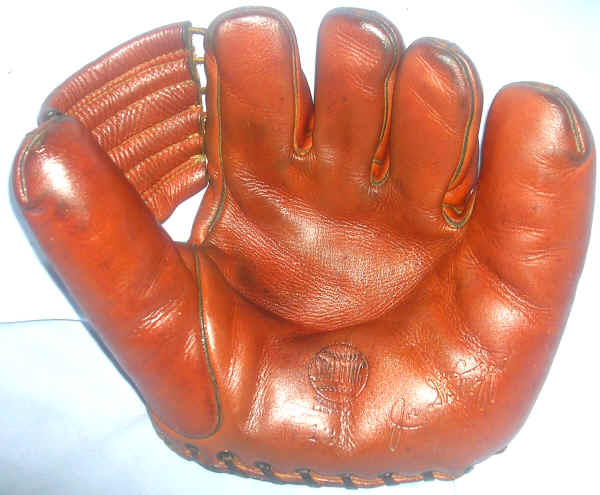
Today I will say goodbye to an old friend, a friend to whom I am and will be eternally linked through a love for the game that is played with one of these,

One of these…..

and nine of these.

And when a love that deep pours out on to a baseball field, any baseball field, it touches every baseball field.

I first met Terry, in the spring of 1994 coaching Little League baseball at the Chuck Reiter Complex in Venice Florida. He had already been coaching for decades. It was my first year as a manager and I had for a lack of a better term, an “over exuberant mommy”. Mommy was absolutely convinced that her little Stevie’s fast track to the major leagues was being derailed by my stupidity and ineptitude; and she had no problem telling anyone and everyone the details of my stupidity and ineptitude.

It was after a practice and I was leaning on the fence watching another team go through the rigors of their drills. I was thinking about what I had gotten myself into and was considering chucking it all when Terry walked up to me, extended his hand and introduced himself. He made reference to the “loo-loo” I had and encouraged me not to let her craziness deter me. “You know what you are doing” he said “and I’ll tell ya, one of them comes along every ten years…..You get through her you can get through anything.” We chatted for a while and I left the field buoyed and regenerated and his words were true. For in all my years of coaching, I have never encountered a situation I felt was beyond me.

For six years we coached together, we battled, we fought, we argued, we won, we lost, we laughed and we endured. There is a brotherhood that comes from “surviving” Little League managing and Terry survived longer than any of us. For over three decades he showed up every spring, every summer, evey fall and was always willing to work with the kid who wanted more.

I asked some friends to describe Terry and the words I heard were humorous, and he was always with a joke. Passionate, when it came to teaching baseball, nobody’s passion burned deeper. Indelible, for noone left his sphere of influence without an idellible mark upon their young lives. Nuts, he was that, nuts about baseball. Tough, in an age when we as a culture are softening at an alarming rate, Terry had the courage to toughen a kid, at times to the chagrin of the “Mommy Ballers”. Committed, far above and beyond, to his kids, to the community and to the program!
Today I will say goodbye to an old friend, the Venice Little League will never be the same and Terry will be missed. But wherever kids play baseball, wherever there is the sound of the ball meeting the bat and the pop of the ball hitting the leather of the glove, Terry will be there.

Goodbye old friend and may the angels wrap their arms around you before the devil even knows you’ve left.

And so it is on this day in Fenway Park history, February 1, 2012.

Posted in Fenway Park Other | Leave a comment

Fenway, the 1946 World Series and Enos “Country” Slaughter…..

The 1946 baseball season was filled with hope, renewal, promise and celebration! World War II had come to an end and the players were returning. For the Red Sox this meant the return of Ted Williams, Johnny Pesky, Bobby Doerr, Dom DiMaggio and company. Fenway Park was buzzing with the anticipation of the baseball season and the possibility that the Red Sox could FINALLY return to the World Series.

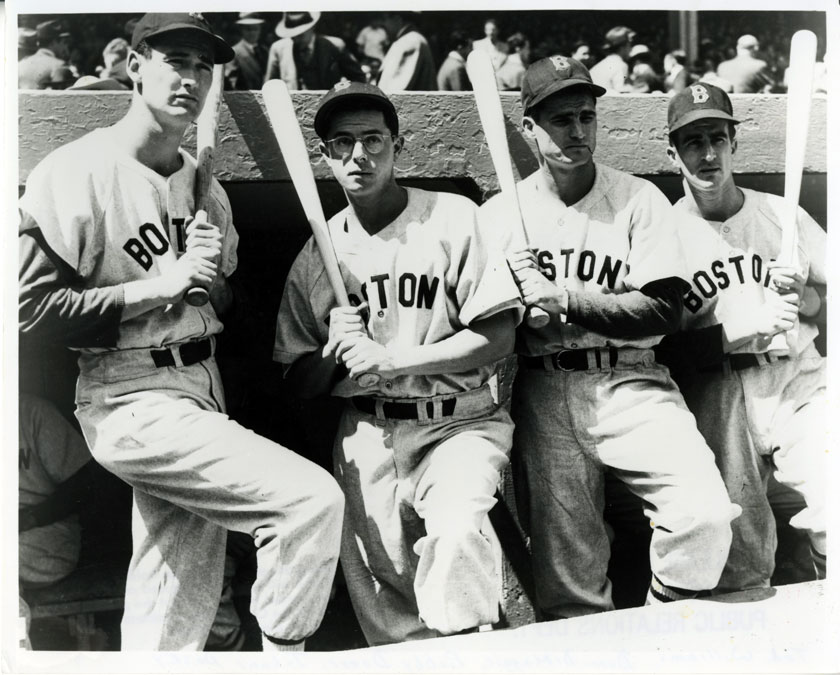
Ted Williams, Dom DiMaggio, Bobby Doerr and Johnny Pesky all rejoined the Red Sox following World War II.

The Red Sox broke out of the gate winning 21 of their first 24 games including a club record of 15 straight wins, which still stands. Two weeks later they reeled of 13 more straight wins and after the first 50 games of the year, they had an astounding record of 41-9, was good enough for a 5 1/2 game lead over the second place Yankees, the largest Red Sox lead in 28 years.

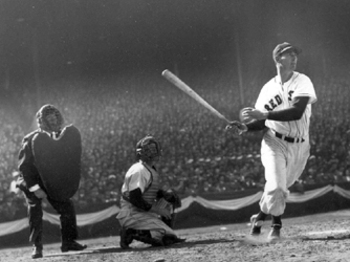
Spurred by the returning veterans, it was Ted Williams who led the way with a .342 batting average while hitting 38 home runs and knocking in 123 teammates. The “Splendid Splinter” won his first MVP award as the Red Sox won 104 games; clinching the pennant on September 10th.

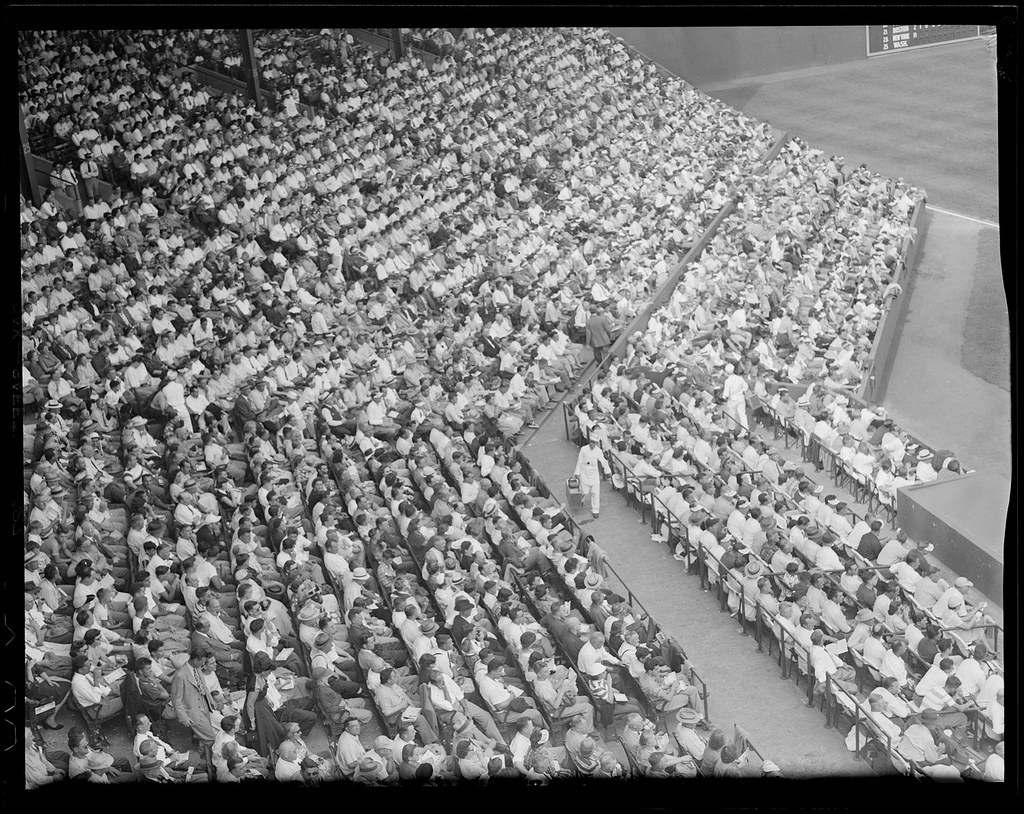
The Fenway Faithful responded in ways they had never done before as 1, 416, 944 fans watched the Red Sox at Fenway Park, the first time a Red Sox team ever drew over a million fans.

While the Red Sox wrapped things up in early September, in the National League, the Dodgers and Cardinals finished in a dead heat. This forced the first ever playoff situation to decide a league champion and the Cardinals prevailed winning the first two games of a best of three series.

As the Cardinals and Dodgers battled , the Red Sox played an exhibition against an American League all-star squad. During the game Ted Williams was hit on the elbow. An incident which had dire consequences. But more on that in a minute.

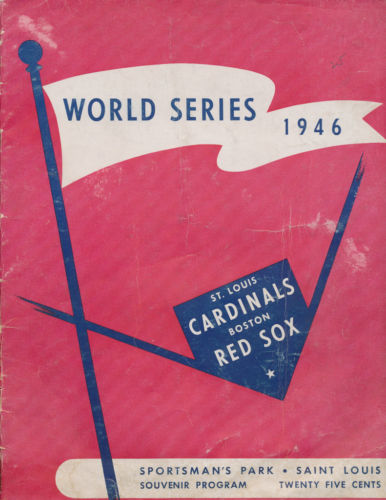
 Sportsman’s Park St. Louis, Game 1 of the 1946 World Series.

The oddsmakers installed the Red Sox as better than two to one favorites to win the Series and when the they won the sixth game to take a three games to two lead; it appeared as if they were correct and the Red Sox would hoist yet another World Championship banner at Fenway Park. Remember, they had never lost a World Series.

The teams returned to St. Louis for games six and seven and a date with destiny. St.Louis won the sixth game sending the Series to a winner take all match the following day.

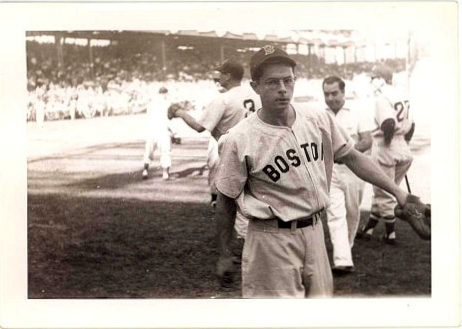
Domenic “The Little Professor” DiMaggio.

Trailing 3-1 in the top of the eighth inning, the Red Sox tied the game on a two out, two run double setting up one of the most famous plays in World Series history.

Enos “Country” Slaughter scores World Series winning run.

Slaughter led off the bottom of the eighth with a single and he was still on first with two outs when Harry “the Hat” Walker stepped to the plate. He lined what appeared to be a single to left center field and Slaughter never stopped, scoring all the way from first; putting $3,742.34 cents into the pockets of his mates while the Red Sox had to settle for the losers share of $2,140.89. Fighting off his elbow injury Ted Williams struggled throughout the Series going 5-25 with only one RBI. To his eternal credit, he never once used his elbow injury as an excuse for his less than stellar performance.

In 1997 my twelve-year-old son and I got to meet Hall of Famer Enos “Country” Slaughter. It was at the Hall of Fame and as we approached him, I told him how much a part of Fenway Park and Red Sox lore was the story of his mad dash. The 81 year old legend looked at me with a smile and a twinkle in his eye and he said, “October 15, 1946, Sportsman’s Park, 4:09 PM”. I smiled back and thought to myself how, in this lifetime, we can literally be defined by a moment.

    And so it was at this time in Fenway Park history, World Series time, 1946.

Posted in Fenway Park Baseball | Tagged , , , , , , , | Leave a comment

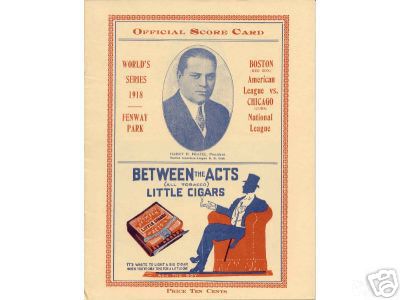
“The 1918 triumph marks the fifth world’s series that the Red Sox have brought to the high brow domicile of the baked bean. Boston is the luckiest baseball spot on earth, for it has never lost a world’s series.” The New York Times

In the annals of Fenway Park and Red Sox legend and folklore, their World Championship season of 1918 season is among the most chronicled. Unfortunately the predominant reason for that was not as much what happened that year, but what didn’t happen for another 86 years.

The 1918 Boston Red Sox 

Their were many historic aspects to the 1918 baseball seasons, not only for Fenway Park and the Red Sox but for baseball in general. The United States entered World War I in April of 1917 and by the spring of 1918, American forces were immersed in France holding off the German Spring Offensive.

On July 18th, word came down from Secretary of War Newton Baker that baseball was declared a “non-essential” industry and would be shut down, following the games of July 20th.

Red Sox owner, Harry Frazee was a proactive force and he along with American League president Ban Johnson, National League president John Tener and other team owners went to Washington to make the case to keep baseball going.

John Tener, Ban Johnson and Reds owner, Gary Hermann.

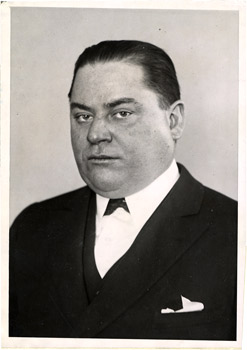
Red Sox Owner, Harry Frazee.

Frazee, whose Red Sox team was in first place by five games at the time, suggested that the World Series  be taken to France and be played for our boys at the frontAlthough that never transpired, Baker did agree to let the season continue until early September.

On the diamond, 1918 brought Babe Ruth’s beginnings as an everyday player. Splitting his duties between, the pitchers mound, left field and first base, Babe managed to lead the league in home runs, lead the team in hitting and RBI and compile a 13-7 record on the mound.

Despite all of his exploits with his bat, when it came to the pennant stretch drive, Babe was inserted back in the rotation and when it came time for the World Series, Red Sox manager Ed Barrow handed the ball to Ruth for games one and four. Babe won both, including a 1-0 shutout in the opening contest.

Red Sox first baseman “Stuffy” McGinnis’ RBI single provided the only run Babe Ruth needed to win the first game of the 1918 World Series.

The crowds were small for the first three games in Chicago and thus the gate receipts were low raising speculation that the winners share for the Series would be in the $1,200.00 range. This prompted a meeting between the National Commission (the three-man body that oversaw baseball before a Commissioner ruled) and four players. The Red Sox representatives were Harry Hooper and Dave Shean. The players wanted to assure they would receive $2,600.00 shares for the winners and $1,400.00 for the losers.

The Red Sox won the fourth game of the Series giving them a commanding three games to one lead and with the issue of the players shares still not decided, the players actually refused to take the field for game five at Fenway Park. It marked the first ever work stoppage in baseball history. The Commision promised a post game ruling and the players finally took the field, delaying the start of the game by an hour.

1918 Fenway Park Press Pin valued today at over $100,000.

Both the players and owners were creamed in the press so, despite the fact there was still no settlement, the players took the field for the sixth and what would be the final game of the Series, a 2-1 Red Sox win. The owners promised to do all it could to get the players a fair settlement. The result, a winners share of $1,102.51 while the losers pocketed $671.09.

Not only did the 1918 World Series bring the smallest players shares in baseball history, it also was the last World Series in which a home run was not hit and the Red Sox scored only nine runs in the entire Series, the least amount ever scored by a World Championship team. Oh, and the world would see The Great Depression and another World War before Fenway Park would see another World Series.

to be continued…..

    And so it was at this time in Fenway Park history, 1918, World Series time.

Posted in Fenway Park Baseball | Tagged , , , , , , , , , , , , , | Leave a comment

WORLD $ERIE$, CA$H AND FENWAY…..

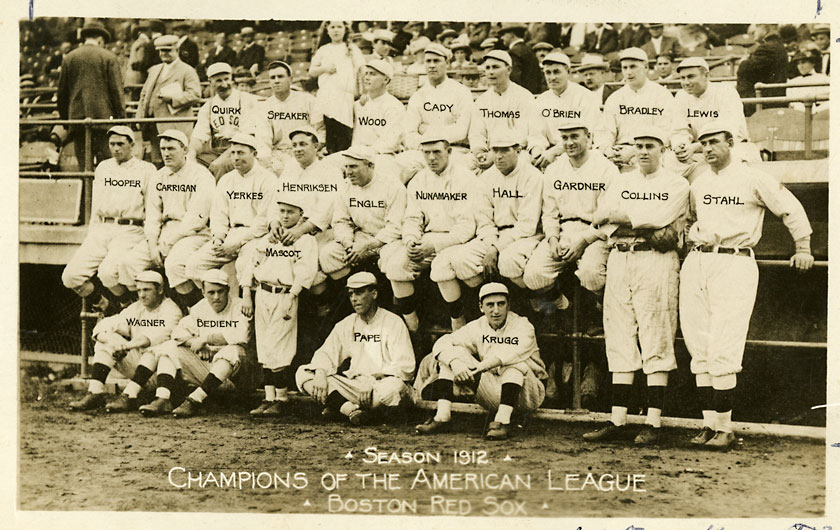
When the Red Sox won the 1912 World Series at Fenway Park, the winners share was $4,024.68 per player. That may not seem like a whole lot but it more than doubled the salary of some players. Well it set me to thinking( oh oh), so I went on a search and now you’re coming with me.

Although salaries of this time are somewhat inconclusive, Tris Speaker was paid about $10,000 and Harry Hooper about $8,000 for the 1912 season. Both are in the Hall of Fame. Thirdbaseman Larry Gardner played for about $2000.

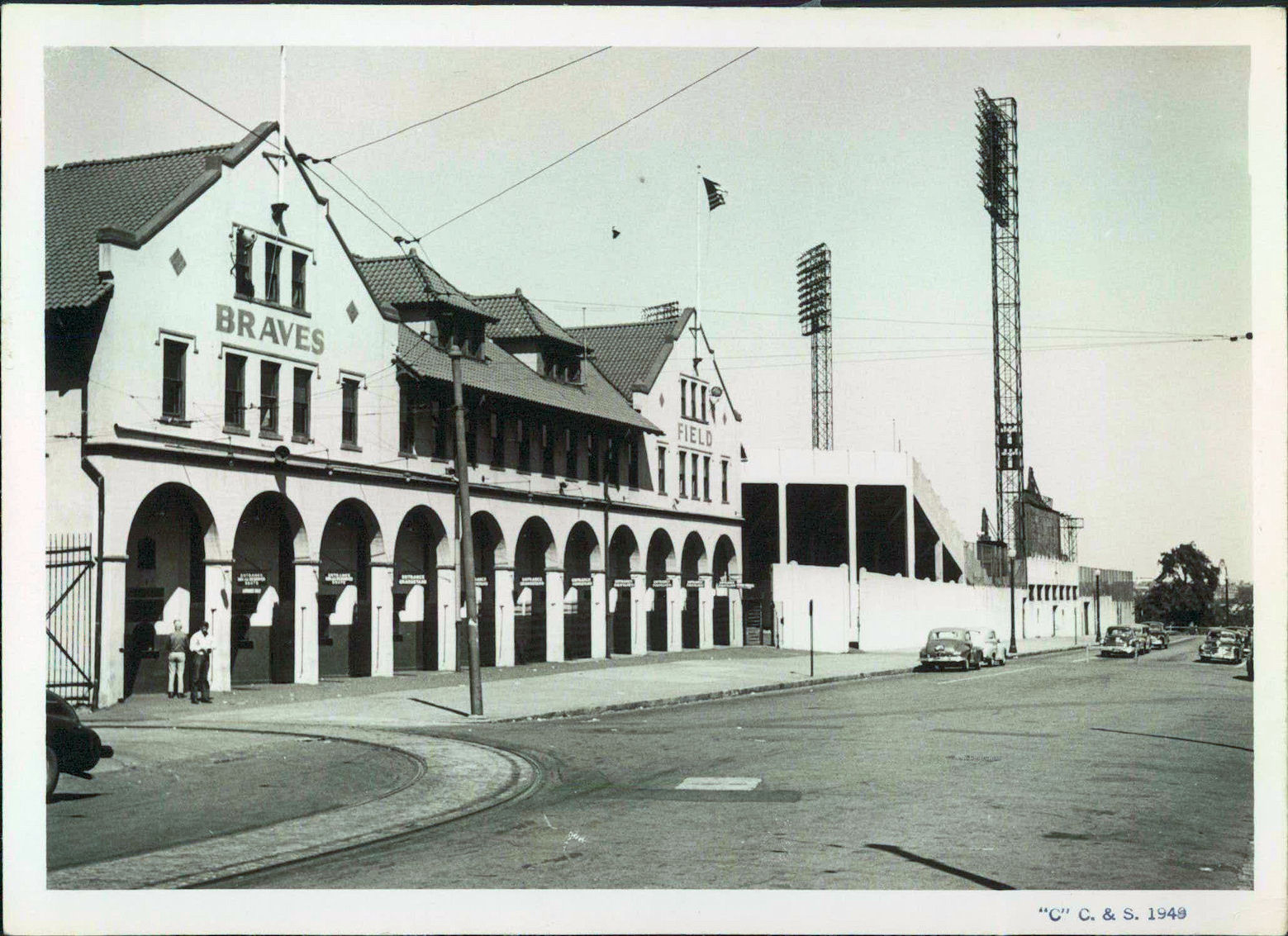
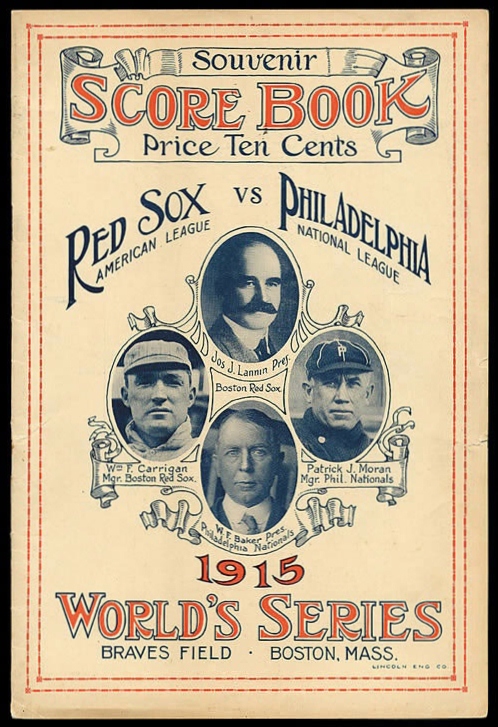
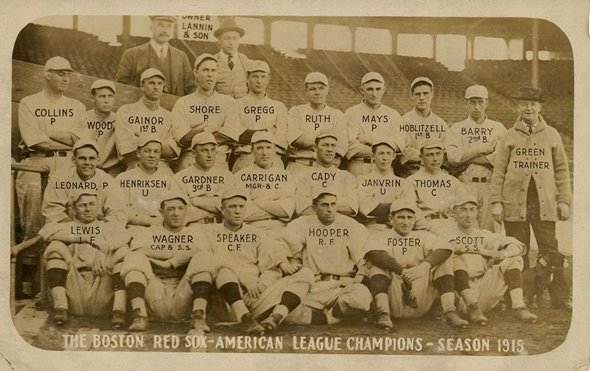
The Red Sox returned to the World Series in 1915 but believe it or not, they did not play their games at Fenway Park, they played them at Braves Field. It may seem a bit coo-coo and it actually get’s a little coo-cooer (is that a word?)  so let me digress a moment and explain.

Fenway Park opened in 1912. A couple of years later the Boston Braves began building their new ball park which they called, strangely enough, Braves Field.

Well in 1914, the “Miracle Braves” won the National League pennant. They were called the “Miracle Braves” because they were in last place in July and came back and won the pennant! But I digress yet again. They played their home World Series games at the NEW Fenway Park and they won the Series! The doors to Braves Field opened in 1915 and when the Red Sox won the American League pennant in ’15’ they played their home World Series games in the NEW Braves Field,

 and they won the Series!

How many guys can you recognize from the 1912 team?  

The Red Sox winners share for the 1915 World Series was $3,780.25 while the Phillies cashed checks for $2520.17. Now in 1915, the 1912 MVP and still the Red Sox best player, Tris Speaker played for $17,500.00. This is considerably more than his 1912 salary and that is because of the renegade Federal League. The Federal League was in operation in 1914 and 1915, and they had “raided” the existing major leagues driving salaries upward. The players liked this a lot! Babe Ruth, in his second year, played for $3,500.00 in 1915. He made more money from the series than he did for the entire season. So, you can see how important it was to win the pennant and get to the World Series!

In 1916, the Red Sox won the American League pennant again and guess what? Yup, they went back to Braves Field to play their home World Series games and again they won the Series!

The winning shares for the 1916 World Champions were $3,910.26. Tris Speaker had been traded just before the start of the 1916 season and Babe Ruth emerged as the star of the team. Babe anchored the pitching staff with a 23-12 record and a 1.75 ERA. He also tied for the team lead in home runs with three in just 136 at bats. He earned the same salary as the year before, $3,500.00. The leader of the offense was Larry Gardner who led the team in hitting, .308 and RBI with 62. His salary for 1916 was in the $7,500.00 range.

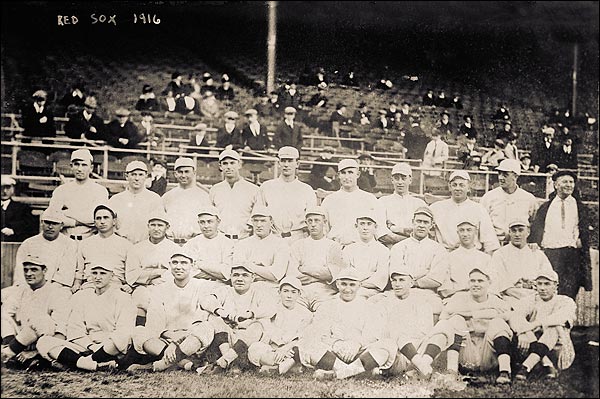
The 1916 Red Sox, led by Babe Ruth, beat the Dodgers in the World Series for their third World Championship in five years.

With the collapse of the Federal League, salaries plummeted and there began talk among the players of forming a “brotherhood”. The average salary of the 1916 Red Sox was in the $4,000.00 range, a figure that was virtually doubled by winning the World Series.

The lowest winners share in World Series history was just on the horizon and it would involve Fenway Park’s Boston Red Sox.

to be continued….. 

    And so it was at this time in Fenway Park history, 1912, 1915 and 1916.                                                         World Series time. 

Posted in Fenway Park Baseball | Tagged , , , , , , , , , , | Leave a comment

Attention Please Ladies and Gentlemen Boys and Girls, Now Batting for your 1912 Boston Red Sox, the Europeans…..

There were eight reserves on Fenway Park’s 1912 Red Sox squad and two of them were actually born in Eurpoe.

reserve infielder Marty Krug and

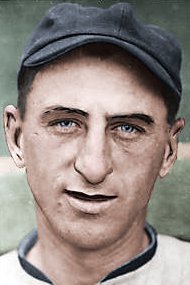
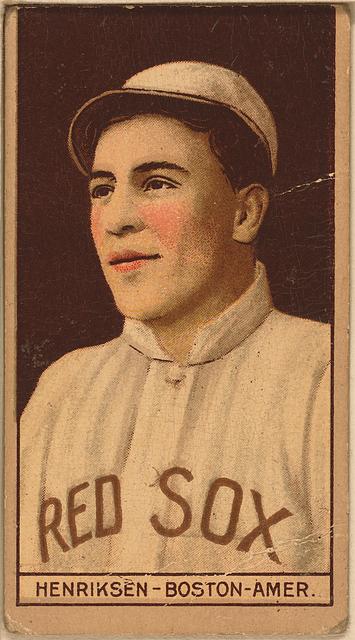
reserve outfielder and pinch-hitter extraordinaire, Olaf Henriksen.

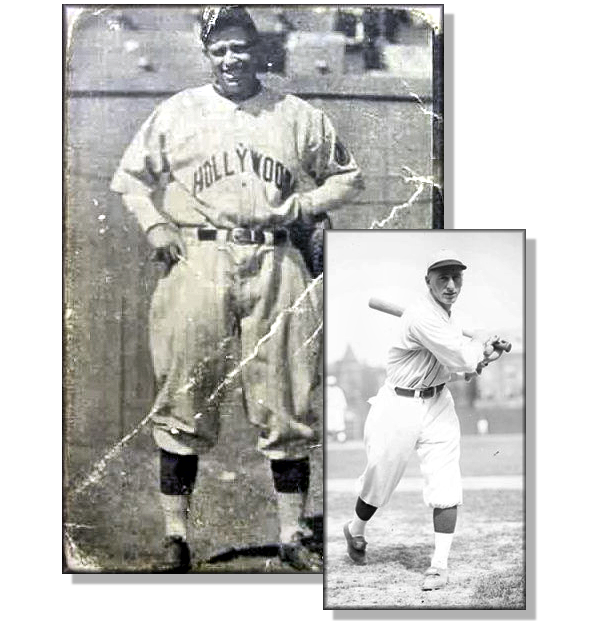
Martin John Krug was born in Koblenz Germany on September 10, 1888.  Drafted by the Red Sox in 1911 he made his debut the following May 29th in a 21-8 Red Sox over Washington at Fenway Park.  He played a total of 20 games for the Red Sox in Fenway’s inaugural summer, 11 at short, four at second and five as a pinch-hitter. He did not make an appearance in the historic 1912 World Series and the following year he was back in the minor leagues where he played until 1922 returning for a full big league season with the Chicago Cubs. He was back in the minors the following year and in 1927, he retired.

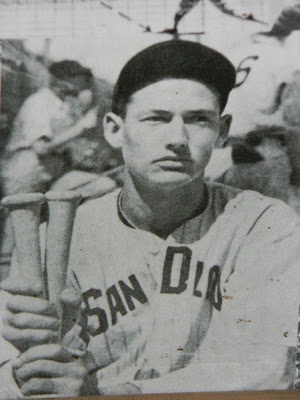
Marty worked as a scout for the Detroit Tigers and Philadelphia Phillies between 1931 and 1948. After scouting a high school player at Hoover High School in San Diego in the mid 1930s; he spoke with the youngster’s mother offering these words, “he is too skinny and frail to play baseball” and he advised her to “discontinue her son’s playing career out of concern for his safety.” That player was this guy…..

Ted Williams

Good call Marty!

Olaf Henriksen, nicknamed “Swede” by his mates, was born in Kirkerup Denmark and remains, to this day, the only player in major league history to be born in Denmark. Joining the Red Sox in 1911, Olaf immediately became known for a proficient, propensity to get on base. It is this quality would define his career which spanned seven years, 321 games and 598 appearances in the left-handed batters box, all with the Boston Red Sox.

Flourishing and reveling in his role, “Swede” made a notable and historic impact in the early years of Fenway Park.  The most significant coming in the deciding game of the 1912 World Series. It was the bottom of the seventh inning and Red Sox rookie Hugh Bedient and the Giants incomparable one, Christy Mathewson were locked in a duel. With the Giants, leading 1-0, there two outs and the Sox had Jake Stahl at second and Heinie Wagner (you remember them) at first. Manager Stahl called upon “Swede” to pinch hit for Bedient. The slashing lefty rifled a ball off the third base bag for a double, scoring Stahl and tieing the game which the Red Sox would eventually win in 10 innings to capture Fenway’s first World Championship.

Olaf “Swede” Henricksen was part of two more Fenway Park World Championships in 1915 and “16”. He was around when this kid showed up in 1914.

The Colossus

In a spring training intra squad game in March of 1916, Olaf was playing right field when Babe launched one which was heading over the fence. Not deterred, Henriksen literally ran through the wooden fence and caught the baseball. On July 7th of the same year, “Swede” again made history when he pinch-hit for Babe Ruth against the Indians at Fenway Park. He walked, scored the tieing run in a game the Sox won 2-1.

Olaf “Swede” Henriksen retired following the 1917 campaign and for a couple of years in the early twenties, he coached at Boston College. He settled in Norwood Massachusetts where he was laid to rest in 1962.

    And so it was at this time in Fenway Park history, 1912-1917, Marty’s time                                                            “Swede’s” time.

Posted in Fenway Park Baseball | Tagged , , , , , , , , , , , | 1 Comment

Rounding out the Red Sox Regulars of 1912, Meet Mr. Larry Gardner, Third Baseman…..

Drumroll please while I introduce to you the last regular in the Red Sox lineup of 1912, Mr. William Lawrence “Larry” Gardner.

Larry Gardner, one of five native New Englander’s on Fenway’s first Red Sox squad, was a teammate of pitcher Ray Collins at the University of Vermont. He is widely recognized as the greatest major league player the state of Vermont has ever produced.

He joined the Red Sox in 1908, foregoing his final year of college eligibility and by 1910 he had worked his way into the starting lineup at second base. Moving over to third, in 1911, Gardner was penciled in at third base by four different managers, for the next seven years, averaging 141 games per season.

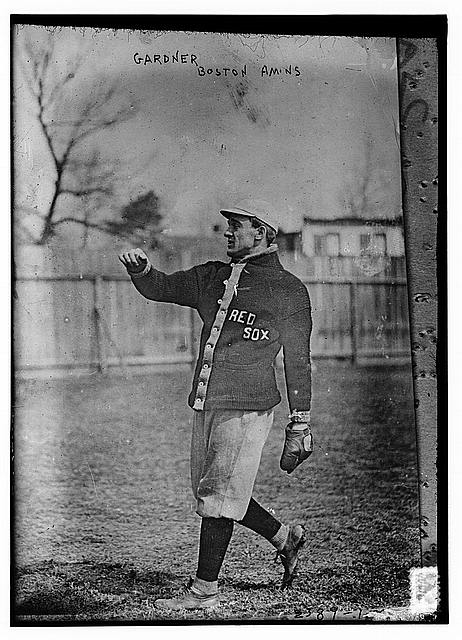
Gardner in Hot Springs circa 1912

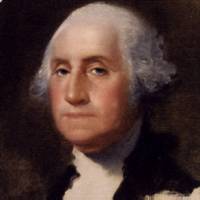
 A managers delight who was tough and hard-nosed, he came from solid “Yankee stock” as he was a distant relative of none other than this man,

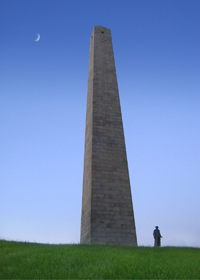
 and his great-great grandfather fought in a very famous battle at this place,

Bunker Hill Monument, Charlestown Massachusetts.

His breakout year came in Fenway’s inaugural season of 1912. Hitting fifth in the lineup, he batted .315 with 86 RBI, 88 runs scored, 25 stolen bases and a team leading 18 triples. All this while playing a solid third base.

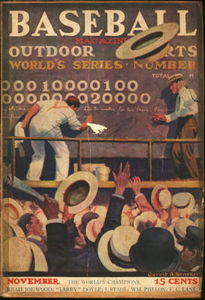
Baseball Magazine named him the 1912 first team third baseman or as they referred to it, the All American third baseman.  

Rooming with his best friend and teammate, Harry Hooper throughout the year, in the north shore town of Winthrop, the teammates would commute to Fenway Park in their brand spanking new Stutz Roadster.

Gardner and Hooper co-owned this four-cylinder beauty and road to Fenway in style all season.

The Red Sox ran away from the field in 1912, winning the pennant by 14 games over the second place Washington Senators and in a meaningless game in late September against the Tigers, Gardner dove for a hot-shot hit to his right. He attempted to bare hand the ball which smashed his baby finger, causing the bone to break through the skin. Todays medical parlance would refer to that as a compound fracture.

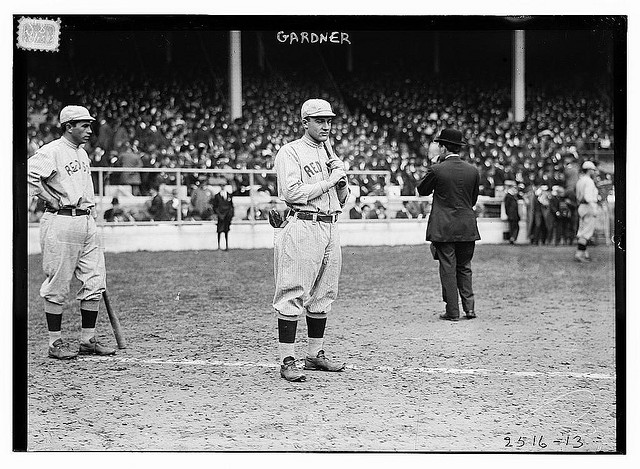
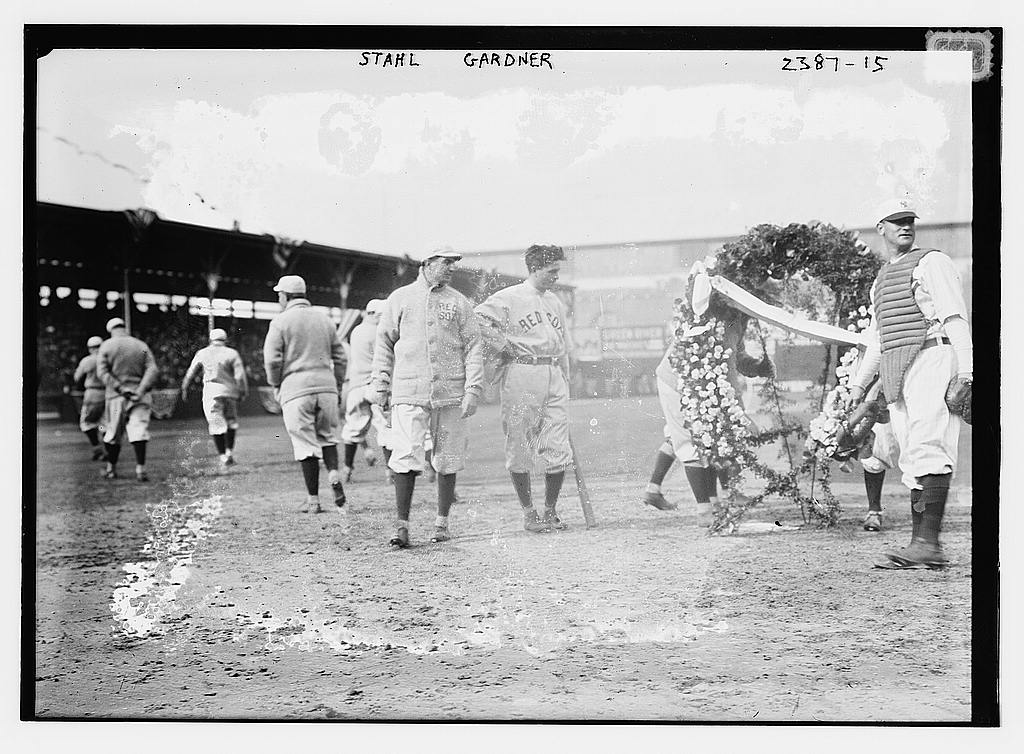
Larry Gardner, leaning on the bat, before a game in the 1912 World Series at the Polo Grounds. On the left, manager Jake Stahl. 

Larry headed home to Vermont to recuperate and it was thought he would be out of the World Series, but he would have none of it. Playing with the last two fingers on his right hand taped together, he struggled with the bat hitting only .179 for the Series. However, in the fourth game he had a single and a triple and scored two of the three runs in a 3-1 victory. And with the entire World Series on the line, in the final game, it was Larry Gardner who delivered. The game was tied with the bases loaded in the bottom of the 10th, and there was one out, Gardner launched a Christy Mathewson offering to deep right field which plated Steve Yerkes with the winning World Series run, capping Fenway Park’s inaugural season with a World Championship.

 He was part of two more Fenway World Championships before being traded after the 1917 season. Retiring in 1924 after 17 years of baseball, he went home to Vermont and opened a car dealership. In 1929 he was named coach of the University of Vermont team, a position he held until 1951.

Larry Gardner passed away in 1976, two months short of his 90th birthday. Ten years later his beloved University of Vermont team wore commemorative patches honoring his 100th birthday.

            And so it was at this time in Fenway Park history,  1912-1917,                     Larry Gardner’s time.

Posted in Fenway Park Baseball | Tagged , , , , , , , , | Leave a comment

Now Batting for the 1912 Boston Red Sox, the Second Baseman, Steve Yerkes…..

The other half of the Red Sox double play combination in 1912 was Stephen Douglas Yerkes. Yerkes joined the Red Sox briefly in 1909 but came back to stay in 1911.

A native of Hatboro Pennsylvania and a graduate of Millville High School in New Jersey, Yerkes played at the University of Pennsylvania before being signed by the Red Sox in 1909. Penn, one of the oldest college baseball programs, in the country, has been playing since 1865. That’s right the last year of the Civil War!

His career was rather nondescript, he played but seven seasons, hit six homers and the most RBI he had in one season was 52. He played for the Red Sox for 92 games in 1914, long enough to see the debut of Babe Ruth, before jumping to the Pittsburgh Rebels of the newly formed Federal League. He played there until the end of ’15’ and joined the Cubs in 1916 for a brief stint before calling it quits.

Pittsburgh Rebels Logo

However, nondescript as Yerkes career may have been baseball, as it so often does, placed him in history’s playground and he occupies a special place in Fenway Park and Red Sox lore.

Fenway Park opened her gates for her inaugural game on April 20, 1912. It came after a few days of rainouts leaving the infield a bit, shall we say “squishy”. Remember this was before the days of tarpaulins and turface so the game was played under what could best be described as “muddy” conditions. The following day, Paul Shannon wrote in the Boston Post,

“Yerkes, in spite of three errors, for which the soft spots around the second bag were wholly to blame, made up for his misdeeds with grand work at the bat. In seven times up, he hammered out three singles, a brace (two) of doubles, scored three of the seven runs and helped to drive in two more himself.”

 The offensive force behind a 7-6 eleven inning win was a great debut for Yerkes and Fenway.

 Steve Yerkes

History was not yet finished with Yerkes, for just as it had deemed him worthy in Fenway’s first ever game, so it did for Fenway’s last game of the 1912 World Series. With the Series knotted at three games apiece, the deciding game was set for Fenway Park.

It was the bottom of the 10th inning and the NY Giants were ahead 2-1. With the Red Sox two outs away from defeat and the tieing run on third, Yerkes stepped in against the great Christy Mathewson. He worked him for a walk and went to third on a game tieing single by Tris Speaker. And when Larry Gardner lofted a flyball to right, it was Yerkes who tagged up and scored the run that made the Boston Red Sox World Champs in Fenway Park’s first year!

All this after having driven in the the run that won game one of the Series at the Polo Grounds. Not a bad year for a nondescript second baseman, not bad at all.

       And so it was at this time in Fenway Park history, 1912 Yerkes time.

Posted in Fenway Park Baseball | Tagged , , , , , , , , , | Leave a comment