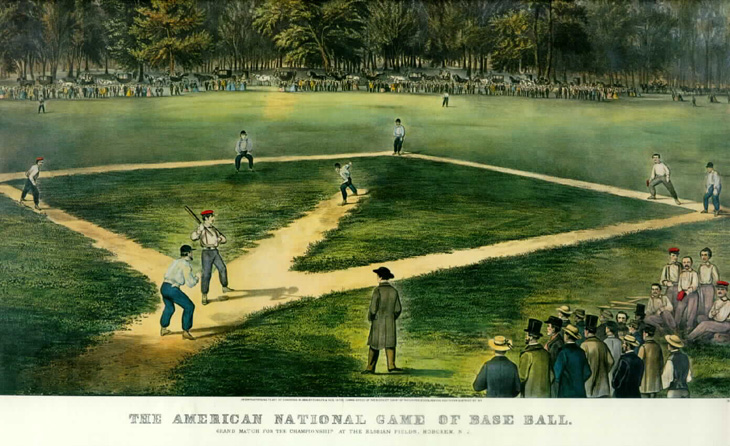
Opening Day and Extra Innings…..

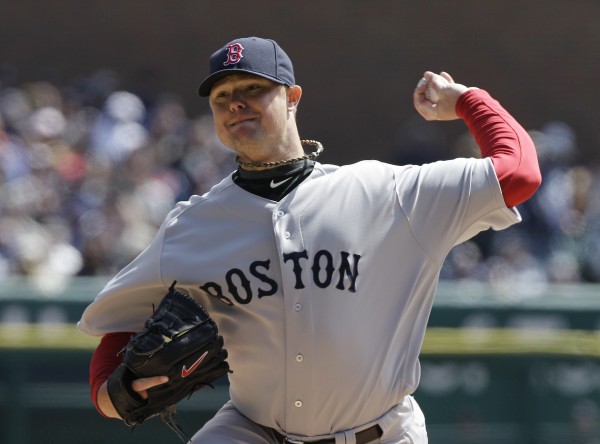
Yesterday’s opener turned into a classic pitching duel between Jon Lester and last years MVP and Cy Young Award winner Justin Verlander. Neither was involved in the decision as the Red Sox tied the Tigers 2-2 in the top half of the ninth only to lose it in the bottom half of the frame 3-2.

Jon Lester went seven innings, surrendering one run on six hits. He walked three, struck out four and threw 107 pitches.

The loss actually put the Red Sox opening day record, since Fenway’s birth, to 51-50 still a tad over .500 and they came within two outs of playing in their 11th extra inning opener in 100 years.

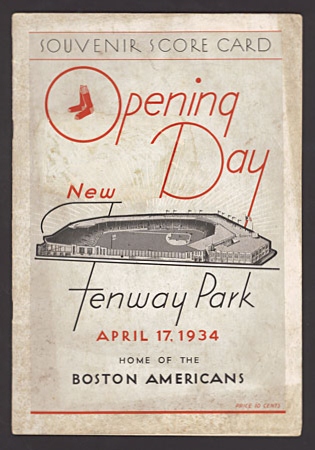
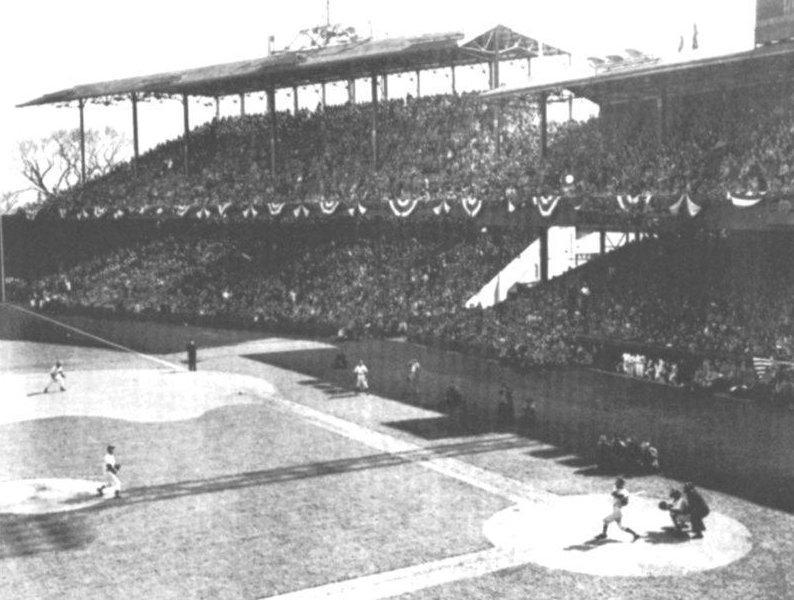
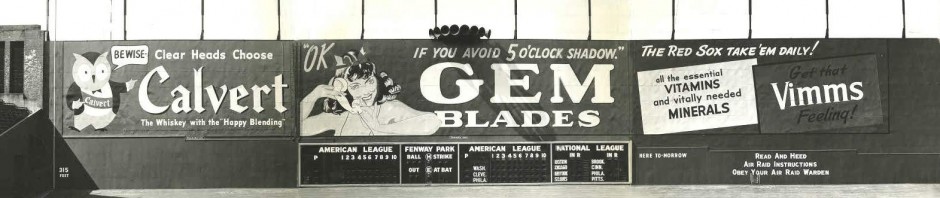
Fenway Park was renovated during the 1933 winter and the “Green Monster” in its current incarnation was constructed and ready to go for the 1934 season.

The near extra inning contest got my brain to thinking and I share with you today my rambling extra inning findings.

The first extra inning opening day contest occurred in Washington on April 11, 1932 a 1-0 10 inning loss to the Senators. Two years later on what happened to be the very first game played before Fenway Park’s fabled “Green Monstah”, the Senators took another opening day extra inning contest  6-5 in the 11th. The Red Sox have played in ten extra innings openers, the aforementioned first in 1932, a loss, and the last in Oakland in 2008, a 6-5 ten inning win.

Hank Johnson was the tough luck loser on opening day 1934. He pitched five innings in relief surrendering only three hits and one unearned run in the 11th inning.

Their overall extra inning record is 3-7 in the openers that have required extra frames and believe it or not they have NEVER won an extra inning opener at Fenway Park! They have lost all five at home.

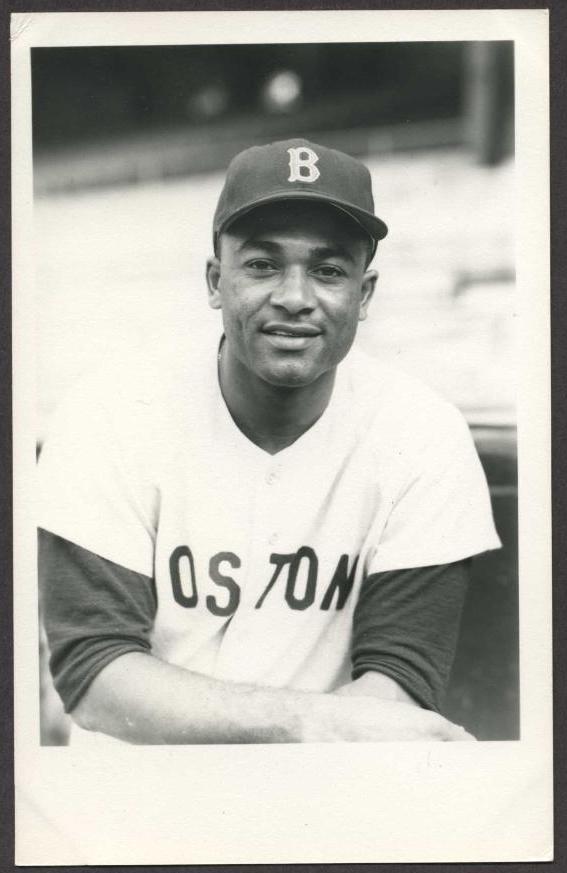
The first extra inning opening day win for the Red Sox came in 1964 when Roman Mejias scored on a wild pitch by Whitey Ford in the 11th inning. Ford took the complete game loss.

Three times the Red Sox have played the Baltimore Orioles in extra inning openers 1966, ’69’ and ’89’ and a couple of those contests have provided some very dramatic moments.

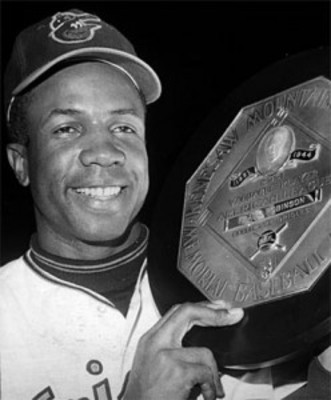
Frank Robinson began his American League career at Fenway Park in 1966. In his first at bat he was hit by Earl Wilson and scored when Brooks Robinson homered. The ’66’ Triple Crown winner went 2-4 including a game tying homer in the fifth.

The 1966 opener is the longest in Red Sox history, decided in the 13th inning when Luis Aparicio scored on a balk by Jim Lonborg, giving Baltimore a 5-4 win.

Opening day 1969 may well be the most dramatic opener in Red Sox history. It took place at Memorial Stadium in Baltimore and it involved the Red Sox boy wonder, Tony Conigliaro.

Tony C. scored the winning run in the 12th inning in the 1969 opener after leading off the inning with a walk.

Suffering what appeared to be a career ending injury in 1967, Conigliaro sat out the entire ’68’ season only to miraculously return in 1969. On opening day in Baltimore, he stepped to the plate in the top of the tenth inning in a 2-2 ballgame and rifled a ball into the left-centerfield bleachers giving the Red Sox a 4-2 lead in a game they eventually won in 12 innings, 5-4.

Lee Smith took the opening day loss in 1988 despite not surrendering an earned run, suffering the same fate as Hank Johnson in 1934.

The last opening day extra inning game at Fenway Park occurred in 1988 against yesterdays opponent the Detroit Tigers. After Roger Clemens and Jack Morris battled through nine innings of a 3-3 tie, the game was turned over to the bullpen. In the top of the 10th an error by Red Sox shortstop Spike Owen opened the flood gates and the game was decided on a two out, two run homer by the Tiger shortstop Allan Trammell.

The Red Sox lost the opener and are 0-1, 100 years ago today they were 0-0 and five days removed from the season’s opener.

The Fenway Faithful can take solace in the fact that in their last three pennant winning seasons of 1986, 2004 and 2007, they opened the season with a loss. We all know what happened in ’04’ and ’07’.

Let’s not think about 1986.

And so it is on this date in Fenway Park history, April 6, 2012.


Posted in Fenway Park Baseball | Tagged , , , , , , , , , , , , , , , , , | Leave a comment

LET THE GAMES BEGIN…..

At precisely midnight last night, I was awakened by a huge clap of thunder which rolled on for a full three minutes before dissipating into the darkness of a new day. This day, opening day. 

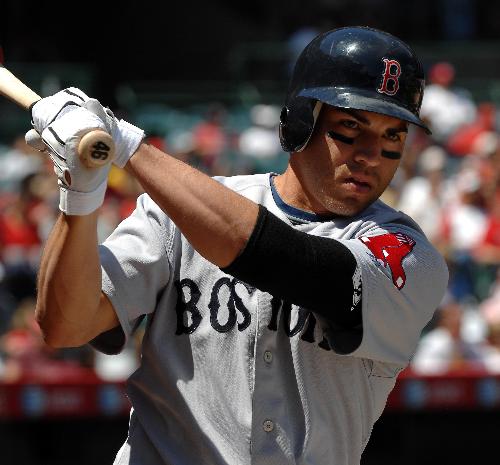
Today at 1:05 Jacoby Ellsbury will step into the left-handed batters box at Comerica Park in Detroit Michigan and just like that Fenway Park’s 100th birthday will be underway! Albeit they will be in Detroit but it will be underway nonetheless and it will begin Fenway’s 101st season.

Jacoby Ellsbury.

A century ago on this date, the Red Sox were setting about breaking camp in Hot Springs Arkansas and were a few days away from the first ever baseball at Fenway Park.

It is appropriate that the Red Sox open their 2012 season on the road, for they did just that 100 years ago, in New York versus the Highlanders/Yankees in Hilltop Park.

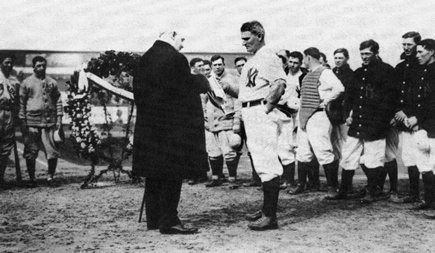
April 11, 1912 Yankee co-owner Bill Devery and manager Harry Wolverton in pregame ceremonies. This marked the first time the Yankees wore pin stripes.

The Red Sox won that opener 5-3 and went on to sweep the three game series embarking upon a 105 win season, which remains the most in their history.

I thought it would be fun to take a look at the Red Sox and their opening day history since they have called Fenway Park their home. So prepare yourselves for a collection of enormously useless, gigantically meaningless, curiously interesting, trivialities of 100 years of Red Sox opening days.

Since 1912, the Red Sox have opened the baseball season only 38 times at Fenway Park. In those 38 games, they have won 21 and lost 17. The astute math minds among you will discern that they have opened the season 61 times on the road. In those games they have won 29 and lost 32 for a total record of 51 wins and 49 losses in opening days since 1912.

The first Fenway Park opener came in 1913 a 10-9 loss to the Philadelphia A’s and the Red Sox would not win the seasons first game at Fenway Park until April 12, 1916 when a young south paw by the name of Ruth pitched them to a 2-1 win over those same A’s.

Babe was 3-0 as the opening day pitcher winning in 1916, ’17’ and ’18’.

Let’s take a look at their opening day opponents, and where better to begin than with the Yankees.

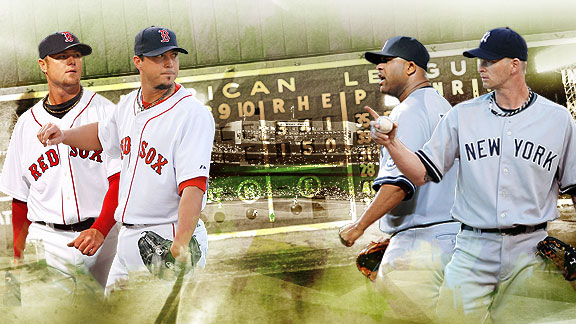
The Sox and Yanks have opened the season against each other a total of 25 times in 100 years. In those 25 games the Yankees hold a 14-11 edge and here is how it breaks down. Nine of those games have been at Fenway Park and in those nine games, the Red Sox are 5-4. They played one game at Hilltop Park which the Red Sox won, two games at the Polo Grounds which the Red Sox won and 13 games at Yankee Stadium in which the Red Sox have gone 3-10.

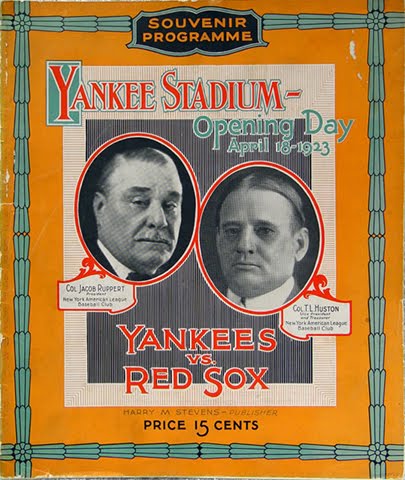
The Sox and Yankees played the first ever game in Yankee Stadium, April 18, 1923.

 The flag raises over Yankee Stadium, April 18, 1923, a 4-1 Yankee win over the Red Sox before 74,200 fans.

The Red Sox first Fenway Park opening day win against the Yankees came in 1938 and they did not repeat that effort until a 3-1 win opening the 1971 campaign.

From 1912 through 1954, if the Red Sox did not open their season at Fenway Park, they were either in New York, Philadelphia or Washington. It was a simple logistic of train travel.

The Senators were their opening day opponent 16 times with the Red Sox emerging victorious in nine of those games. They were 4-3 at Fenway Park, 4-4 at Griffith Stadium and 1-0 at DC Stadium.

The Red Sox last opening day game at Griffith Stadium was a 10-1 shellacking in 1960.

There have been three version of the Athletics, or A’s if you will. The Philadelphia version, the Kansas City version and the Oakland version. The Red Sox have battled all three as opening day opponents and are a collective 9-8 in the contests. They have twice opened in Oakland and won both in 1998 and 2008. Only once did they play the Kansas City version and that was a 5-2 loss at Fenway in 1962. They were 7-6 against the Philadelphians.

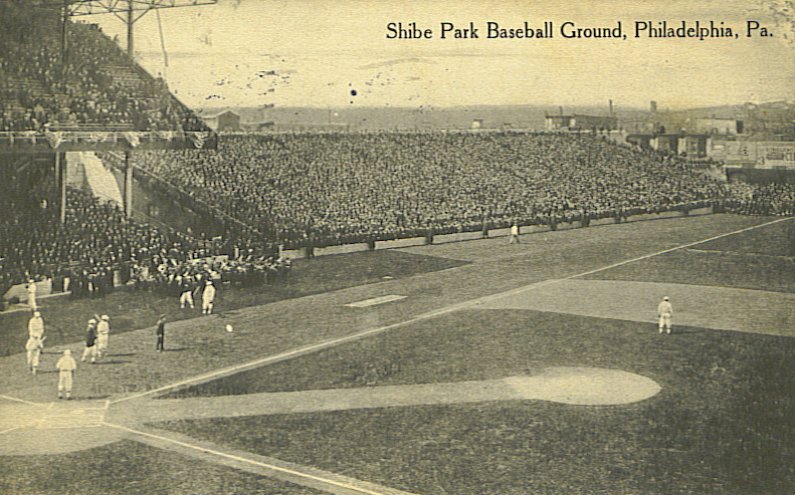
The Red Sox opened the season seven times in Shibe Park winning three of them.

As for today’s opponent the Detroit Tigers. The Red Sox did not open against the Detroit Tigers until 1968 and they have played them a total of six times in their inaugural season game. They are 3-0 at Fenway Park and 1-2 at Tiger Stadium. It was 1994 when they last clashed in game one and this marks their first opener in Comerica Park.

It’s here! Let the games begin!

And so it is on this day in Fenway Park history, April 5, 2012, the first day, OPENING DAY!


Posted in Fenway Park Baseball | Tagged , , , , , , , , | Leave a comment

Opening Day LBJ, RMN, GRF, JEC, RWR, GHWB, WJC, GWB, BHO…..

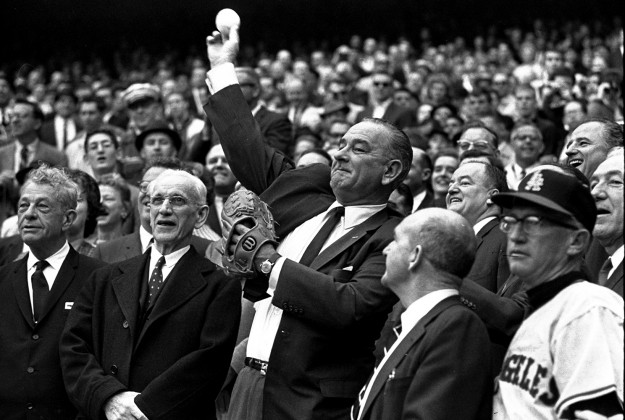
LBJ continued the Presidential pitch parade firing the opening pitch in 1964, ’65’ and ’67’. He became the first President to not pitch the Senators to an opening day win. The new expansion version of the Washington home team lost all three games under Johnson’s watch.

LBJ on opening day, April 13, 1964 at DC Stadium. The Angels shut out the Senators 4-0.

He was scheduled to open the 1968 season with a first pitch as well, however the assassination of Martin Luther King precluded that and VP Hubert Humphrey stepped in for him. The Senators still took it on the chin losing 2-0 to the old Senators, now called the Twins.

The summer of 1968 was a transforming year for both baseball and the nation. Just two months following the death of Dr. King, Senator Robert Kennedy was assassinated following his victory in the California primary.

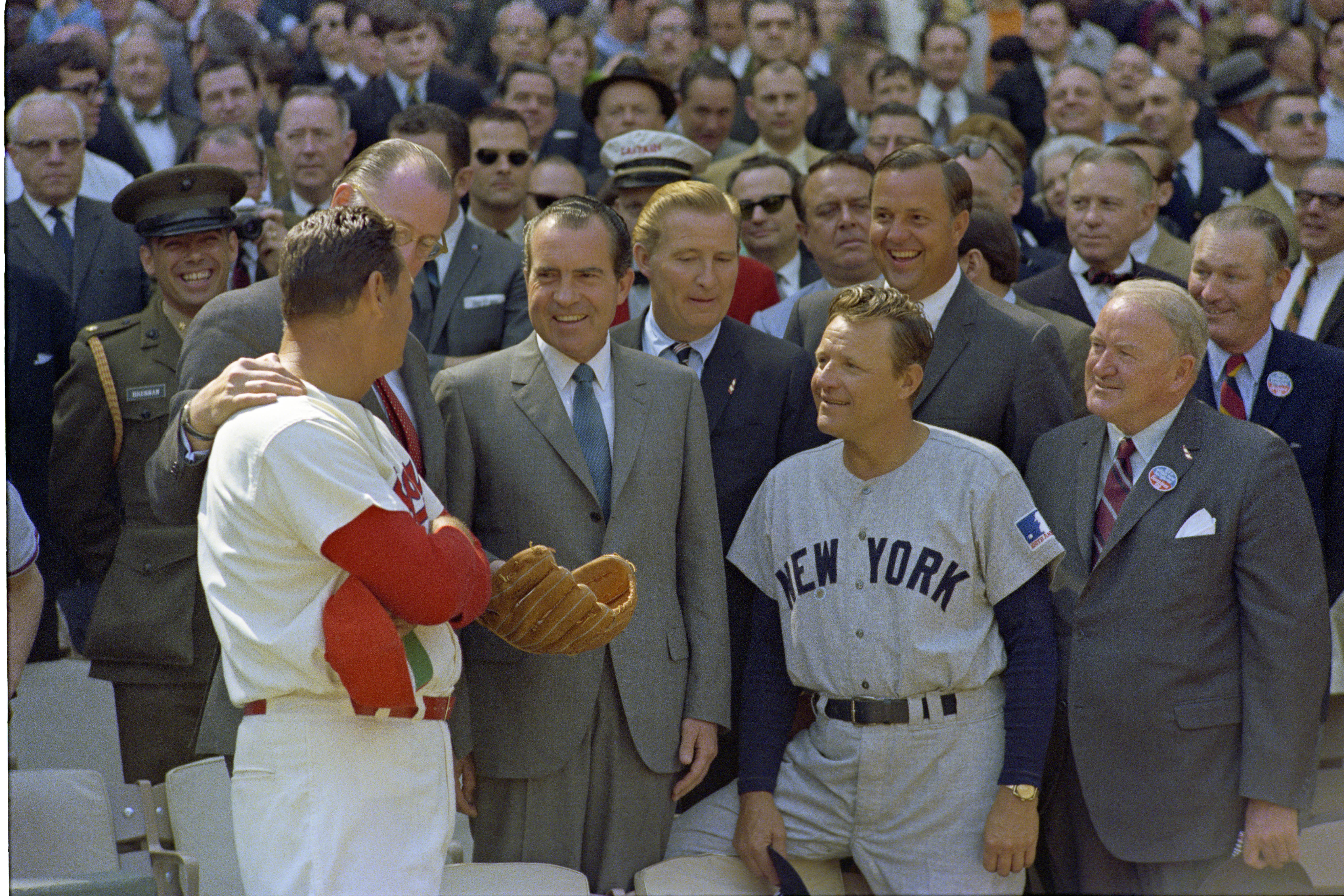
Richard Nixon was elected in November and he opened the 1969 season throwing out the first pitch at what was now RFK Stadium. The result was an 8-4 win for the Yankees over Washington. It would be 36 years before a President would throw another opening day first pitch in Washington DC. Following the 1971 campaign, the Senators moved to Arlington Texas and have been playing as the Texas Rangers ever since.

Nixon closed the book on the Washington Senators in the Nation’s Capital with his 1969 loss and coupling his loss with the three straight suffered by his predecessor, the Washington Senators finished with a record of 24-22 in opening days begun with a Presidential First Pitch.

Richard Nixon became the first President to throw out an opening day first pitch as Vice-President (1959) and President (1969 above). He also became the third  President to open the All Star game with a pitch (1970) and he started a new tradition, the traveling opening day Presidential First Pitch, with a toss in Anaheim to open the 1973 season.

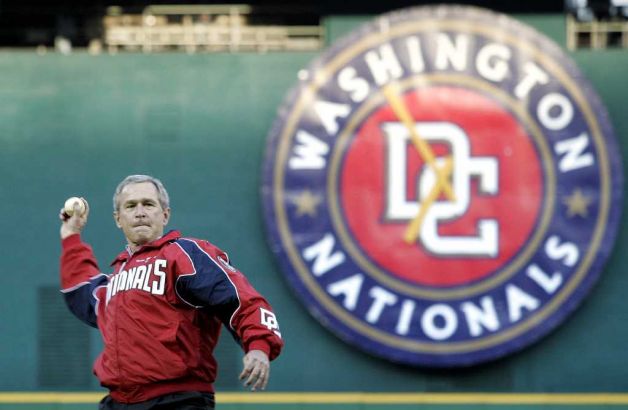
Baseball returned to the Nation’s Capital in 2005 when the Montreal Expos relocated and became the Washington Nationals. President George W Bush became the first president since Nixon to open the season for the home team with ceremonial first pitch at RFK Stadium. The Nats beat Arizona 5-3.

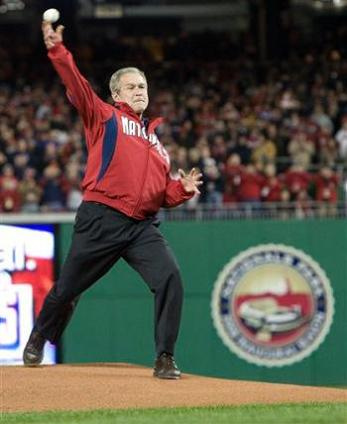
George W Bush also christened the new National Park with its first opening day Presidential First Pitch on March 30, 2008. The Nationals beat Atlanta 3-2 making GW 2-0 in opening day “First Pitch” games.

The 43rd President also was an active participant in the traveling opening day “Presidential First Pitch” begun by Nixon. Along with his two Washington appearances, he has opened the season with a first pitch in: Milwaukee’s Miller Park (2001), St. Louis’ Busch Stadium (2004), Cincinnati’s Great American Ball Park (2006), and the Rangers Ballpark in Arlington (2009).

He threw out what was undoubtably the most dramatic Presidential First Pitch in history on October 30, 2001 at Yankee Stadium. Clad in a bullet proof vest and with a secret service agent on the field dressed as an umpire, he made his way to the mound just weeks after the attack of 911.

GW Bush, October 30, 2001, “USA, USA, USA, USA” remember this?

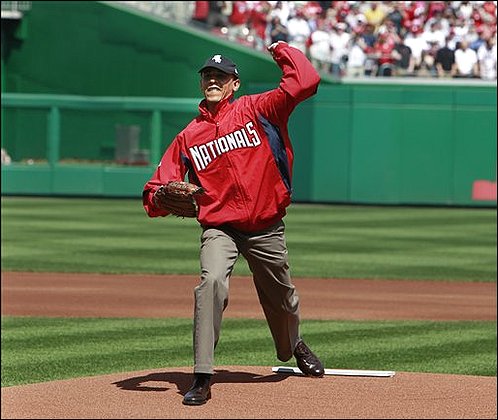
President Obama, opening day first pitch at National Park, 2010, an 11-1 win by the Phillies over the Nationals.

Barack Obama’s first pitch in Washington marked the 100th anniversary of Taft’s first Presidential Toss in 1910. It was his first and, thus far, only opening day first toss. He did throw out the first pitch at the 2009 all-star game in his home town of Chicago. He was the sixth president to throw out the first pitch at the all-star game.

Between Mr. Nixon and Misters Bush 43 and Obama, presidents have hurled opening day first pitches at 10 different venues.

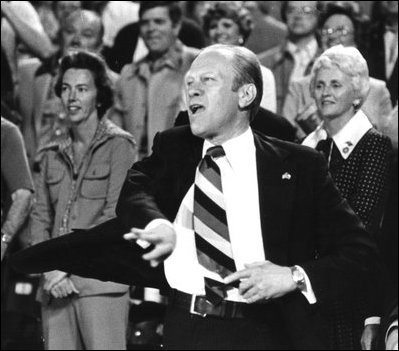
Gerald Ford opened the 1976 season with a first pitch in Arlington Texas. He also began the 1976 All Star game in Philadelphia’s Veteran’s Stadium.

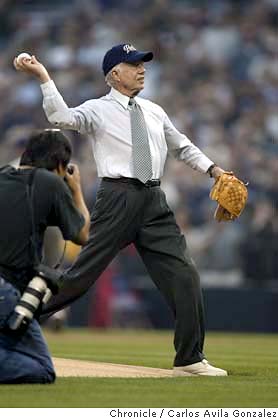
 Jimmy Carter was the only president since Taft to not throw out an opening day first pitch. A situation which was remedied in 2004 when he was on the mound for the first pitch in Petco Park’s inaugural game in San Diego.

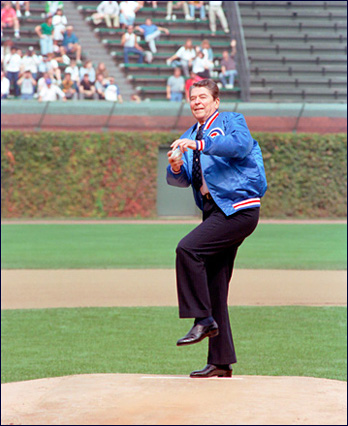
Ronald Reagan had two opening day first pitches at Memorial Stadium in Baltimore before traveling to Wrigley Field to open the ’88’ season. He became the first president to then transfer to the radio booth where he participated in the broadcast with Harry Carey for an inning and a half.

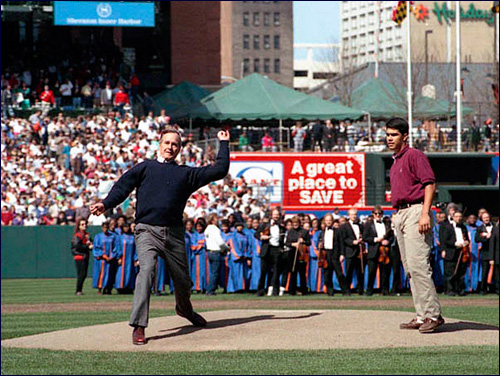
Bush (41) opens Oriole Park at Camden Yards in 1992. He also threw first pitches at Memorial Stadium in Baltimore (1989), the Skydome in Toronto (1990) and Arlington Park in Texas in 1991.

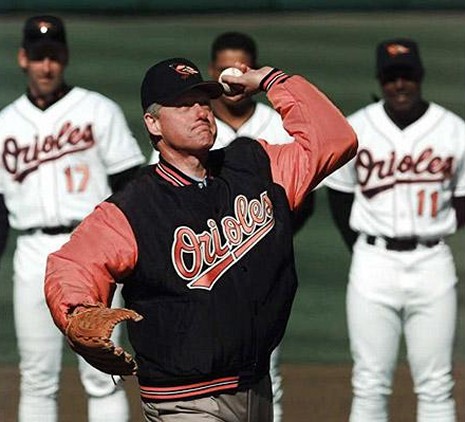
President Bill Clinton hit four ballparks in five years, Camden Yards, (1993 and 96), Jacobs Field in Cleveland in 1994, Shea Stadium in New York in 1997 and Pac Bell Park in San Francisco in 2000.

The Boston Red Sox have not played in “Presidential First Pitch” presence since Dwight Eisenhower. Next week Fenway Park, now a designated National Historical Landmark, will open its 100th season; do you think it’s worthy of a Presidential First Pitch?

And so it is, and so it was at this time in Fenway Park history, first pitch time, Presidential First Pitch time.

Posted in Fenway Park Baseball | Tagged , , , , , , , , , , , , | Leave a comment

Opening Day Presidentially Speaking, FDR, HST, IKE and JFK…..

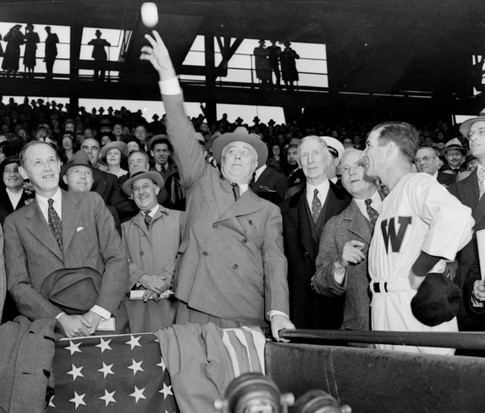
Franklin Roosevelt tossed more opening day first pitches than any other President in history.

FDR hurls the opening day pitch on April 18, 1938, a 12-8 Senators win over the Philadelphia A’s.

From 1933-1941 he hurled an opening day toss every year except 1939 and his record was .500 as the Senators won four and lost four. He also became the first president to throw out the first pitch at a major league baseball all-star game when the game was played at Griffith Stadium in 1937.

The American League won the ’37’ All Star game 8-3. It was the fifth All Star game and the American league was 4-1 at this point in the mid season classic competition.

The New Deal architect added two World Series games on his pitching resume. In 1933 he opened the third game of the Series with a pitch in Washington’s Griffith Stadium as the Senators won their only game in that Series, 4-0 over the Giants. The World Series has not been played in the Nation’s Capital since that year! He traveled to the Polo Grounds in 1936 for game two of that subway series and after flipping the first pitch, he watched the Yankees annihilate the Giants 18-4 on their way to a World Series triumph that would turn out to be their first of four straight World Championships.

The Red Sox were twice the opponents of the Senators during FDR’s reign as First Pitcher, and they twice shut out Washington extending their Presidential record to 5-2. As for the hometown Senators, they were 16-9 in Presidential Opening Days  following FDR’s tenure.

Harry S Truman attended 16 games while he was President, all in Washington and seven of them to throw out the first pitch of the season which he did in every year of his Presidency 1946-1952.

April 20, 1951 Washington beat the Yankees 5-3.

HST was the first Presidential southpaw and in fact in 1950 he threw out two first pitches, one lefty and one righty. Truman was a bit streaky as the opening day First Hurler, losing his first three, winning his next three before losing his seventh and final contest leaving him as the first President with a losing mark of 3-4. When he turned the duties over to Dwight Eisenhower, the Senators opening day Presidential record was at 19-13.

Twice during the Truman Administration, the Red Sox were present for opening day and twice they emerged victorious. They were there in ’46’ for Truman’s first, a 6-3 win and his last in ’52’, a 3-0 shutout by Mel Parnell. The Red Sox liked presidential attention as they were now 7-2 in first pitch games by the Chief Executive.

President Truman was a frequent visitor to Griffith Stadium and he was the first president to see a night game, the first to attend a game on July 4th and he made his way there in 1947 to pay tribute to Walter Johnson whose monument was unveiled that evening.

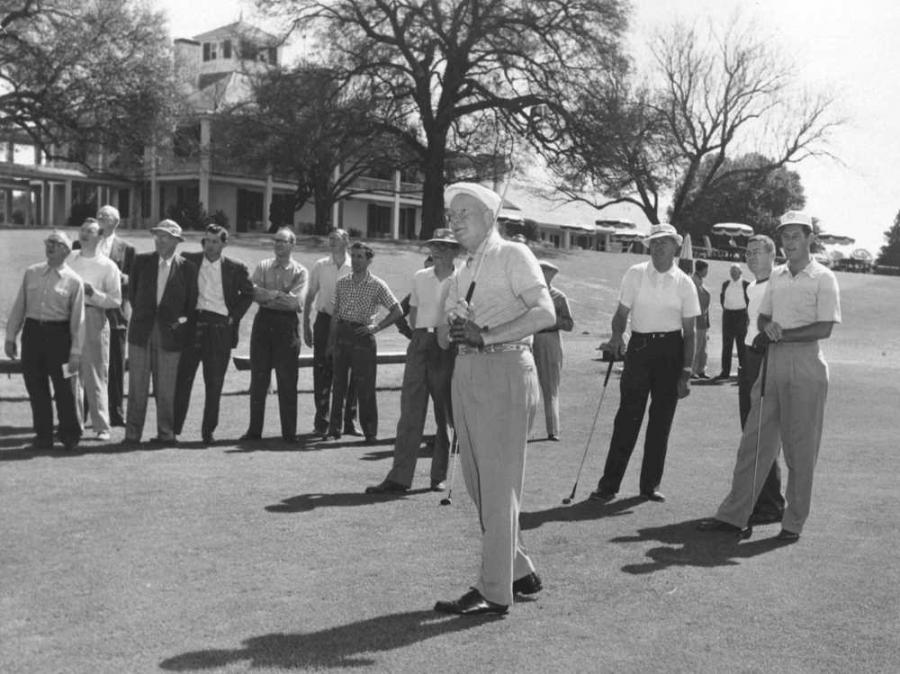
President Eisenhower on the first tee at Augusta National.

When “Ike” took up residence in the Oval Office in 1953, his passion for another sport nearly brought the presidential opening day pitch streak to a halt at seven games. With opening day set in Washington for April 15, 1953, the President opted for a round of golf at Augusta National instead of tending to the presidential duty of hurling the first pitch at Griffith Stadium. Vice-President Richard Nixon was scheduled to pinch-pitch however DC rains postponed the game and the President was able to play his round and hurl the first pitch the following day in Washington.

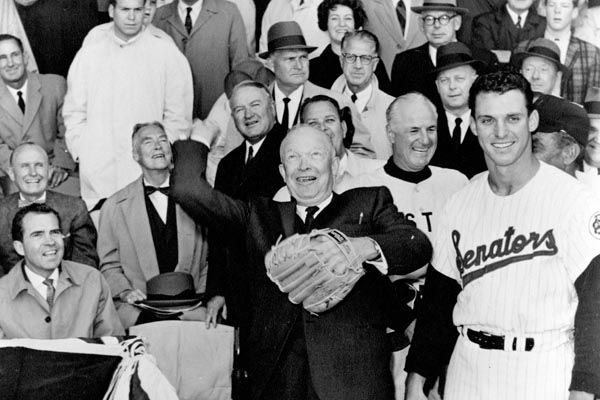
April 18, 1960, Eisenhower’s last first pitch was a 10-1 Senators win over the Red Sox.

Under Eisenhower, the presidential opening day first pitch streak reached 13 games as he was present at every opening game except for 1959. In his seven games opening the Senators season with a presidential pitch the home team was 4-3 which is quite an accomplishment as the Senators had established themselves as perennial league doormats. They were now 23-16 following a President’s first pitch. 

Twice the Red Sox were opponents under Eisenhower’s Senators and twice they lost, 5-2 in 1958 and 10-1 in 1960. Their record in Presidential First Pitch games was now at 7-4.

April 10, 1961, JFK opens the final season for Griffith Stadium.

When John F Kennedy assumed the Presidency in 1961 he continued the American tradition of opening the season in Washington with a presidential first pitch. It was a historic time for the country and for baseball. JFK was the first president born in the 20th century and for the first time since 1900, major league baseball expanded, adding two teams to the American League. This had a direct effect on Washington.

The Los Angeles Angels were added to the junior circuit along with the Washington Senators. Now this may seem a bit confusing but really it’s not. You see the Washington Senators we’ve been talking about packed up their bats, balls and gloves and made their way to the Twin Cities of Minneapolis and St. Paul Minnesota to become the Minnesota Twins. This left a vacancy in the Nation’s Capital which was filled by the “new” Washington Senators.

JFK became the second President to open the All Star game with a first pitch at DC Stadium in 1962, The National League prevailed 3-1.

So in 1962, the new Senators got a new stadium which they called appropriately enough DC Stadium. In Kennedy’s three first pitches the Senators, old and new, were 1-2 bringing the Washingtonians 52 year presidential first pitch record to 24-18. The Red Sox were not in Washington during JFK’s presidency so they remained 7-4 when performing in front of the Commander-in-Chief.

to be continued…..

And so it was at this time in Fenway Park history, first pitch time.


Posted in Fenway Park Baseball | Tagged , , , , , , , , , | Leave a comment

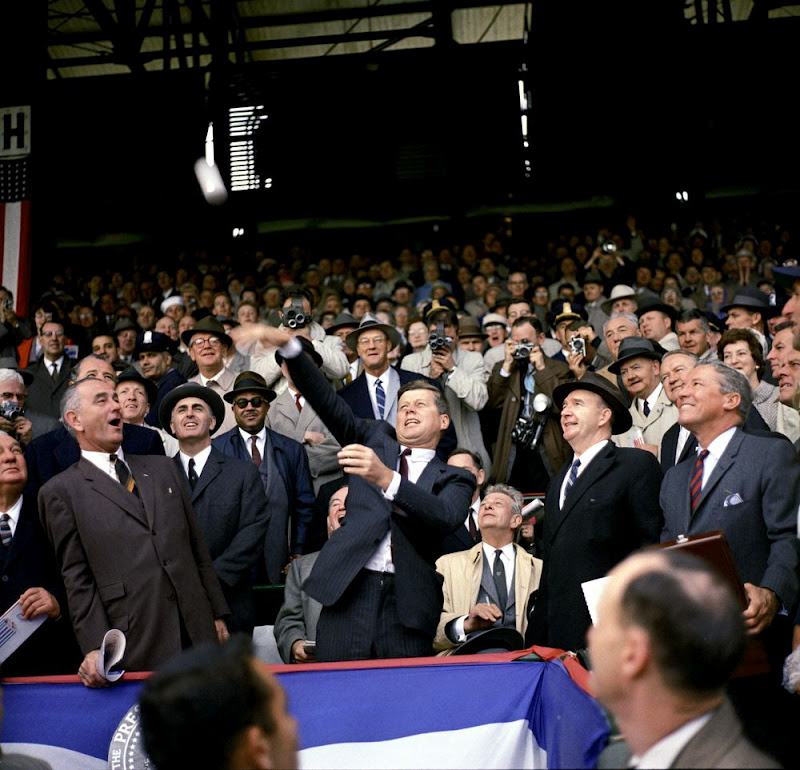
“Ladies and gentlemen, boys and girls can I direct your attention to the first base box where the President of the United States will throw out the first pitch.”…….What Sherm Feller might have said

Barak Obama is the 44th president of the United States, well sort of. He is actually the 43rd human being to occupy the highest office in the land and that’s because Grover Cleveland was both the 22nd and 24th President, pretty cool huh? But enough of that, oh except that of those 43 guys, 19 have thrown out the first pitch of the baseball season.

So, if you will allow me,

Opening Day Presidentially Speaking.

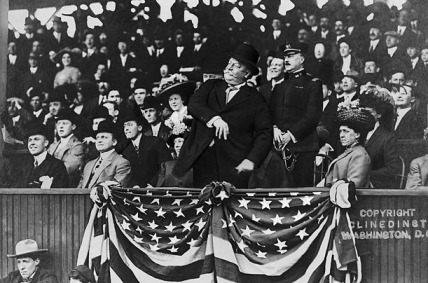
William Howard Taft was the first president to throw out a ceremonial first pitch. He did it on April 14th to usher in the 1910 baseball season. 

 Taft.

The field was National Field and the Washington Senators took on the Philadelphia A’s. Hall of Famer Walter Johnson beat Hall of Famer Eddie Plank 3-0 for the home team.

Taft threw out the first pitch in 1910 and 1911, both were victories as the Senators beat “Smokey” Joe Wood and the Red Sox 8-5 to start the 1911 season. In 1912, Taft handed off the first pitch responsibilities to his VP, James Sherman. The President was attending the funeral of his friend and military aid, Major Archibald Butt who was lost on the Titanic.

 The next Presidential pitcher was Woodrow Wilson. He threw out the first pitch at National Park in 1913, ’15 and ’16’.

Walter Johnson was the winning pitcher in all the games in which President Wilson threw out the first pitch. Including a 12-4 win against the Yankees on April 20, 1916.

The home town Senators were now 5-0 in games in which a Presidential toss signified the start of the game and thus the season. In fact they even won when VP Sherman pinch tossed in 1912. There only opening day loss at home since 1910, had occurred in 1914 when there was no Presidential first pitch!

Wilson became the first President to throw out the first pitch in the World Series when he traveled to the Baker Bowl in Philadelphia for game two in October of 1915. The opening day Presidential magic did not translate to the Fall Classic as the Red Sox defeated the Phils 2-1 to even the Series they would eventually win in just five games. This marked the second time the Red Sox were ever involved in a Presidential first pitch.

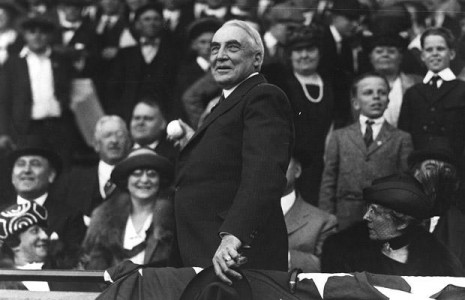
In 1920, the name of the Senators park was officially changed from National Park to Griffith Stadium after Washington’s owner Clark Griffith.The Senators lost their first “Presidential” opening day when Warren Harding tossed the inaugural pitch in 1921.

President Harding on April 12, 1922 at Griffith Stadium. The Senators beat the Yankees 6-5.

Warren G Harding threw out the first pitch in 1921, ’22’ and ’23’ at Griffith Stadium. In 1921 the home town Senators lost for the first time following a Presidential first pitch as the Red Sox took the opener from Washington 6-3. The Red Sox were now 2-1 following Presidential tosses.

Calvin Coolidge took over first pitch duties following the untimely death of Harding in 1923 and he made his pitch in 1924, ’25’, ’27’ and ’28’.

Calvin Coolidge, April 22, 1924 pitched the Senators to a 6-5 win over the Yankees.

Old Cal had a 3-1 record as the opening day tosser with his only loss coming to Boston in 1928. The Red Sox were the Senators opening day opponent in both 1927 and ’28’ losing 6-2 in 1927. The Red Sox were now 3-2 in five games they played following an opening day Presidential first toss.

Coolidge also threw out first pitches in the 1924 (game one) and’25’ (game three) World Series; and he was in attendance for games six and seven of the ’24’ World Series as the Senators won the first and, to date, only World Championship for the Nations Capital.

Following the taciturn Chief Executive’s tenure, the Senators were now 11-2 on opening Presidential toss days and 1-1 in Presidential toss World Series games.

Coolidge handed over to Herbert Hoover the reins of opening day duties, in 1929 and Herbie boy threw out the first pitch of the Washington season every year of his four years as President. He also, like Woodrow Wilson, traveled to Philadelphia to flip the first pitch in the 1929 and ’30’ World Series.

Hoover throws out first pitch April 14, 1931, Griffith Stadium opening day, a 5-3 11 inning loss to the Philadelphia A’s.

Perhaps indicative of what would become Herbert Hoover’s legacy as the President who presided over the Great Depression, the Senators were 1-3 in his four opening day tosses. The Senators only win came in 1932, a 1-0 ten inning decision against the Red Sox.

At the end of Hoover’s term, the Senators were 12-5 in opening day games in which the President began the season with his first pitch. The Red Sox were 4-3 in the seven games they participated in which the President made the ceremonial first toss.

By the time FDR assumed the Presidency in 1933, the ceremonial first pitch was as much a part of baseball’s opening day scene as peanuts and hot dogs. Roosevelt would throw out eight opening day first pitches and he would also add a new wrinkle to the presidential first pitch repertoire.

to be continued…..

And so it was at this time in Fenway Park history, first pitch time.


Posted in Fenway Park Baseball | Tagged , , , , , , , , , , , , , | Leave a comment

And on the seventh day He rested….Genesis

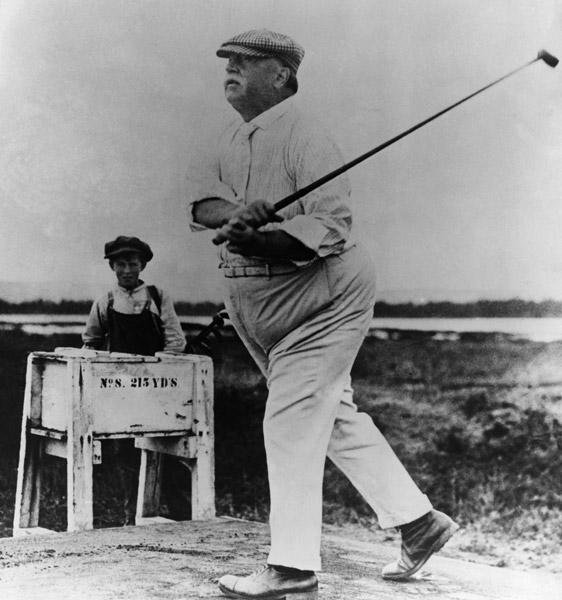
And President William Howard Taft played golf.  

Taft is the only American to serve as President of the United States and Supreme Court Chief Justice! And he was asked to be the Commissioner of Baseball before Kenesaw Mountain Landis took the position.

William Taft was the first American President to openly play golf.

Some other tasty Taft tidbits:

  • He was the first President to throw out the season’s first pitch on April 14, 1910, National Park in Washington DC.
  • He was the heaviest president tipping the scales at over 300 lbs.
  • He dropped 80 lbs after he left the Withe House which no doubt prolonged his life.
  • He retired as Supreme Court Justice on February 3, 1930.
  • Five weeks later, March 8, he died. Associate justice Edward Sanford died the same day.
  • An advocate for black equality, he was a strong proponent of Booker T. Washington.
  • He was the first President to be buried in Arlington National Cemetary and he and JFK remain the only Presidents to be interred on America’s most hallowed ground.

And William Howard Taft was the US President when Fenway Park opened her gates.

And so it is on this date in Fenway Park history, April 1, 2012.

Posted in Fenway Park Other | Tagged , , , , , | Leave a comment

“And when you talk of heroes, and I’ve had many since a lad”…..Raymond Sinibaldi

Ninety two years ago today in a three-decker apartment on Cottage Street in East Boston, Remo Coradini Sinibaldi was born.

He grew up as a “Dump Rat” which was the moniker the residents of Cottage Street put on themselves because of the area’s proximity to the East Boston landfill. At the age of eight he contracted rheumatic fever, an infection of the heart which in those days called for complete bed rest and you either lived or died. Well, he lived, although in the same epidemic he lost his older sister Amelia.  

This left his heart permanently damaged and with a life expectancy of between 40 and 50 years. That was before the days of antibiotics, heart surgery and valve replacements. Despite his ailment which limited him physically, he served his country in WW II and again during the Korean Conflict. He married Mary Kelly, fathered Ruthann, Willie, Yours truly and Nancy. He was Papa to ten grandkids and he was a “rock to stand on for lo so many years.”

We are all “up there” in age now and Dad has been gone for nearly 15 years but I can honestly say there are times that I feel closer to him than ever! We have no control of the miracle of life or the accident of birth which brings us all here; no control over who are parents will be, however I do know that on that roulette wheel I hit the jackpot a gazillion times over. So on this Easter Sunday, this grateful man gives thanks to God for bringing me here through the union of Mary Kelly and Remo Sinibaldi and I share with you once again, my birthday tribute to Dad!

Today I share with you the honor of being his son.

I wrote this to him for his 75th birthday!

HEROES

 I suppose that Teddy Ballgame would have to have been my first;

And learning of him at your hand, I could have done much worse.

They followed fast and furious, all of them played my game;

Runnels….

Conig

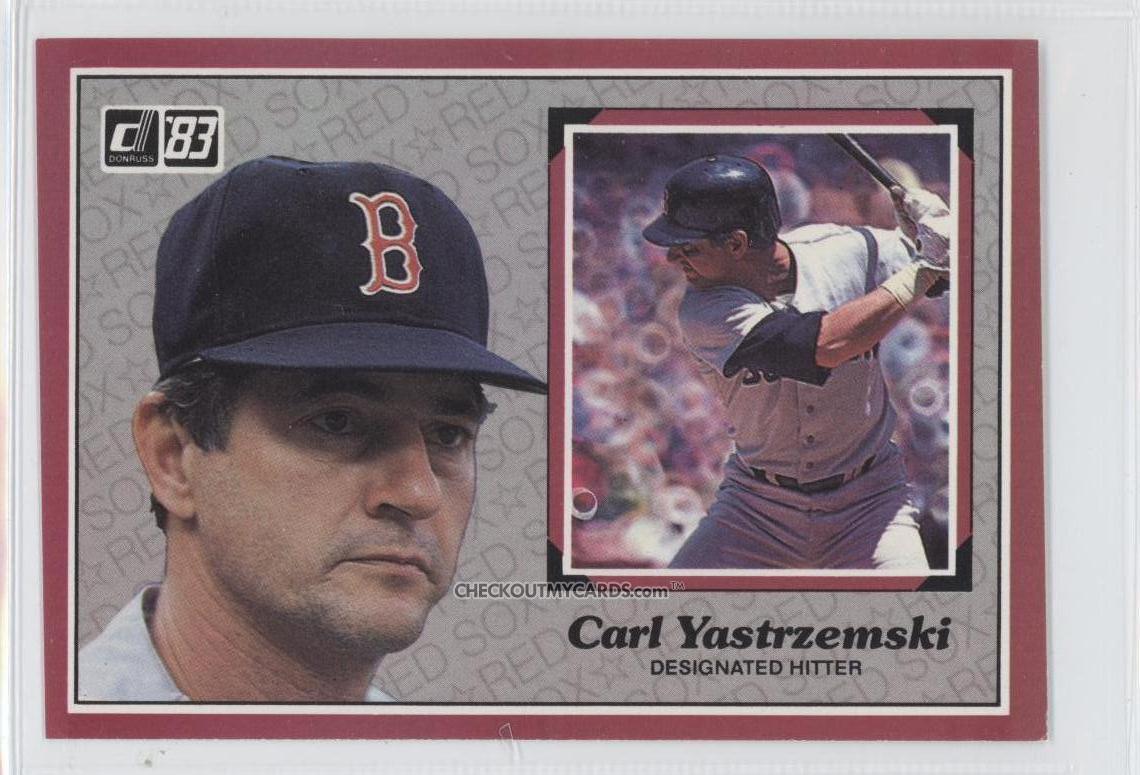
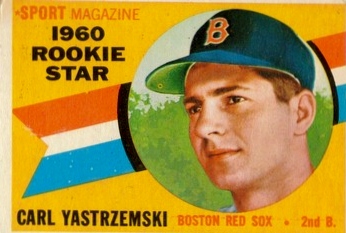
And Yaz….

Just to mention some by name.

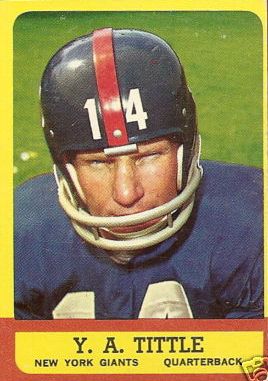
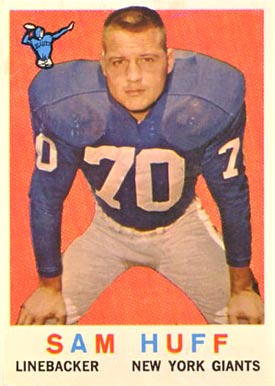
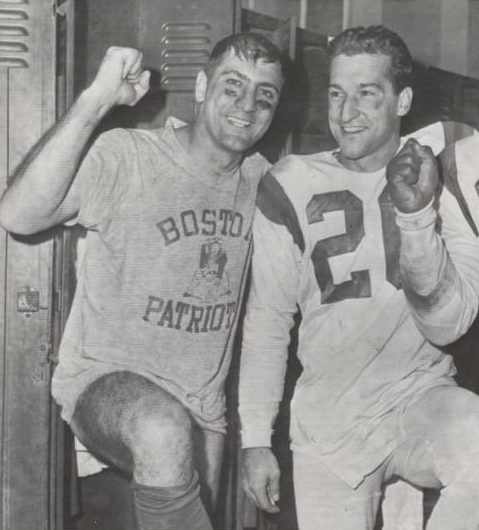
Football game me some of them. There was…..

Tittle

Webster

Huff.

 Babe and Gino

Were among them too….

And all of them were tough.

From the parquet floor they also came…..

Russell

Havlicek,

The Cooz.

In green and white they forged their fight,

we knew they’d never lose.

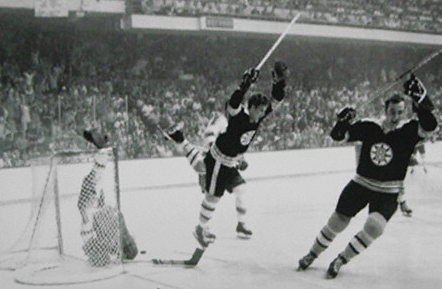
The Garden ice gave me but one, the fabulous number 4, players come and players go,

There’ll never be another Orr.

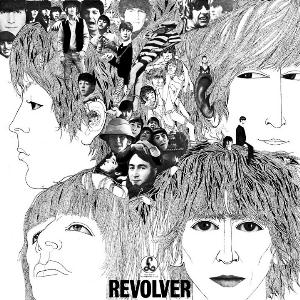
The music world presented them, social comments with their songs,

The Beatles

Dylan, Joan Baez

In my eyes could do no wrong.

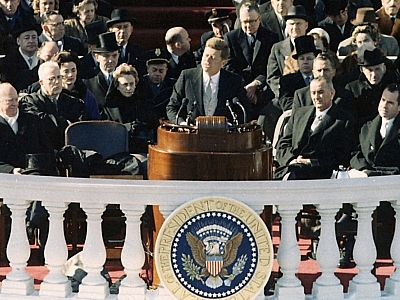
In ’61’ he said “the call had summoned us again”…..

He sought for us a higher place where we had never been.

In ’63’ they shot him down,

 But let it never be forgot,

That one brief shining moment that was known as Camelot.

The sixties were tumultuous, there were bus rides, sit-ins, protests.

 Martin Luther King taught us, non-violence is best.

 He marched on Washington DC to tell us of his dream,

And they shot him down too, as crazy as it seems.

Our country then exploded and our cities burned at night, who or where could we turn now to show us what was right?

Bobby Kennedy stepped forward to pick up the New Frontier.

But a bullet….. would claim him too,

 confirming our worst fears.

We stumbled to the seventies, and barely stayed in tact.

Without a clue of where to turn, to straighten up our act,

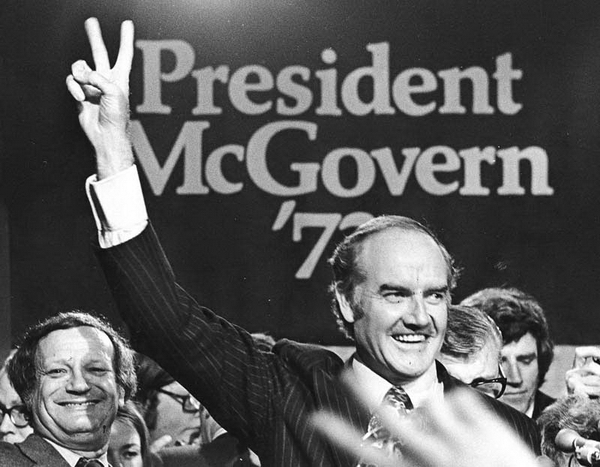
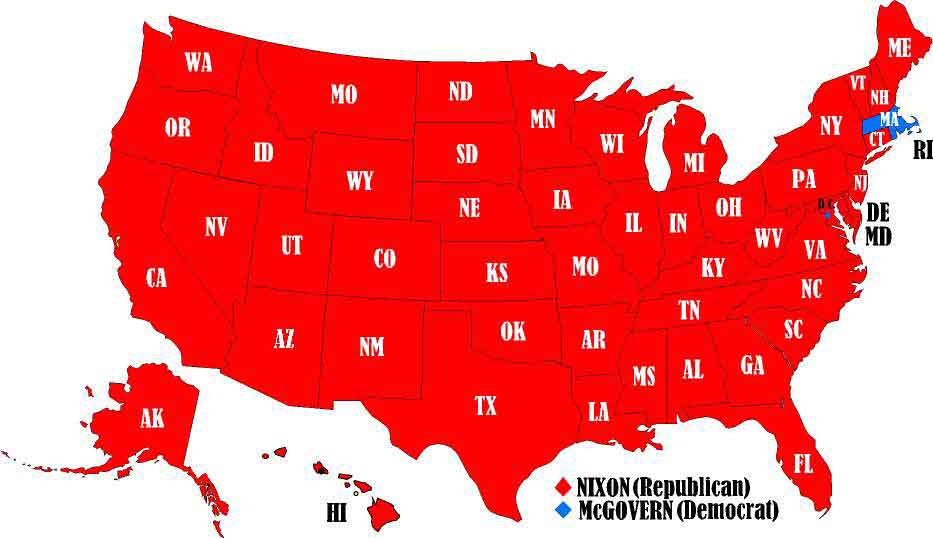
Election year 1972,

And Senator George McGovern,

Massachusetts was oh so right,

As America came to learn…..

He was the last to stand upon my pedastal called hero,

For the seventies gave us Nixon, Agnew and a significant flock of zeros.

Or maybe I’ve grown wiser, as the years have tiptoed by,

Or maybe there just are no more, I think to myself and sigh.

Alas the 1980s, which Orwell said to fear,

Twenty plus years of baseball

And Yastrzemski was still here.

In ’83’ he said goodbye,

 That final boyhood link was gone….

For at 30, I was a big boy now, it was time for movin on.

It’s March the year 2012 and I’ve snuck past 55, appreciating more with each new day what it means to be alive.

And as I sit here and reflect on heroes of the past, one stands head and shoulders over this or any class.

He never hit one over Fenway’s monster made of green, in the Senate or the White House he was never seen.

He never threw a touchdown pass or sank two from the line, and he never wrote a song before and that suits me just fine.

For he’d guide with all his wisdom, and support with all his strength, and when ere he was asked to please help out, he would go to any length.

He’s been a rock to stand on for lo so many years, and with love and understanding, he has soothed so many fears.

So when you talk of heroes, and I’ve had many since a lad, one and only one remains to me…..


and that’s my Dad!

Happy Birthday Papaluche, you are with me always!

And so it was, and so it is on this day in Fenway Park history, March 31, 1921, March 31, 1953, March 31, 2012.
Posted in Fenway Park Baseball, Fenway Park Other | Tagged , , , , , , | 5 Comments

“The Mystic Chords of Memory”…..Abraham Lincoln

I am an ephemera freak! There I admit it, I said it, it’s out there and I feel better already. Now you won’t find me on an episode of hoarders or anything but there are a few who might contend that I am slightly over the top.

Now for those of you not in the know, ephemera is: a class of collectible items not originally intended to last for more than a short time, such as tickets, posters, postcards, or labels. It also includes things such as letters, and for the memorabilia lovers, things such as programs and yearbooks.

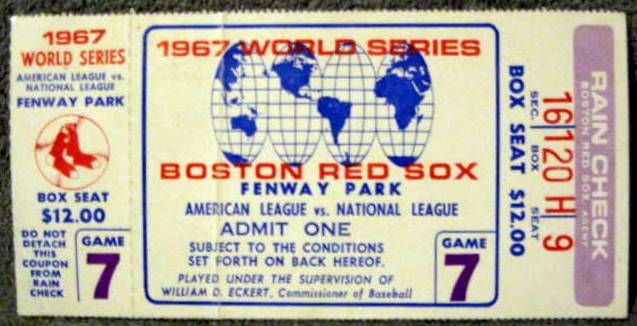
Rain Check for Game 7 of the 1967 World Series at Fenway Park.

I thought it would be a fun and interesting way to end the week by taking a look at programs from the first decade of Fenway Park.

Program from a Fenway Park game in its first year, 1912.


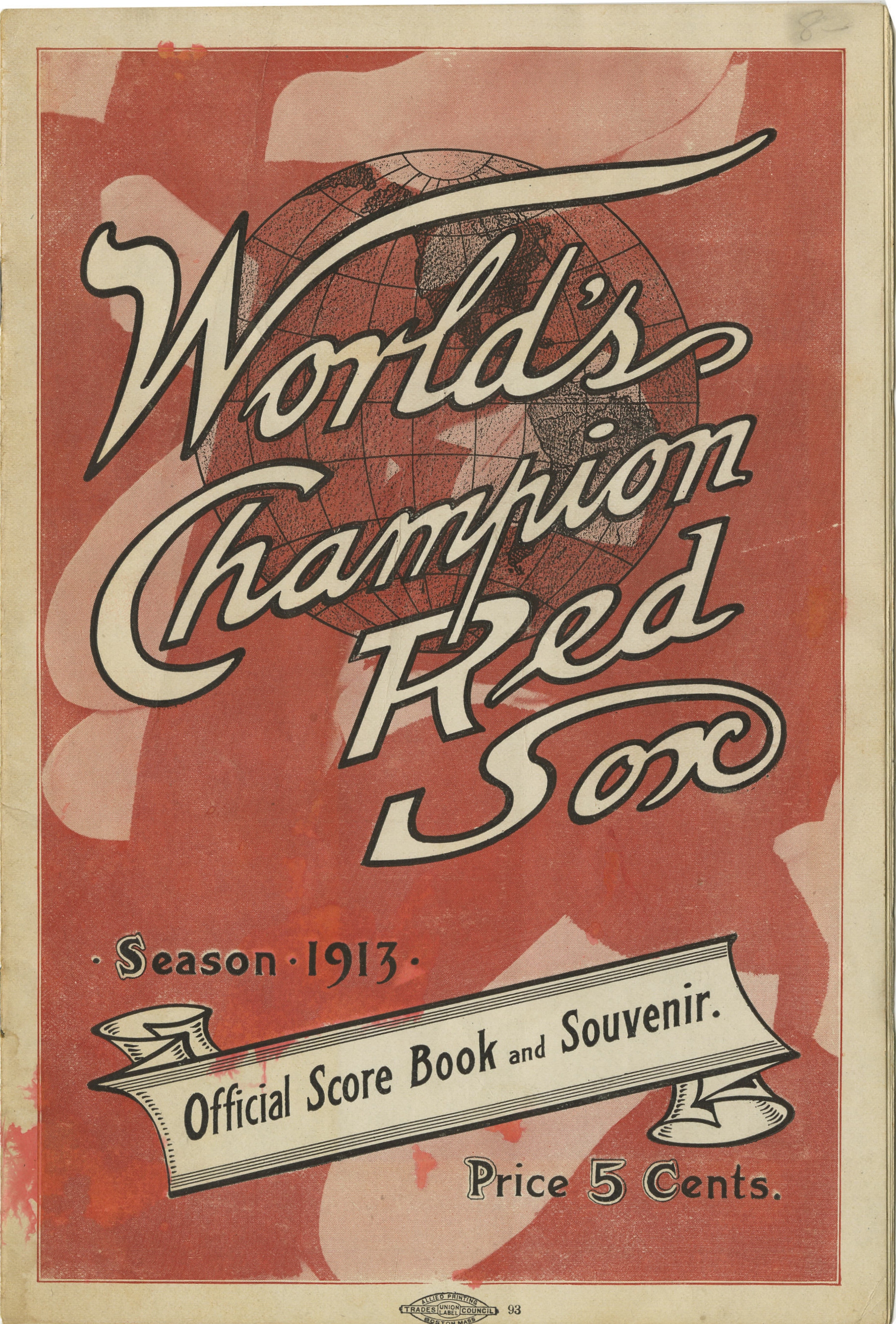
The 1913 Fenway Park program trumpeted the Red Sox 1912 World Championship.

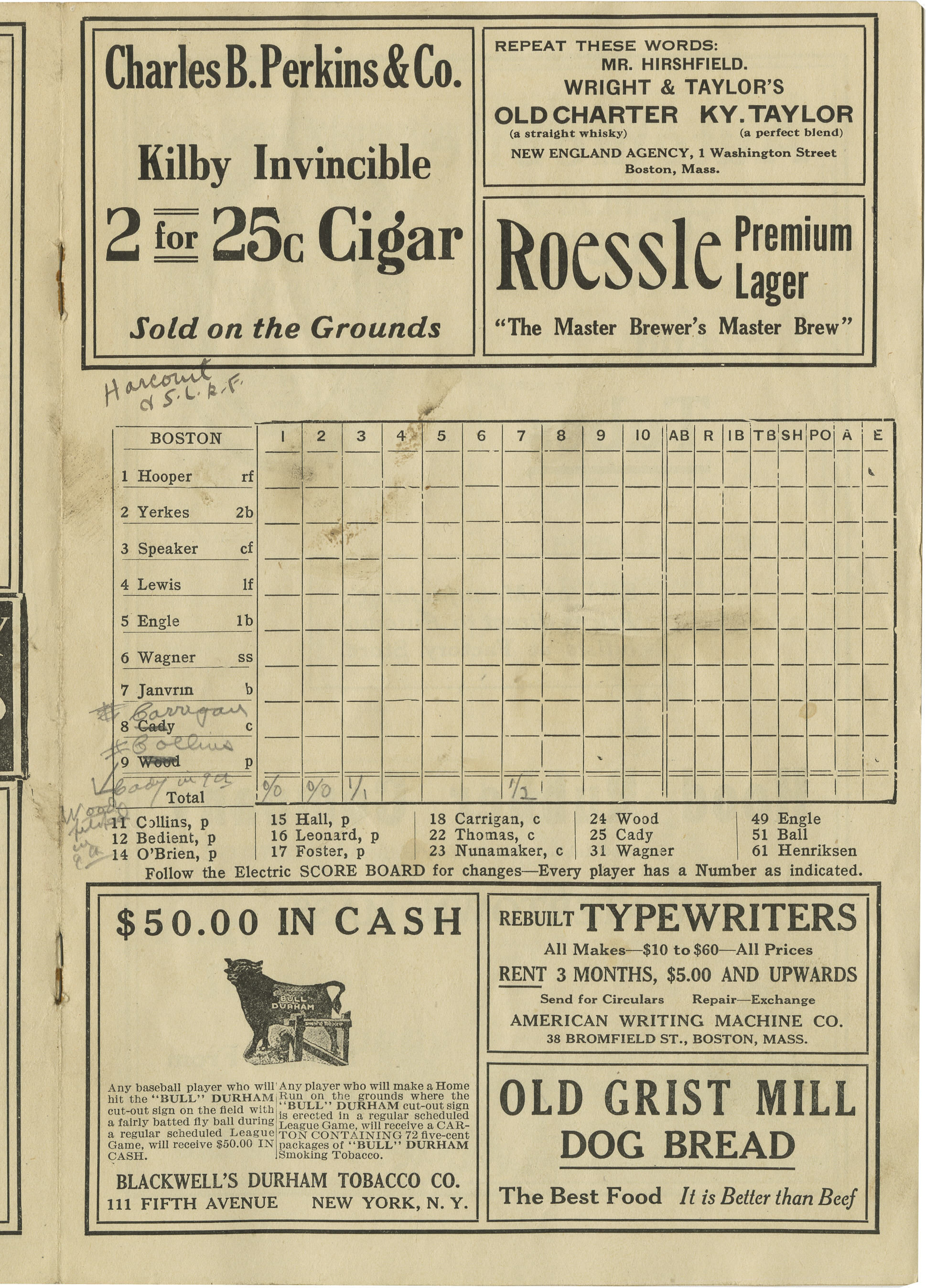
Numbers were not worn on Major League uniforms until the 1920s and the Red Sox did not adopt them until their 1931 season, however as the following photo reveals, numbers were a part of the game and the programs from its inception.


This 1913 program sold at auction in February of 2008 for $286.81.

When numbers were first used, they simply reflected the batting order which were printed in the programs.

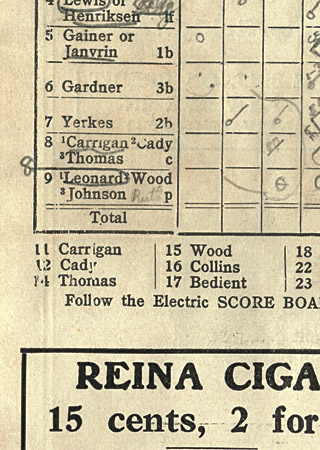
Babe Ruth became part of the Fenway Park scene in 1914 and this program is from his first game on July 11th.

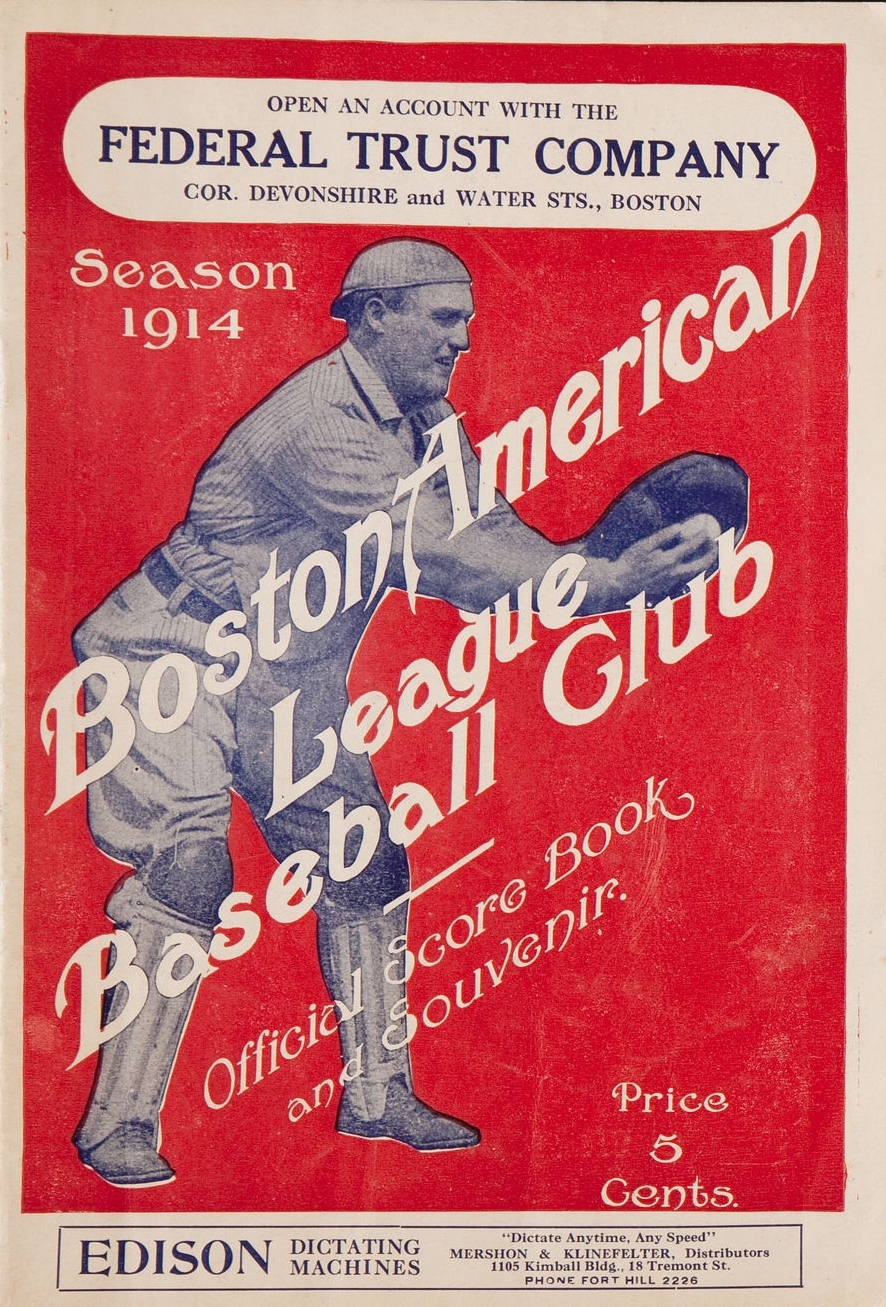
Catcher and Manager Bill Carrigan graced the cover of this 1914 Fenway Park program.


This program sold for $4,333.00 in 2002.

Note Babe’s name written in pencil. He arrived in Boston at about 10:00 AM, was at Fenway by noon and pitched the 3:05 game against the Indians. Oh, and he won!

 The 1915 World Series program has an interesting twist to it, note it says Braves Field. The Red Sox played the ’15’ World Series at the brand new, larger venue to accommodate more fans.

The inside of this program tells the tale of Game 4 of the Series, a complete game 2-1 win by Red Sox pitcher Ernie Shore.

You could have had one of these “Dorts” for only $650 or perhaps become a dealer.

The “Dorts” were $650, the program sold at auction in November of 2011 for $1135.00. Hmmm, almost two “Dorts” worth!

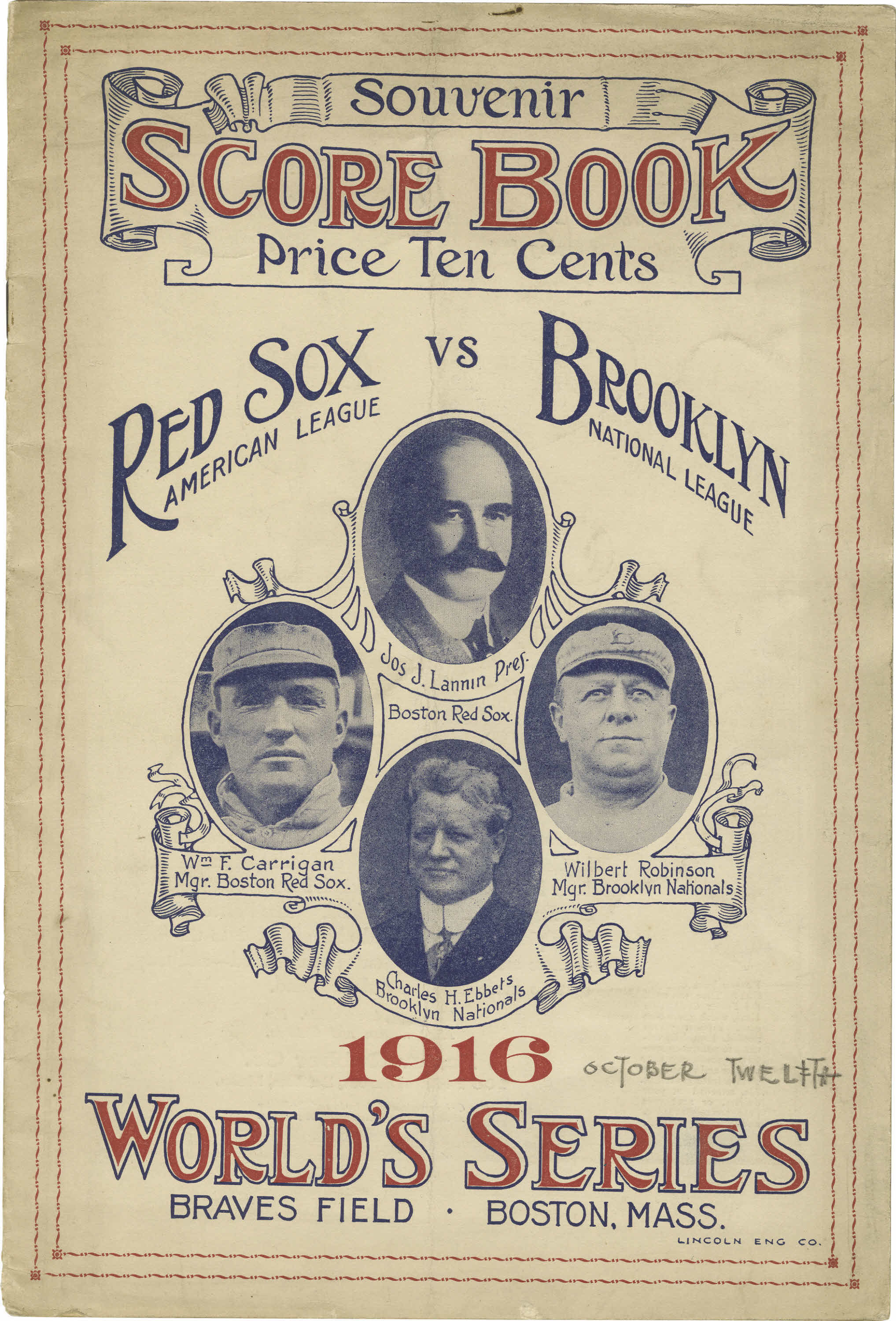
The Red Sox played the 1916 World Series in Braves Field as well, defeating the Dodgers in five games.

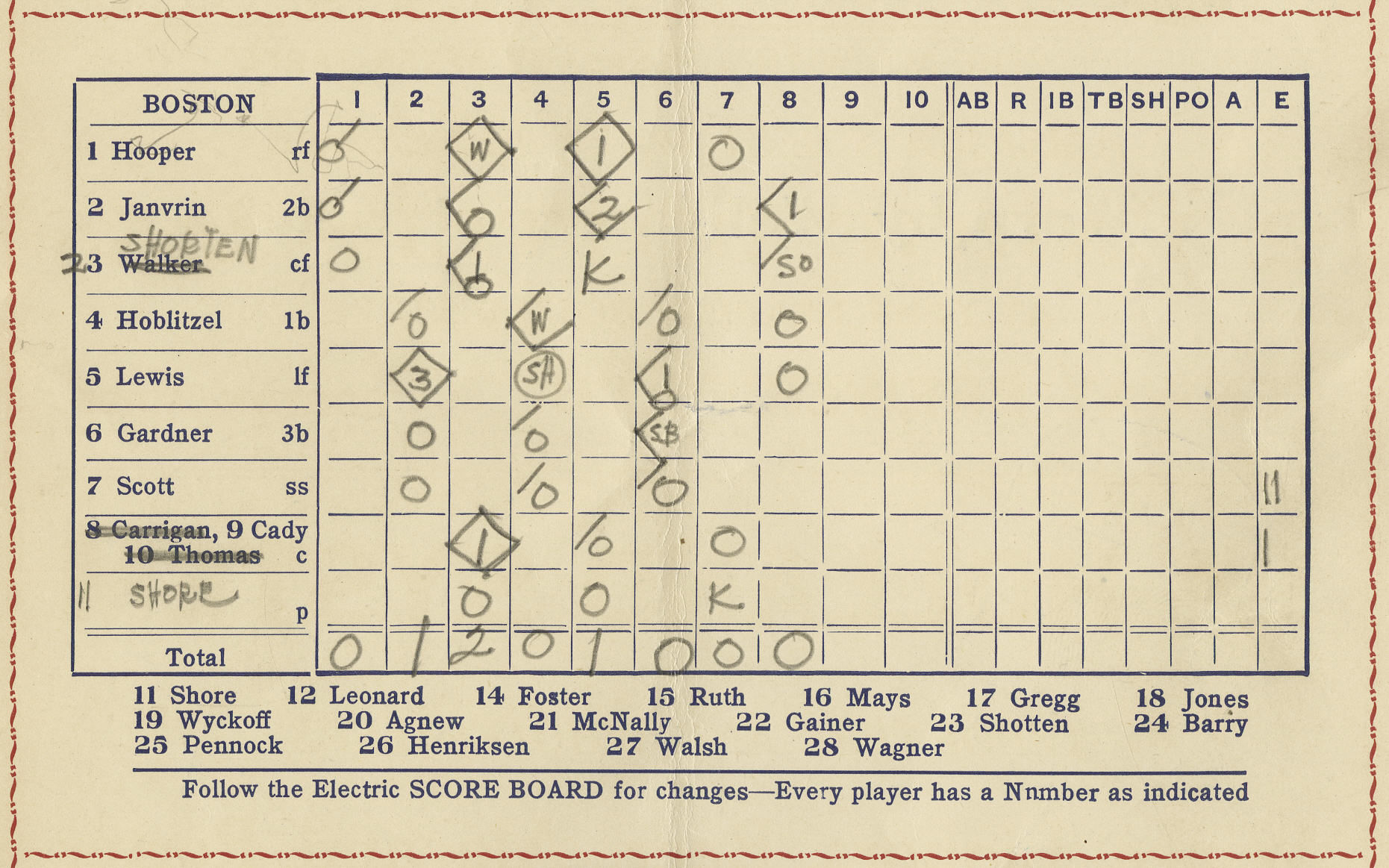
Note the pencil mark indicating the 12th of October. There are some ephemeraphiles (I just made up that word) who prefer their items to be pristine, unused. Not me, I love the fact that a game has been scored, a program has been written in. On a rare occasion, you will get lucky and even snag a ticket stub from the same game!

Note the numbers, if the Red Sox had decided to put numbers on their uniforms in 1916, Babe Ruth would have worn the number 15.

This came from Game 5, the clincher which garnered the Red Sox their only back to back World Championships in their history. The 1916 World Series program is among the rarest, with precious few still surviving. This one sold at auction in May of 2007 for $3883.75.

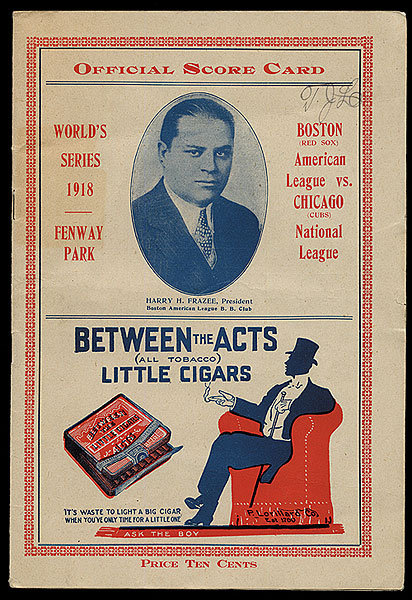
The World Series came back to Fenway Park in 1918 and below is a program from Game 5 of that fabled Series. The Cubs won this game 3-0 extending the Series to a game six in Chicago the following day.

The next World Series game would be played at Fenway Park in 1946.

The historical significance of this particular program adds considerably to its value. It sold at auction last year for, $23,500.00! Wow, that’s almost four “Dorts” worth!

The 1918 World Championship was Boston’s fourth in seven years. Note that Ruth is printed in and crossed out of the fourth spot in the line up, having pitched the day before.

So there you have it, a quick look at the programs of yesteryear, stories nearly a century old told in the paper and pencil remnants of fans whose memories add links in the chain of the “mystic chords of memory” which are such a part of the Red Sox story. The Fenway Park story!

And so it was, and so it is at that time in Fenway Park history, at this time in Fenway Parjk history, at all time in Fenway Park history, Ephemera time.


Posted in Fenway Park Baseball | Tagged , , , , , , , , | Leave a comment

“An opener is not like any other game. There’s that little extra excitement, a faster beating of the heart. You have that anxiety to get off to a good start, for yourself and for the team. You know that when you win the first one, you can’t lose ’em all.” Early Wynn

You have got to be kidding me! I can’t stand it! It started in the year 2000 so I should be used to it should I not? Then why? Why am I so irritated? Why am I so aggravated? Why does it seem that the more it happens the more it bothers me? I don’t get it! I can’t get it! I don’t ever want to get it! What in the hell are we doing opening the baseball season in Japan?

Yesterday while most of us were sleeping, the Seattle Mariners beat the Oakland A’s 3-1 in an 11 inning contest in Tokyo Japan!

Now don’t misunderstand me or get me wrong, I have nothing against the good folks of Tokyo Japan, I’m not a xenophobe, it’s just that I’m an old school kind of guy. Old school kind of guys have a tendency to appreciate and want to honor tradition and there is no sport more steeped in and linked to tradition than our American Pastime!http://www.youtube.com/watch?v=7SB16il97yw

“The one constant through all the years has been baseball” and for 120 years the one constant was Opening Day in Cincinnati! Why Cincinnati you say? Well that’s where it all began, sort of.

The 1869 Cincinnati Red Stockings.

The 1869 version of the Cincinnati Red Stockings were the first ever professional baseball team. In honor of that and, with a few exceptions, from then until 1990, the season always opened there on the day before it opened every place else.

Opening Day 1968, Crosley Field Cincinnati.

It irritated me in 1990 when that tradition was abandoned but now that irritation is compounded by the fact that we now open the season out of the country and I am left to ponder the whys of all that.

Opening Day 1971 Riverfront Stadium, Cincinnati.

Oh I get that it’s about new markets, broadening and cultivating the international fan base. I get that the primary reason behind it all is

$$$$$$$$$$$$$$$$$$$$$$$$$$$$$$$$$$$$$$$$$$$$$$$$$$$$$$$$$$$$$$$$$!

I get all that, but really, really? Can’t all that be done and still open the season right here in good old Cincinnati? In the heart of the land from which this great game was spawned?

The Great American Ballpark has been the home of the Cincinnati Reds since 2003 and it has never hosted the inaugural game of a baseball season.

In May of 2004, in Pittsfield Massachusetts a document, dated in 1791, was revealed which made reference to a bylaw protecting the windows of the towns meeting-house by refusing to allow baseball to be played within 80 yards of the new building.


On October 6, 1845, Alexander Cartwright’s  Knickerbocker Club played an intrasquad game at Elysian Fields in Hoboken New Jersey. It’s significance is that it appears to be the first ever baseball game which was written about in the newspaper.

Elysian Fields.

There is a uniquely American flavor to this the greatest of games. And it is, in fact in this writers opinion, the greatest thing which this great country has ever exported! And I am all about the continued exportation and cultivation of it throughout the world.

But is it too much to ask that the season begin each year in Cincinnati? If for no other reason then to remind us  from where we have come, to remind us of our beginnings, to remind us of the role baseball has played in shaping our country, to remind us of what baseball has meant and continues to mean to our history, to remind us of the best we can be as a people, as a culture, as a nation! And all wrapped up in this the simplest, the most complex, the most difficult, the greatest of games! Is it too much to ask that America’s pastime kick off in America?

Ahhhhhh baseball is upon us!

Let the games begin!

And so it is on this date in Fenway Park history, March 29, 2012.


Posted in Fenway Park Baseball | Tagged , , , , , , , , , , , , | Leave a comment

A few more of the “Fellers” from Fenway Park’s 1912 Red Sox, the Guys Behind the Dish…..

 I think that today,  it’s time you learned about some of the other “fellers” on the 1912 Red Sox team. We’ve looked at the big boys, and the stars, now we meet some of those guys who provided the link in the 1912 Fenway Park chain.

Let’s start with the catchers. We met Bill Carrigan, he was the main man behind the dish, catching 87 games for manager Jake Stahl.  But do you know that there were three other dudes who caught for the first Fenway Park team, three! Two of them were rookies and one was in his second year.  

So, in order of most games caught I introduce first, Mr. Forrest Leroy Bergland, aka, Forrest Leroy Cady, aka Hick Cady (good lord do I love those old names)

Hick Cady caught for the Red Sox from 1912 through 1917 seeing action in three World Series!

 Next is Leslie Grant “Les” Nunamaker


Nunamaker caught with Boston from 1911-1914 including 35 games in Fenway Park’s inaugural 1912 season.

And last but certainly not least is, Chester David “Pinch” Thomas, see what I mean about those names?

Thomas caught from 1912-1917 in Boston and appeared in the 1915 and ’16’ World Series.

It was Hick Cady’s deadly accurate arm which impressed manager Jake Stahl in Hot Springs Arkansas during spring training in 1912 and impressed him enough to take the 26-year-old rookie to Boston as Bill Carrigan’s back up catcher for Fenway Park’s inaugural squad.

A defensive stalwart behind the plate, Cady actually became the preferred catcher of Red Sox ace “Smokey” Joe Wood in 1912. The battery clicked pretty well as Wood went an astounding 34-5 in Fenway’s inaugural year.


Hick Cady races and wins against teammate “Buck” O’Brien (head turned) and trainer Jack O’Brien at Fenway Park in September of 1912, just a few days before Fenway     Park’s first ever World Series.               

Cady caught in the World Series of 1912, ’15’ and ’16’ with the Red Sox including seven of the games of the 1912 Series.  Hick Cady actually pinch hit for a guy named Babe Ruth during the 1915 season. Ruth was strictly a pitcher in those days and did not appear as an everyday player until 1918.     

 Les Nunamaker saw limited duty with the Red Sox in parts of the 1911, ’12’, ’13’ and ’14’ seasons. He caught only 131 games for them, however he is forever solidified in history as a member of the 1912 World Champion Boston Red Sox, Fenway Park’s first team.

Nunamaker was traded to the Yankees in 1914 where he became the first catcher in history to throw out three runners in an inning trying to steal second base.

Chester ‘Pinch” Thomas caught only 13 games with the Red Sox in 1912, however he was the regular Red Sox catcher for the 1915 and ’16’ World Championship seasons.

 Thomas was  a pinch-hitter extraordinaire throughout his career, going 13-31 (a .417 clip) in that role from 1913-1918.

Chester David “Pinch” Thomas played for 10 seasons. He was a .237 lifetime hitter. He hit only two career home runs and he never had more than 24 RBI nor more than 24 runs scored. However, “Pinch” Thomas was a winner, for in four of those 10 seasons, Thomas was part of four World Championship teams. Three of them were the Boston Red Sox of 1912, ’15’ and ’16’.

And so it was at this time in Fenway Park history, 1912 Fenway’s inaugural season.


Posted in Fenway Park Baseball | Tagged , , , , , , , , , | Leave a comment